
The Storyline Test: Does the Deck Make Logical Sense?
You aren't rejected for market size; you are rejected for 'Logical Insolvency.' A forensic audit on the Storyline Test: If Slide 4 does not mathematically prove Slide 6, your deck is dead on arrival.
1.3: THE STEP-BY-STEP INVESTOR EVALUATION WORKFLOW
1/21/20265 min read

The Storyline Test: Does the Deck Make Logical Sense?
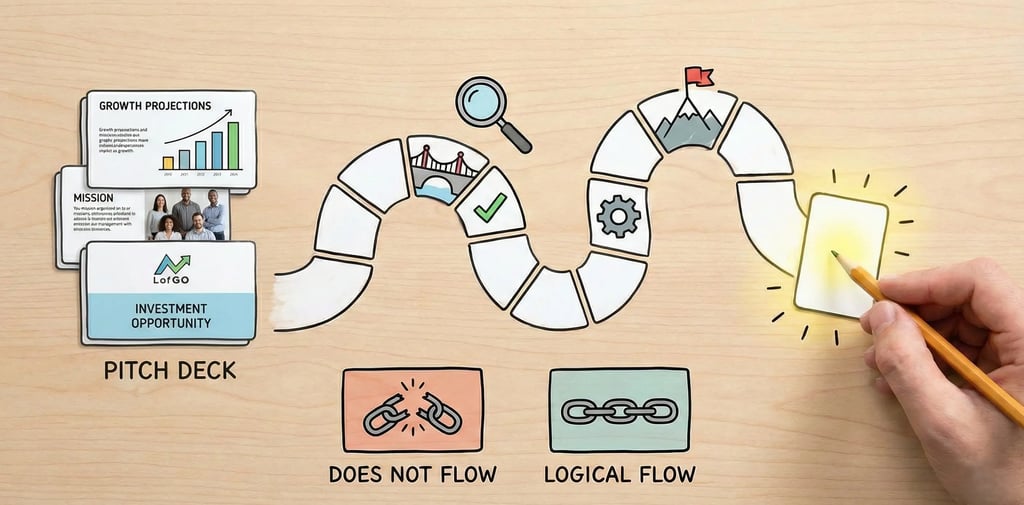
Most Series A founders believe they are rejected because of market size or traction. That is a lie. You are being rejected because your deck is logically insolvent. A pitch deck is not a marketing brochure; it is a legal argument for capital allocation. If Slide 4 (Problem) does not mathematically necessitate Slide 6 (Solution), you are dead on arrival. This logical decay is the primary filter in The Step-by-Step Investor Evaluation Workflow (How VCs Decide What Moves Forward). If the causal chain breaks, the analyst closes the file. We do not fund "vision" that lacks a sequential, non-negotiable logical progression. We fund inevitable outcomes. If your narrative requires a suspension of disbelief rather than a validation of facts, you are not fundraising; you are gambling.
The Forensic Diagnosis: Why Logic Gaps Trigger Automatic Rejection
When I audit a deck, I am not looking for potential; I am looking for structural integrity. The "Storyline Test" is a forensic examination of the causal links between your claims. A failure here is not a "narrative issue"—it is a competency signal.
The "Red Flag" Scenario
The most common structural failure occurs in the transition from Market Sizing (TAM) to Go-to-Market (GTM).
The Slide: You claim a $10B Serviceable Addressable Market (SAM).
The Error: Two slides later, your GTM strategy relies entirely on "Organic Viral Growth" and a generic sales team, with a projected Year 1 revenue of $2M.
The VC Internal Monologue: "This founder does not understand the mechanics of their own market. To capture 1% of a $10B market ($100M), they need an enterprise sales motion with a CAC of $50k and a sales cycle of 6 months. They are pitching a PLG (Product-Led Growth) motion for an Enterprise problem. The math is broken. Pass."
The "Founder’s Delusion"
Why do intelligent founders submit logically broken decks?
The "Visionary" Trap: You believe your passion compensates for a lack of mechanics. You assume VCs will connect the dots for you. We won't.
Siloed Slide Creation: You built the Financials on Tuesday and the Problem slide on Friday. You treated them as separate essays rather than variables in a single equation.
Fear of Specificity: You keep the logic vague because specific logic can be debated. Vague logic is safe from specific criticism, but it is invisible to capital.
The Mathematical Proof: The Cost of Cognitive Dissonance
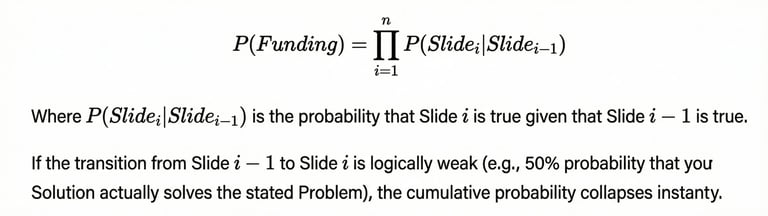
In venture analysis, narrative flow is a function of Cognitive Load ($C_L$). Your goal is to minimize $C_L$ to near zero. Every time a VC has to pause to reconcile two conflicting data points, your probability of funding ($P_f$) decays exponentially.
We model this using a basic Logical Continuity Probability:
The "Cognitive Cost" Breakdown:
0-3 Seconds (Pattern Match): The analyst scans. If the Problem is "Inatention to Detail" but the Solution is "AI-Powered HR Software," the link is weak.
Result: Cognitive Load spikes. Skepticism activates.
3-10 Seconds (Verification): The analyst checks the metrics. If you claim "High Demand" (Slide 2) but show "High Churn" (Slide 9), the deck is flagged for incoherence.
Result: Trust evaporates.
10+ Seconds (The Drop): If I have to re-read a previous slide to understand the current one, you have lost. In 2026, with deal flow velocity at an all-time high, no analyst dedicates mental energy to fixing your broken logic.
The Logical Equity Equation:
Every logical gap increases the Implied Risk Premium.
High Logical Continuity = Low Perceived Risk = Higher Valuation.
Low Logical Continuity = High Perceived Risk = Valuation Crush or Pass.
If you force me to guess how your Business Model supports your Ask, I will assume the worst-case scenario.
The "Insider" Solution Protocol: The "If/Then" Chain
To pass the Storyline Test, you must strip your deck of "marketing" and rebuild it as a logic proof. This is the "If/Then" Protocol. Every slide must be the mathematical resultant of the previous slide.
The Framework: Causal Density
Your deck must function like a domino run.
IF the [Problem] is acute and expensive...
THEN the [Market] must be willing to pay $X to solve it.
IF the market pays $X...
THEN the [Business Model] captures Y% of that value.
IF we capture Y%...
THEN the [Traction] should currently show Z% MoM growth.
IF we have Z% growth...
THEN we need [The Ask] to scale the machine.
Before vs. After Comparison
The Weak Version (The "Storyteller"):
Slide 1 (Problem): "Healthcare is inefficient."
Slide 2 (Solution): "We use Blockchain to secure records."
Slide 3 (Team): "Ex-Google Engineers."
Critique: This is a collection of facts, not a narrative. "Inefficiency" does not logically demand "Blockchain." It demands "Speed" or "Cost Reduction." The solution does not map to the problem.
The VC-Ready Version (The "Logician"):
Slide 1 (Problem): "Hospital admin costs represent 30% of revenue due to non-interoperable data silos." (Specific, Quantifiable).
Slide 2 (Market Consequence): "This costs the average hospital $12M/year in lost billing." (Financial Validation).
Slide 3 (Solution Mechanism): "Our API unifies data silos, reducing admin time by 40%." (Direct causal link to Slide 1).
Slide 4 (Product Value): "This saves the average hospital $4.8M/year." (Direct causal link to Slide 2).
Slide 5 (Traction): "3 Hospitals pilot closed. Verified savings of $4M." (Proof of Slide 4).
The Fix: The "Head-line Read" Audit
Isolate the headlines of your deck. Read them aloud in sequence.
Bad: "The Problem. Our Solution. The Market. Our Team. Financials."
Good: "Hospitals lose $12M/year due to data silos. -> We unify silos to recover that revenue. -> 3 Hospitals have already recovered $4M. -> We need $2M to hire 5 sales reps to close the next 50 hospitals."
If the headlines alone do not form a coherent paragraph, your deck is broken.
The "Death Traps"
In attempting to fix logical flow, founders often over-correct into new failure modes.
1. The "Over-Explanation" Spiral
Do not confuse "logic" with "text." A wall of text does not prove logic; it hides insecurity. If you need 200 words on a slide to explain the connection between your product and the market, the connection doesn't exist. The logic must be visible in the structure, not the prose.
2. The "Backward-Engineering" Fallacy
Founders often start with the Valuation/Ask they want ($5M at $20M Cap) and try to warp the logic to justify it. We can see this. When your bottom-up TAM calculation is artificially inflated to exactly justify a 100x return on a $20M cap, it looks manipulated. Build the logic forward from the truth, not backward from your greed.
3. The "Buzzword Bridge"
Never use "AI," "Web3," or "Platform" to bridge a logical gap.
Wrong: "We have low retention... but our AI Engine will fix it."
Right: "We have low retention... so we are pivoting to an Enterprise SLA model."
Buzzwords are not structural load-bearing beams.
The "High-Ticket" Conclusion
Passing the Storyline Test is the difference between being perceived as a "Project" and a "Company." A logically sound deck moves through the Partner Meeting because it gives the internal champion the ammunition they need to defend the deal. It removes the friction of disbelief. Fixing this logical flow does not just improve readability; it validates your valuation. A logical deck commands a premium because it signals a logical CEO.
For the complete architectural breakdown of how these components fit into the wider funding ecosystem, review How VC Pitch Decks Really Work in 2026 — And Why Most Founders Get Them Wrong.
The Filter: You can spend weeks A/B testing your narrative flow and risking rejection, or you can simply execute the proven logic chains we have already built. Use The Slide-By-Slide VC Instruction Guide included in our $5k Consultant Replacement Kit ($497) available on the home page. It forces your raw data into a narrative structure that VCs are programmed to accept. If you cannot invest $497 to secure a seed round, you fail the logic test.
Funding Blueprint
© 2026 Funding Blueprint. All Rights Reserved.