
The Risk Test: How Decks Reduce or Increase Perceived Risk
Investors don't fund 'Potential'; they fund 'Probability.' A forensic audit on the Risk Test: Why 'Upside-Only' decks trigger an automatic rejection and the math of the 'Kill-Points' slide.
1.3: THE STEP-BY-STEP INVESTOR EVALUATION WORKFLOW
1/23/20264 min read
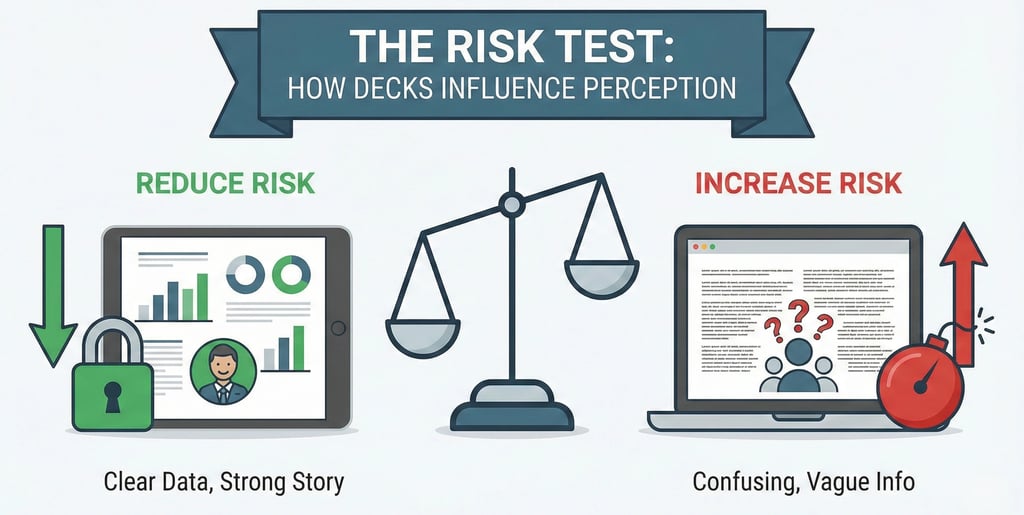
Most Series A founders hallucinate that a pitch deck is a marketing brochure designed to sell "Upside."
This fundamental misunderstanding is the primary cause of immediate pass emails from Tier-1 firms in Silicon Valley and London. A pitch deck is not a sales document; it is a risk mitigation instrument.
Investors do not fund "potential." They fund the probability of capturing that potential. If your deck screams "Unchecked Optimism" without acknowledging structural threats, you flag yourself as a novice operator. You must prove you have identified the kill-points before we do. This is the first filter in The Step-by-Step Investor Evaluation Workflow, and failing it ensures your metrics never even reach the Investment Committee.
The Forensic Diagnosis
The specific error that destroys fundraises is the "Upside-Only Narrative."
The Red Flag Scenario: You present a "Hockey Stick" revenue projection slide (J-Curve) showing ARR growing from $1M to $10M in 18 months. There are no caveats, no sensitivity analysis, and no "Downside Case."
The VC Internal Monologue: When a partner at Sequoia or Andreessen Horowitz sees this, they don't think, "Wow, look at that growth." They think: "This founder has zero awareness of the friction awaiting them. They haven't factored in diminishing returns on ad spend, churn spikes at scale, or competitor reaction. They are driving blind."
The Psychological Audit: Why do 90% of founders commit this error?
Selection Bias: You are pathologically optimistic (required to start a company), but you fail to switch gears to "Capital Allocator" mode (required to raise funds).
Bad Advisory: Lower-tier advisors tell you to "sell the dream." In 2026, capital is expensive. We don't buy dreams; we buy de-risked execution machines.
Fear of Weakness: You believe acknowledging risk makes the deal look "fragile." In reality, hiding risk makes the founder look fragile.
Valuation vs. Discount Rates
We price risk using the Discount Rate in a Discounted Cash Flow (DCF) or comparable analysis. Your pitch deck's job is to lower that discount rate.
Here is the mathematical reality of how "Perceived Risk" destroys your pre-money valuation:
Scenario A (High Perceived Risk): The founder ignores CAC volatility. The VC applies a 60% Discount Rate because the outcome is binary (Win/Die).
Projected Exit Value: $100M
Risk-Adjusted Present Value: ~$6.25M
Scenario B (Managed Risk): The founder details a specific "CAC Defense Strategy." The VC lowers the Discount Rate to 30% because the downside is capped.
Projected Exit Value: $100M
Risk-Adjusted Present Value: ~$26.9M
The Cognitive Load Cost: If your narrative forces the investor to hunt for the risks you hid, you increase "Cognitive Load."
0-30 Seconds: Investor scans for growth.
30-60 Seconds: Investor scans for validity of growth.
Result: If the validity isn't explicit, the mental model switches from "Opportunity" to "Audit." Once you are in "Audit Mode" before the first meeting, the probability of a Term Sheet drops by ~80%.
The Logic Chain:
Unaddressed Risk = Information Asymmetry.
Information Asymmetry = Higher Required Rate of Return (Risk Premium).
Higher Risk Premium = Lower Valuation or an automatic "Pass."
The "Insider" Solution Protocol
To survive the Series A filter, you must execute the "Risk/Mitigation Inversion." Instead of burying risks, you front-load them and systematically dismantle them.
Step 1: The "Kill-Points" Slide
Stop hiding the skeletons. Create a dedicated slide titled "Structural Risks & Mitigation Protocols."
The Weak Version (Do Not Do This):
Risk: "Competition."
Mitigation: "We have a better UI and AI features." (This is fluff. It signals you don't understand network effects or switching costs.)
The VC-Ready Version:
Risk: "Platform Dependency: API access from OpenAI/Google could be revoked or price-hiked."
Mitigation Protocol: "We have built a model-agnostic routing layer. We are currently running Llama 3 locally for 40% of queries to establish leverage. Switch-over time is <4 hours."
Step 2: The "Burn Multiple" Defense
Don't just show revenue. Show efficiency.
Framework: The Burn Multiple = Net Burn / Net New ARR.
VC Expectation: If your Burn Multiple is >2.0 at Series A, you are inefficient.
The Fix: Explicitly state: "Current Burn Multiple is 1.8. Series A capital will deploy into [Specific Channel] where Unit Economics are verified at 3:1 LTV/CAC, driving Burn Multiple down to 1.2 within 12 months."
Step 3: The "Pre-Mortem" Narrative
Use the "Pre-Mortem" technique in your financial model narration.
Script: "We project $10M ARR. The primary failure mode for this target is a failure in our Mid-Market sales motion. To de-risk this, we have already hired a VP of Sales with a rolodex in this sector and signed 3 pilots before full launch."
The "Death Traps"
While correcting for risk, do not fall into these inversely fatal traps:
The "Defensive Crouch": Do not apologize for the risk. State it coldly. If you sound apologetic, you look unsure. If you sound clinical, you look like a CEO.
Using 2021 Multiples in 2026: Do not mitigate valuation risk by citing comps from the ZIRP (Zero Interest Rate Policy) era. If you reference a 100x ARR multiple from 2021 to justify your price, you will be laughed out of the room. Stick to trailing 12-month public market SaaS multiples (approx. 6x-12x depending on growth/churn).
The "No Competition" Fallacy: Never claim "We have no direct competitors." This signals a lack of market research or a market so small no one cares. Always map the "Status Quo" (Excel/Pen & Paper) as a competitor.
The "High-Ticket" Conclusion
Perceived risk is the difference between a "Gambling" bet and a "Capital Allocation" decision. By mathematically de-risking your deck, you do not just increase conversion; you defend your equity. A risk-optimized narrative can shift your dilution from 25% down to 15% by commanding a higher premium.
For the complete architectural breakdown of a Series A narrative that survives due diligence, refer to How VC Pitch Decks Really Work in 2026 — And Why Most Founders Get Them Wrong.
The Filter Plug: You can attempt to build these risk-mitigation slides manually, or you can use "The Slide-By-Slide VC Instruction Guide" included in our $5k Consultant Replacement Kit ($497) available on the home page. It contains the exact "Risk/Mitigation" templates used to clear Investment Committees in Q4 2025.
Funding Blueprint
© 2026 Funding Blueprint. All Rights Reserved.