
Pitch Deck Structure by Funding Stage: Choosing Your Exact Layout
VCs score Pre-Seed and Series A pitch decks using completely different logic. Master the 4 stage-specific pitch deck layouts to secure your term sheet.
3.1 CORE PITCH DECK STRUCTURES: HOW VCS RECOGNIZE SIGNAL VS NOISE
3/5/20268 min read
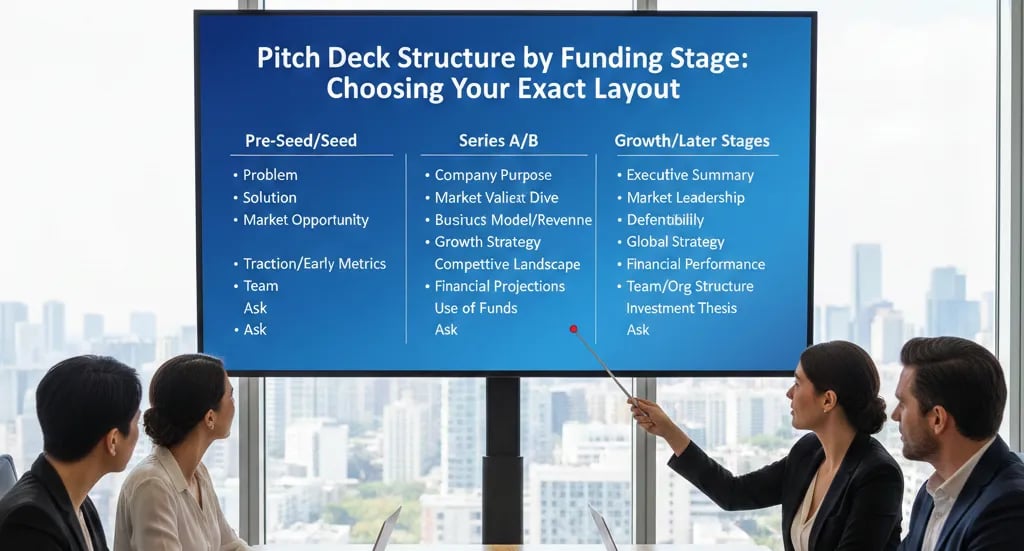
Pitch Deck Structure by Funding Stage: Choosing Your Exact Layout
Most Founders Think There Is One Right Pitch Deck Structure. There Are Four — and Using the Wrong One Costs You the Room.
Most founders think there is one correct pitch deck structure — a canonical 10–12 slide sequence that applies from first cheque to Series B. That belief is the reason structurally sound businesses lose raises to structurally weaker ones. There is no universal pitch deck layout. There are four stage-specific layouts, each calibrated to answer a different primary question, each carrying different mandatory information categories, and each evaluated by a VC using a different internal scorecard. Deploying a Pre-Seed layout at Series A is not a formatting error — it is a signal that the founder does not understand the investment thesis they are asking the VC to adopt. Deploying a Series A layout at Pre-Seed overloads a VC with evidence categories that do not yet exist and makes the founder appear to have borrowed someone else's credibility. The full architecture behind how stage-specific structure maps to VC pattern recognition is the operating logic of Core Pitch Deck Structures: How VCs Recognize Signal vs Noise. What follows is the exact layout for each stage — not principles, not guidelines, but the specific slide sequence and mandatory content categories a VC expects to find, in the order they expect to find them.
Why a Single "Universal" Deck Structure Signals Stage Blindness to Every Experienced Investor
Stage blindness is the specific failure mode where a founder builds a deck without internalising what the investor is actually pricing at that moment in the company's life. It produces decks that are internally consistent — every slide is competently made — but collectively incoherent as an investment thesis, because the narrative architecture is answering the wrong question for the stage.
A Pre-Seed investor is pricing founder conviction and problem acuity. They are betting on whether this person has identified a real, painful, underserved problem and has the insight and access to build a solution worth backing. They do not need a burn multiple. They cannot evaluate one — there is nothing to burn yet. Presenting a detailed operating model at Pre-Seed does not signal financial sophistication. It signals that the founder has copied a later-stage deck template and does not know what their current investor actually needs.
A Series A investor is pricing repeatability and capital efficiency. They need a revenue engine they can inspect — CAC by channel, cohort retention, gross margin, and an 18-month operating plan that is anchored in observable data rather than ambition. Presenting a problem-heavy, evidence-light narrative at Series A signals that the founder is still operating in founder-story mode and has not yet built the commercial infrastructure a $5M+ cheque requires.
In a deal reviewed two quarters ago, a founder at $900K ARR submitted a deck that was architecturally a Pre-Seed pitch — strong problem framing, compelling founder story, a product overview, and a market size number. No cohort data. No CAC. No competitive moat argument. The lead partner's written feedback to the associate: "good founder, no business yet." That was not a judgment about the ARR. It was a judgment about the deck.
As of Q1 2026, the median first-meeting-to-term-sheet timeline for top-quartile US Series A funds runs 9–11 weeks — down from 14–16 weeks in 2022, reflecting tighter pre-screening and more stage-specific pattern matching at the associate level before a founder reaches a partner. A stage-misaligned deck now fails earlier in the funnel than it did three years ago, with less feedback and less opportunity to course-correct.
The Four-Stage Layout: Mandatory Slide Architecture at Every Funding Stage
These are not suggested sequences. These are the minimum information categories required at each stage, in the order that matches VC cognitive architecture. Disqualifying omissions are flagged explicitly.
Stage 1: Pre-Seed Layout — 8 to 10 Slides
Primary VC Question Being Answered: Is this problem real, is this insight sharp, and is this founder credible?
Slide 1 — Problem: Specific, quantified, buyer-named pain statement. One sentence minimum. No bullet list of pain points — one crisp, costly, named problem.
Slide 2 — Insight: What you know that the market does not. Proprietary access, domain expertise, or a counter-intuitive structural observation about why the problem persists.
Slide 3 — Why Now: A named market catalyst. Regulatory shift, infrastructure change, or behavioural inflection — not "the market is growing."
Slide 4 — Solution: What it does, in one functional statement. No feature list. No roadmap. The teaser deck rule applies here: one sentence on function, one on delivery mechanism.
Slide 5 — Traction Proxy: LOIs, design partners, pilot data, prototype engagement, or waitlist conversion rates. Revenue is optional at Pre-Seed; signal is mandatory.
Slide 6 — Market Sizing: Bottoms-up beachhead sizing — named segment, estimated addressable accounts, estimated ACV. Not a TAM pyramid with no logical connection to your wedge.
Slide 7 — Founder-Market Fit: The explicit connection between your background and this specific problem. Not a bio — a credibility argument. Why are you the person who finds this before anyone else does?
Slide 8 — Ask: Amount, use of funds, 12-month milestone map. Pre-money valuation not required if the round is structured as an uncapped note or SAFE.
Disqualifying omission at Pre-Seed: Removing the Insight slide or merging it with the Solution slide. Without a demonstrated insight advantage, the deck carries no competitive moat argument — and the VC cannot price why this team solves this problem before a better-resourced competitor does.
Stage 2: Seed Layout — 10 to 13 Slides
Primary VC Question Being Answered: Is there early evidence of product-market fit, and is the business model credible?
All Pre-Seed categories remain. Three new mandatory categories are added:
Early Traction slide (positioned after the Traction Proxy): Revenue if present, or detailed usage metrics. Cohort 1 and Cohort 2 retention if available. MoM growth rate with the time frame explicitly stated — not just a number, but a number in context.
Business Model slide (positioned after Market Sizing): How money moves. Pricing structure, ACV range, and contract type — subscription, usage, or transaction. One slide, no P&L required.
Competitive Landscape slide (positioned after Business Model): Not a feature comparison grid. A positioning map that shows the structural gap your product occupies and why that gap is defensible over a 24-month horizon.
Disqualifying omission at Seed: Removing the Business Model slide or folding it into the Solution slide. At Seed, the VC is beginning to price commercial viability, not just problem severity. A deck without a standalone Business Model slide cannot answer "how does this become a company?" — and that question is now squarely on the table.
Stage 3: Series A Layout — 13 to 16 Slides
Primary VC Question Being Answered: Is the revenue engine repeatable, and are the unit economics trending toward sustainability?
All Seed categories remain, substantially upgraded in depth and specificity. Four new mandatory categories are added:
Revenue Engine slide (replaces Early Traction, positioned after Competitive Landscape): CAC by acquisition channel. Sales cycle length. ACV. Payback period. Pipeline coverage ratio if applicable. This is the slide that determines whether you reach a second meeting — it must show a channel, not just a number.
Unit Economics slide (positioned after Revenue Engine): LTV:CAC by cohort — minimum 3:1 threshold for a credible Series A narrative. Gross margin by segment. Net revenue retention if applicable. Present this as a trend across cohorts, not a single static snapshot.
Operating Model slide (positioned after Unit Economics): 18-month plan. Headcount by function. Burn multiple at current run rate — as of early 2026, top-tier US funds flag any burn multiple above 2.0x without an explicit efficiency improvement narrative as a partner-meeting challenge point. Key milestones must be tied directly to revenue targets, not to activity metrics.
Series B Bridge slide (positioned after Team): What does this raise get you to? What are the Series B qualifying metrics, and what is the 24-month path to reach them? This slide reframes the entire raise as a stage in a larger capital strategy, not a standalone transaction.
Disqualifying omission at Series A: Presenting LTV:CAC as a static snapshot without cohort-level data to anchor it. A claimed 4:1 ratio based on an assumed churn rate is not a unit economics slide — it is a projection dressed as proof. Every experienced Series A investor will ask for the underlying cohort table. If it does not exist in the deck, it must exist in the data room with an explicit reference in the slide.
Stage 4: Series B Layout — 14 to 18 Slides
Primary VC Question Being Answered: Is this a category leader or a niche player, and what does the path to market dominance look like?
All Series A categories remain. Two new mandatory categories are introduced that do not exist at any earlier stage:
Market Leadership Thesis slide (positioned after Competitive Landscape): Why you are the default choice in your category within 36 months. This requires named structural advantages — network effects, data flywheel, switching cost architecture, regulatory positioning — not just market share projections.
Capital Deployment Architecture slide (positioned after Operating Model): Not "we will hire salespeople and expand marketing." A specific allocation model: headcount investment by function, R&D deployment rationale, geographic expansion logic — each mapped to a measurable return metric within the raise period.
The Series B narrative shift: At Series A, the founder proves the machine works. At Series B, the founder proves the machine wins. The deck must carry a category ownership thesis — a specific, evidenced argument for why this business becomes the dominant infrastructure in its segment — not simply a scaled-up version of the Series A growth narrative.
The Four-Question Structural Audit Before Every Submission
Run every deck through this diagnostic before sending:
Question 1 — Stage Calibration: Which stage-specific primary question is your deck answering? Write it in one sentence. If you cannot, the deck is not stage-calibrated.
Question 2 — Category Completeness: Are all mandatory information categories for this stage present? Use the relevant layout above as a checklist. A missing category is a structural gap, not a design preference.
Question 3 — Stage Contamination: Are you carrying information categories that belong to a later stage? A detailed Operating Model in a Pre-Seed deck, or a Series B Market Leadership Thesis in a Seed raise, creates cognitive dissonance — later-stage evidence in an early-stage deck does not signal sophistication, it signals misalignment.
Question 4 — Closing Congruence: Does your final slide answer the question the VC will be holding when they reach it? At Pre-Seed: "What does this money unlock in 12 months?" At Series A: "What does this money get you to, and what is the Series B trigger metric?" The ask must be stage-congruent — not just a dollar amount.
What Stage-Calibrated Architecture Is Worth at a Valuation Negotiation
The financial case for getting this right is direct. A stage-calibrated deck shortens the diligence cycle because it eliminates the orientation phase — the VC does not need to mentally reconfigure your narrative into the framework they use for your stage. Every slide answers a question they were already preparing to ask. That alignment produces faster conviction, cleaner diligence calls, and a more efficient path to term sheet. In a market where the median US Series A pre-money sits at $22M–$28M and partner time is the actual scarce resource, a founder who walks in with stage-perfect architecture is giving the VC permission to move faster. That permission, in practice, compresses the average raise timeline by two to four weeks — preserving runway, reducing dilution risk from bridge extensions, and improving the founder's negotiating posture at the term sheet stage. Structure is never neutral. It is always either working for you or against you. For the complete system governing pitch architecture across every stage and slide type, Pitch Deck Slides Structure & Frameworks is the full reference.
Every week your deck runs with the wrong stage layout is a partner meeting you are not reaching, and a term sheet you are not negotiating. The Slide-By-Slide VC Instruction Guide inside the $497 $5K Consultant Replacement Kit maps the exact mandatory architecture for every funding stage — so you walk into each raise with a deck that is already calibrated to the specific scorecard the investor on the other side of the table is running.
There is no universal pitch deck. There is only the deck that answers the right question for the stage you are at. Build that one.
Funding Blueprint
© 2026 Funding Blueprint. All Rights Reserved.