
The Differentiation Test: How Investors Spot True Innovation
Stop selling 'Better.' 'Better' is a rounding error. A forensic audit on the Differentiation Test: Why 'Feature Parity' triggers an automatic rejection and the math of 'Structural Defensibility'
1.3: THE STEP-BY-STEP INVESTOR EVALUATION WORKFLOW
1/23/20264 min read
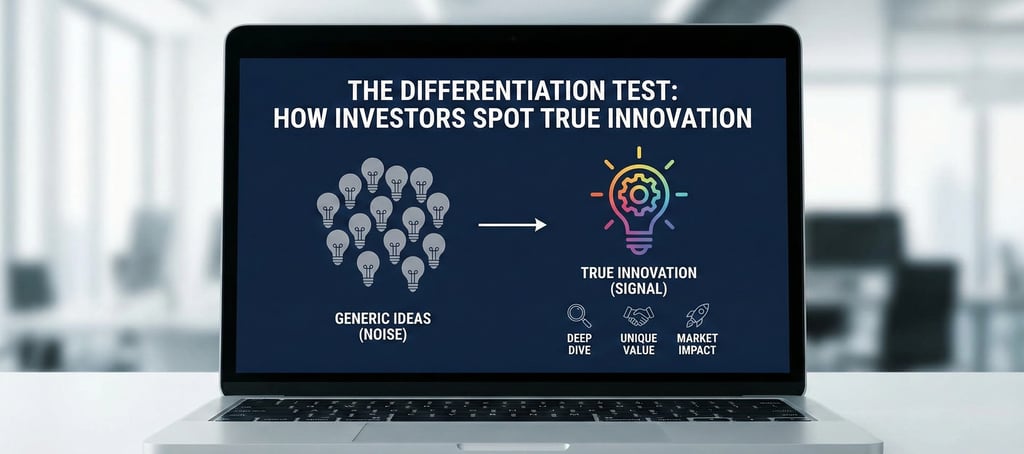
The Differentiation Test: How Investors Spot True Innovation
Stop selling "Better." "Better" is a rounding error.
If your Series A pitch relies on being 10% faster or 15% cheaper than the incumbent, you are already dead in the water. In the current capital environment—specifically for SaaS and Fintech across Silicon Valley and London—incrementalism is unfundable. Investors do not care about your feature set; they care about your structural defensibility. This is the foundational layer of the The Step-by-Step Investor Evaluation Workflow. True innovation isn’t a product spec; it is a mechanism that makes competition economically irrational. If your "differentiation" is a slightly cleaner UI or a wrapper around OpenAI, you are not building a company; you are building a feature for Microsoft.
Why "Feature Parity" Kills Rounds
The most common "Red Flag" I see in Series A decks is the Comparison Table Fallacy.
You know the slide: A grid with you and your competitors. You have green checks in every row; they have red Xs. When a Partner at Sequoia or Accel sees this, they don't see dominance. They see insecurity.
The VC Internal Monologue: "If they have to list 10 features to explain why they win, they don't have a moat. They have a temporary lead."
The Psychological Audit: Founders default to this because of Complexity Bias. You spent 18 months building the architecture, so you assume the architecture is the selling point. It isn't. The market does not pay for code complexity; it pays for outcome asymmetry.
When you pitch "we have better AI," you are pitching a commodity. In 2026, "AI" is table stakes, not a differentiator. By focusing on the what (features) rather than the how (proprietary data loops, network effects, regulatory capture), you signal that you do not understand your own business model. You are signaling that you are a Product Manager, not a CEO.
The Cost of Replication
differentiation must be quantified by the Replication Cost Coefficient (RCC).
If a well-funded incumbent (e.g., Salesforce, Stripe) can replicate your core value proposition with a 6-person engineering team in a single sprint, your valuation is effectively zero.
Consider the "Cognitive Load" cost of your narrative.
Weak Differentiation: Requires the investor to understand 15 variables to see why you win. (Time to comprehension: >4 minutes. Result: Pass.)
Strong Differentiation: Requires understanding one structural advantage that compounds mathematically. (Time to comprehension: <30 seconds. Result: Term Sheet.)
The Logic Chain:
Zero Marginal Cost of Replication: In software, features are cheap to copy.
CAC Arbitrage: True differentiation lowers Customer Acquisition Cost (CAC) naturally. If you are "better" but your CAC is identical to the incumbent, the market views you as a commodity.
Churn Correlation: "Nice to have" features have high churn. "Structural" innovation has negative churn (Net Dollar Retention > 120%).
If you cannot prove that your differentiation results in a 3x LTV/CAC ratio without aggressive paid spend, you do not have innovation. You have a marketing angle.
The "Insider" Solution Protocol
To pass the Differentiation Test, you must move your narrative from Comparative to Contrarian.
Do not tell me you are better. Tell me why the old way of working is mathematically impossible to sustain, and why your mechanism is the only logical successor.
The "Before vs. After" Transformation:
Weak Version (The "Feature" Pitch): "We use advanced machine learning to automate expense reporting with 99% accuracy, which is 5% better than Expensify." (Verdict: Who cares?)
VC-Ready Version (The "Mechanism" Pitch): "We do not scan receipts. We issue the cards and control the settlement layer. By owning the transaction data at the source, we eliminate the need for reporting entirely. We don't compete with Expensify; we erase the problem they solve."
The "Power Law" Framework for Differentiation: Use this specific framework to audit your "Competition" slide. Your differentiation must fall into one of these three buckets to be investable:
Data Gravity: The product gets better the more users use it (e.g., Waze, TikTok). The "Cold Start Problem" prevents competitors from catching up.
Regulatory/Infrastructure Capture: You own a license, a partnership, or a patent that makes it illegal or impossible for others to operate (e.g., BioTech, Banking-as-a-Service).
Counter-Positioning: Doing what you do would destroy the incumbent's existing business model (e.g., Netflix vs. Blockbuster).
If your "moat" is "User Experience," delete the slide.
The "Death Traps"
Be warned. In attempting to fix your differentiation story, founders often fall into these traps:
The "Category Creation" Trap: Do not claim you have "zero competitors." If you say this, VCs assume there is no market. Unless you are curing cancer, you have competitors. Acknowledge them, then explain why they are fighting the wrong war.
The "Buzzword Salad" Trap: Stacking terms like "Web3," "Generative AI," and "Quantum" does not create differentiation. It creates suspicion. Precision builds trust; ambiguity destroys it.
The "Price War" Trap: Never differentiate on price for a Series A pitch. "We are the cheaper option" signals a race to the bottom. VCs want to fund the premium option that captures the majority of the profit pool.
The "High-Ticket" Conclusion
Your valuation is directly correlated to the perceived defensibility of your innovation. A "feature" company trades at 2x revenue. A "platform" company with structural differentiation trades at 10x-20x revenue. Fixing this narrative isn't just about slide design; it is about adding millions to your pre-money valuation.
For the complete system on structuring your entire narrative—from Team to Exit—review How VC Pitch Decks Really Work in 2026 — And Why Most Founders Get Them Wrong.
The Filter: You can struggle to articulate your differentiation manually, or you can use "The Slide-By-Slide VC Instruction Guide" included in our $5k Consultant Replacement Kit ($497) available on the home page. It forces you to answer the hard questions before you get in the room, ensuring your deck survives the first pass.
Funding Blueprint
© 2026 Funding Blueprint. All Rights Reserved.