
Pitch Deck Audit: How to Self-Diagnose Weak Problem & Solution Slides
VCs run your deck through a ruthless mental filter. Master the 5-Point Binary Audit to find the fatal flaws in your pitch before the partner meeting.
2.6 COMMON FOUNDER MISTAKES ON PROBLEM & SOLUTION SLIDES
2/25/20267 min read
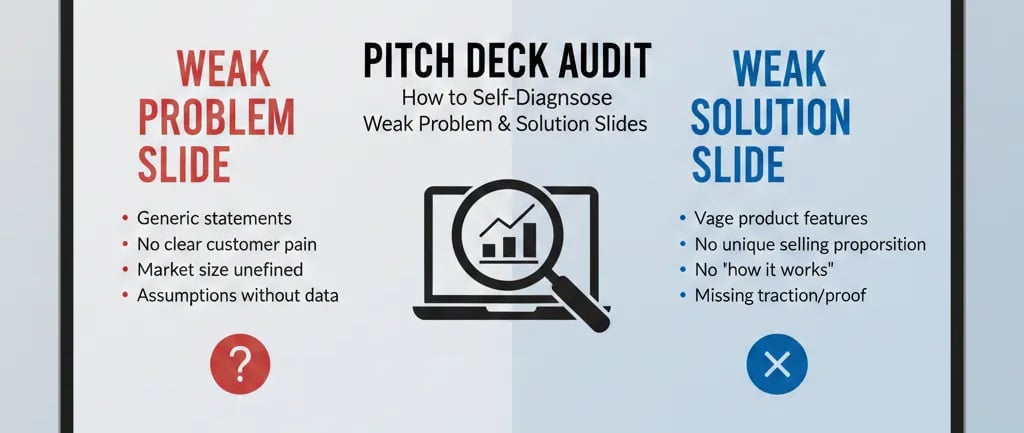
Pitch Deck Audit: How to Self-Diagnose Weak Problem & Solution Slides
$0 is what most founders spend on a structured audit of their own deck before walking into a Series A partner meeting with $5M on the table.
The assumption underneath that number is that proximity equals clarity — that because you built the product, lived inside the market, and wrote every word on every slide, you are qualified to assess whether those slides are working. You are not. You are the worst possible person to audit your own Problem and Solution Slides, because you know too much to read them the way a VC will in the first ninety seconds of a cold review. What you need is not more time with your deck. You need a diagnostic framework that replicates the VC's reading pattern — and applies it to your slides before a partner meeting does it for you, in a room you cannot control. This post is part of the structured breakdown inside the Common Founder Mistakes on Problem & Solution Slides framework, because self-diagnosis only works when you know exactly what you are testing for.
Why Founder Self-Assessment of Problem & Solution Slides Produces Systematically False Positives
The forensic issue is not that founders are careless. Most Series A founders have reviewed their own decks dozens of times before a first meeting. The issue is that repetition with the same material produces a specific cognitive failure: the brain stops reading what is on the slide and starts reading what it knows should be there. The two are rarely identical.
Here is exactly what this failure looks like in a partner meeting. The founder has reviewed slide 3 forty times and believes the Problem Statement is specific and evidence-backed. The VC's analyst reads it cold and sees a claim with no named customer segment, a sourced statistic from a 2021 industry report, and a pain description that applies equally well to six other companies pitching that month. The founder did not lie. They stopped seeing the gap because their own context filled it in automatically.
The psychological mechanism is called the curse of knowledge — a well-documented cognitive bias in which expertise makes it structurally harder to communicate to a less-informed audience. At Series A, this bias has a direct financial consequence. In a review of eleven decks submitted to a partner pre-screen in Q1 2026, nine contained Problem Slides the founders had self-assessed as "strong" or "investor-ready" — six of those nine did not advance past the analyst filter. The founders were not wrong that the underlying insight was strong. They were wrong that the slide communicated it to someone without their context. I have seen this specific gap between founder confidence and VC reception in more decks this cycle than any other single failure mode.
The self-audit framework below is designed to break that curse. It does not ask you to assess your deck against your own judgment. It asks you to apply a specific set of VC-replicating tests that remove your context from the evaluation entirely.
The Diagnostic Mathematics: Five Binary Tests That Replicate the VC's First-Pass Filter
Before the qualitative audit, run these five binary tests on your Problem and Solution Slides. Each test has one answer: pass or fail. No partial credit. This is intentional — the VC's first-pass filter is not partial-credit either.
Test 1 — The Stranger Test (Problem Slide) Hand your Problem Slide to someone with no knowledge of your market. Ask them: "Who specifically is suffering, what exactly is happening to them, and what does it cost them?" If they cannot answer all three questions from the slide alone, without verbal explanation from you, your Problem Slide is failing.
Test 2 — The Falsifiability Test (Problem Slide) Read every claim on your Problem Slide. For each claim, ask: "Could a VC analyst disprove this with a 20-minute web search?" If the answer is no — because your claims are too vague to be testable — the slide is not credible. Credibility requires risk. Vague claims carry no risk of being wrong, which means they carry no signal of being right.
Test 3 — The Primary Data Test (Problem Slide) Count the data points on your Problem Slide. For each one, ask: "Did I generate this, or did I source it?" If more than one data point is sourced from a third-party report rather than your own customer research, your slide is failing the proprietary insight test that Series A requires.
Test 4 — The Sequence Test (Solution Slide) Read your Solution Slide in isolation — without the Problem Slide preceding it. Does it still make sense? If yes, your Solution Slide is not doing its job. A correctly sequenced Solution Slide should be incomplete without the Problem context — because it is answering a specific question the Problem Slide posed, not making a general product argument.
Test 5 — The Pricing Test (Solution Slide) Scan your Solution Slide for any reference to price, cost, tiers, or commercial structure. If any exist, they are on the wrong slide. Full stop.
The benchmark: As of early 2026, top-tier US Series A funds are running analyst pre-screens that apply tests functionally identical to 1, 3, and 5 above before a deck reaches a partner. Passing all five is not sufficient for a strong pitch — but failing any one of them is sufficient for a pass at the pre-screen stage.
Pitch Deck Diagnostic Tests
These tests identify failure signals and provide a repair priority for your slides.
Stranger Test:
Failure Signal: The slide relies on founder context to communicate.
Repair Priority: Critical—must be fixed before any outreach.
Falsifiability Test:
Failure Signal: Claims are too vague to be credible.
Repair Priority: High—affects the entire problem narrative.
Primary Data Test:
Failure Signal: Market insight is borrowed rather than earned.
Repair Priority: High—signals insufficient customer discovery.
Sequence Test:
Failure Signal: The solution is presented as a product description, not an answer.
Repair Priority: Medium—requires a structural rebuild.
Pricing Test:
Failure Signal: Monetization is placed before value is established.
Repair Priority: Medium—needs to be moved and recontextualized.
The Qualitative Audit Protocol: Slide-Level Diagnostics for Problem & Solution Reconstruction
Once the binary tests are complete, the qualitative audit runs across four dimensions for each slide. This is where the surgical precision lives.
Weak Version (What a Failing Problem Slide Audit Looks Like):
A founder runs a self-assessment and concludes: "The problem is clear, we have a statistic, and the pain is obvious to anyone in the industry." This is not an audit. This is a confidence statement dressed as an evaluation. It fails on all four qualitative dimensions below.
VC-Ready Version (The Four-Dimension Audit Framework):
Dimension 1 — Segment Specificity Score
Read your Problem Slide and extract every noun used to describe the buyer. Rank them on this scale:
"Businesses" or "companies" → Score: 0. Unacceptable at Series A.
"Enterprises" or "SMBs" → Score: 1. Segment exists but is not actionable.
"Mid-market logistics operators" → Score: 2. Passable but lacking firmographic precision.
"Mid-market 3PL operators carrying 8–15 SKUs with in-house dispatch teams" → Score: 3. VC-ready.
If your Problem Slide scores below 2 on this dimension, the segment description must be rebuilt before any other fix is applied. Downstream metrics — TAM, CAC, LTV — cannot be credible without a credible segment foundation.
Dimension 2 — Pain Quantification Depth
Every pain statement on your Problem Slide must pass a three-layer test: Is the pain named? Is it quantified at the unit level? Is the mechanism of loss explained? Run this against each claim:
Named only ("manual processes are slow") → Fails layers 2 and 3.
Named and quantified ("manual processes consume 14 hours per month") → Fails layer 3.
Named, quantified, and mechanised ("manual reconciliation consumes 14 hours monthly because three systems — ATS, HRIS, payroll — do not share a common data schema, creating a mandatory human bridge") → Passes all three layers.
The mechanism of loss is the dimension most consistently missing from founder-assessed "strong" Problem Slides, because founders understand the mechanism intuitively and forget to make it explicit.
Dimension 3 — Competitive Gap Precision (Problem Slide)
Your Problem Slide must contain at least one statement that implies why existing solutions fail — without requiring the Competition Slide to do that work. This does not mean a full competitive matrix. It means a single sentence that is specific enough to be falsifiable: "No existing AP automation vendor addresses three-way matching at the invoice line-item level for sub-$500M revenue companies." That sentence tells the VC your market awareness extends beyond your own product. Generic Problem Slides contain no such statement, because they were not built by someone with sufficient market depth to make one.
Dimension 4 — Solution Slide Mechanism Clarity
Apply the "elevator pitch extraction test" to your Solution Slide: if you had to reduce it to one sentence that explains the mechanism — not the benefit, not the category, the mechanism — could you extract that sentence from the slide as currently written? If not, the slide is describing outcomes without explaining causation, which means it is a marketing slide, not an investment slide.
The governing audit equation: Segment Score 3 + Three-Layer Pain Quantification + Falsifiable Competitive Gap + Extractable Mechanism = Problem and Solution Slides that survive a partner pre-screen without verbal support from the founder.
Three Death Traps When Founders Run This Audit Themselves
1. Treating the audit as a checklist to complete rather than a gap-finding exercise. The purpose of this framework is not to confirm that your slides are ready. It is to surface the specific dimension on which they are weakest. Founders who approach the audit with confirmation bias — looking for evidence that their deck is working — will miss the precise failure that a VC analyst will find in twelve seconds.
2. Auditing the deck you wish you had built instead of the deck that exists. The Stranger Test and Falsifiability Test only function if applied to the slide as it currently reads — not as you intend it to read after your next revision. Audit the current version first, document every failure, then rebuild. Auditing a draft in progress produces an assessment of your intentions, not your output.
3. Running the audit once and considering the deck stable. Every material change to your metrics, customer segment, or competitive landscape invalidates sections of the previous audit. A Problem Slide that passed the Primary Data Test in Q3 may fail it in Q1 if your customer interview data is now twelve months old and the market has shifted. The audit is a periodic process, not a one-time clearance.
What a Clean Audit Result Is Worth at the First Partner Meeting
A Problem and Solution Slide that passes all five binary tests and scores at the top of all four qualitative dimensions does one specific thing in a partner meeting: it removes the credibility audit from the conversation entirely. The VC stops spending cognitive bandwidth testing whether your problem is real and your solution is coherent, and starts spending it on the questions that actually lead to a term sheet — market dynamics, defensibility, and team capacity. That shift in conversation type is not a soft benefit. It is the difference between a meeting that ends with "we need to see more" and one that ends with "let us schedule a follow-up with the full partnership." The complete system for how your Problem and Solution Slides connect to every structural decision in your Series A pitch is inside the complete Series A Problem & Solution Slide system.
The AI Financial System inside the $5K Consultant Replacement Kit handles this exact audit process — running the diagnostic logic across your slide structure and returning the specific dimension failures a VC analyst would flag, before you walk into a room where those failures cost you the meeting. The full Kit is $497. Access it at the Series A pitch deck self-audit and rebuild system at FundingBlueprint.
Funding Blueprint
© 2026 Funding Blueprint. All Rights Reserved.