
The Credibility Test: How VCs Judge Whether Your Numbers Are Real
We don't reject you for slow growth; we reject you for 'Logical Fraud.' A forensic audit on the Credibility Test: Why your financial projections trigger an automatic 'Pass' before we finish the deck.
1.3: THE STEP-BY-STEP INVESTOR EVALUATION WORKFLOW
1/21/20265 min read
The Credibility Test: How VCs Judge Whether Your Numbers Are Real
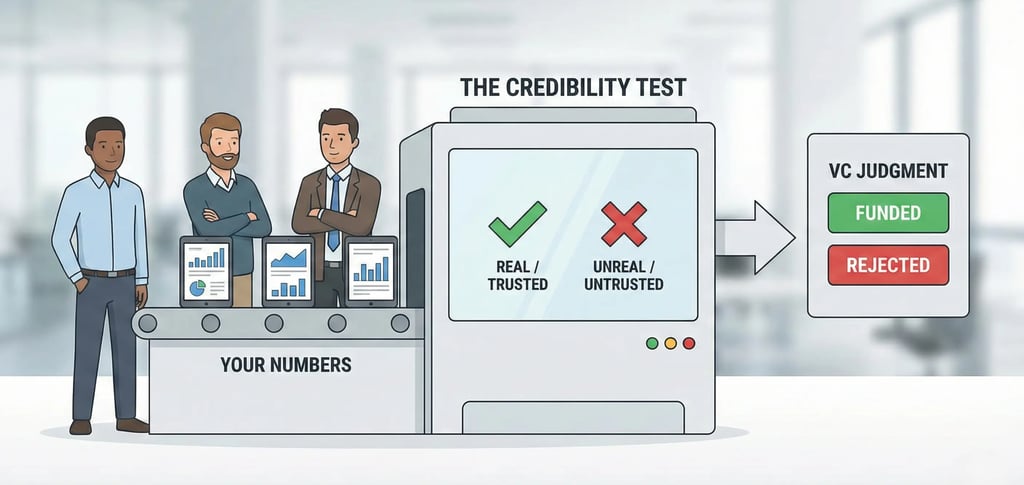
Founders lie. Usually, they don't even know they are doing it. They confuse "optimism" with "fraud," and they present projections that defy the fundamental laws of unit economics. If you are a Series A founder showing a hockey-stick chart without the underlying unit-economic leverage to support it, you are already dead in the water. We don’t reject you because your growth is slow; we reject you because your logic is broken. This assessment happens before we even finish your deck, part of the brutal, rapid-fire filtration process known as The Step-by-Step Investor Evaluation Workflow (How VCs Decide What Moves Forward). You think you are pitching a vision. We are auditing a crime scene. If the numbers on Slide 7 contradict the narrative on Slide 2, the meeting isn't just over—your reputation in the valley is actively decaying.
The Forensic Diagnosis
Why does a single metric discrepancy incinerate a $5M raise? Because capital allocation is a function of trust, and trust is a function of consistency. When a VC sees a mismatch—say, your User Acquisition Cost (CAC) drops by 50% in Year 3 with no explanation of the mechanism—we don't assume you found a marketing miracle. We assume you are incompetent.
The "Red Flag" Scenario:
You present a slide claiming a $100M revenue projection by Year 5. It looks clean. It looks ambitious. But a forensic glance at your "Marketing Spend" line item reveals you’ve budgeted $500k to acquire $20M in new ARR. That implies a CAC of $0.025 per dollar of revenue. Unless you are viral consumer social in 2012, this is mathematically impossible.
The VC Internal Monologue:
"This founder doesn't understand the cost of liquidity. They are projecting outcome without input. If I give them $10M, they will burn it chasing a fantasy CAC that doesn't exist. Pass."
The Psychological Audit:
Why do you do this? It is rarely malice. It is The Delusion of Linearity. You believe that as you scale, things naturally get cheaper and easier (Economies of Scale). In reality, specifically in B2B SaaS and high-growth tech, things get harder and more expensive before they stabilize. You are suffering from "Excel Sheet Syndrome"—typing a growth rate into a cell because it looks nice, rather than deriving it from the friction of the market. You are optimizing for the slide, not the solvent business.
The Physics of "Fake" Growth
We don't need to "believe" in your numbers. We just need to divide them. The credibility of your financial model is not an opinion; it is a derivative of your inputs. If the inputs are disconnected from reality, the output is garbage.
We test for "Metric Drift"—the inevitable decay of efficiency as volume increases. If your model shows static efficiency at dynamic scale, it is a lie.
The Logic Chain of a Rejected Model:
The CAC Floor: You claim a LTV:CAC ratio of 5:1. However, your LTV assumes a 0.5% churn rate (best-in-class enterprise) while your product is SMB self-serve (where churn is typically 2-3% monthly). Result: Your actual LTV is 6x lower than stated. Your real ratio is <1:1. You are losing money on every customer.
The Burn Multiple Disconnect: You project growing from $1M to $5M ARR while keeping headcount flat at 10 engineers. Result: You have ignored "Technical Debt Accrual." As users scale, support tickets scale linearly, and server costs scale exponentially if unoptimized. Your margin analysis ignores the COGS required to service the revenue.
The Impossible Market Share: You project capturing 10% of a $1B market in 2 years with $2M in funding. Result: To acquire $100M in revenue in 24 months, you would need a sales velocity that exceeds Salesforce’s IPO run rate. You have not modeled the "Sales Cycle Lag"—the 6-9 months it takes to close enterprise deals.
The Cognitive Load Cost:
Every time we have to perform mental division to correct your optimism, you add "Cognitive Load." If I have to recalculate your burn rate because you excluded founder salaries, I have spent 30 seconds doing your job. 30 seconds is the difference between a partner meeting and a "nice to meet you" email.
The "Insider" Solution Protocol
Stop projecting. Start deriving.
The only way to pass the credibility test is to switch from Top-Down Hallucinations to Bottoms-Up Mechanics. A Top-Down model says, "The market is huge, we will take 1%." A Bottoms-Up model says, "We have 2 sales reps making 40 calls a day, converting at 2%."
The Protocol: "The inputs determine the output."
Step 1: The Unit Economics Anchor
Isolate your unit economics for one customer.
Gross Margin per Unit
CAC per Unit (Blended vs. Paid)
Payback Period (Months)
Step 2: The Constraint Layering
Apply constraints to your growth.
Hiring Constraint: You cannot grow revenue faster than you can hire Account Executives (AEs). If it takes 3 months to ramp an AE, your revenue is flat for Q1 after funding. Model that lag.
Capital Constraint: Growth consumes cash. Calculate your Burn Multiple (Net Burn / Net New ARR). If you project a Burn Multiple of 0.5 immediately, you are lying. A healthy Series A startup often sits at 1.5 - 2.0. Show the inefficiency.
Step 3: The "Before vs. After" Transformation
The Weak Version (Instant Rejection):
Slide Header: "Financial Projections"
Content: A bar chart showing revenue doubling every year for 5 years.
Metric: "EBITDA Positive in Year 2."
Verdict: Naive. Founders don't understand that Series A is for growth, not profit maximization.
The VC-Ready Version (Fundable):
Slide Header: "Operating Levers & Unit Economics"
Content: A table showing the drivers of revenue. Number of leads -> Conversion Rat -> ACV -> Churn.
Metric: "Targeting $1.50 return on every $1.00 of S&M spend by Q3."
Verdict: Operational. This founder knows the machine they are building.
The Framework: The "Sandbagged" Alpha
Present a "Base Case" and a "Stretch Case."
Base Case: Everything goes wrong. Churn is 10% higher than expected. Hiring is slow. You still survive.
Stretch Case: The magic happens.
The Win: Pitching the Base Case shows you are a risk manager. Pitching the Stretch Case shows you are a visionary. Pitching only the Stretch Case shows you are a gambler.
The "Death Traps"
In the rush to fix your numbers, do not over-correct into new errors.
The "Conservative" Over-Correction:
Some founders get scared and project 20% year-over-year growth to look "realistic." This is Series A venture capital, not a bank loan application. We need to see the potential for 3x year-over-year growth, grounded in logic. If you show us a lifestyle business, we will pass. You need "auditable ambition."
Using 2021 Valuations in 2026:
Do not use revenue multiples from the ZIRP (Zero Interest Rate Policy) era to justify your projections. Just because a SaaS company traded at 50x ARR in 2021 does not mean you can project a $100M valuation on $2M ARR today. Use current public market comps, discount them for illiquidity (30-50%), and work backward.
Mixing Cash vs. Accrual Accounting:
Never confuse "Bookings" (contract signed) with "Revenue" (service delivered) in your cash flow forecast. If you book a $120k deal but get paid monthly, and you project receiving $120k cash on Day 1, you will run out of money. We check your cash flow statement against your billing terms. If they don't match, you fail the forensic audit.
The "High-Ticket" Conclusion
Your numbers are not just math; they are the map of your future execution. A forensic-proof financial model doesn't just prevent rejection; it defends your valuation. When your logic is unassailable, VCs cannot negotiate you down based on "risk." A tight model can easily add $1M - $2M to your pre-money valuation because it removes the "Incompetence Discount."
For the complete systemic approach to building a deck that survives this level of scrutiny, you need to understand the full ecosystem detailed in How VC Pitch Decks Really Work in 2026 — And Why Most Founders Get Them Wrong.
The Filter: You can spend three weeks building a bottoms-up financial model from scratch in Excel, likely missing the crucial burn multiple calculations we look for. Or, you can simply plug your variables into "The AI Financial System" included in our $5k Consultant Replacement Kit. It generates VC-compliant, forensic-ready projections automatically.
The kit is $497. If you are serious about passing the credibility test, this is the cost of doing business. Available on the home page.
Funding Blueprint
© 2026 Funding Blueprint. All Rights Reserved.