
What Happens When Your Pitch Deck Enters “Waitlist Mode”
You’re not "on the radar"—you’re in the Optionality Trap. Learn how VCs use waitlists to get a free look at your growth while you burn through runway.
1.8 HOW PITCH DECKS AFFECT DEAL FLOW & SCREENING
2/8/20264 min read
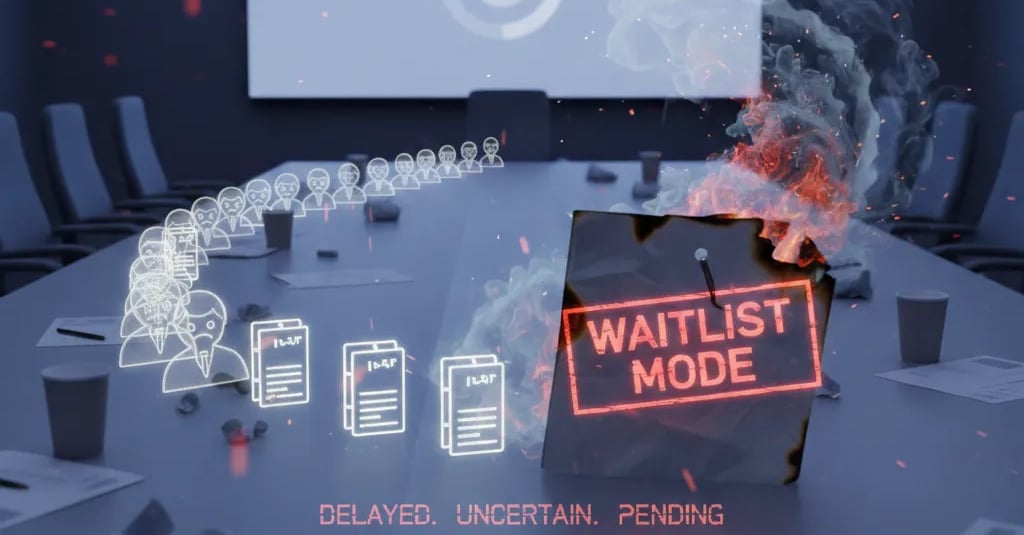
What Happens When Your Pitch Deck Enters "Waitlist Mode"
Your deck just triggered the VC equivalent of a spam filter. You don't know it yet, but your pitch is now sitting in a Partner's "Circle Back Later" folder—which, in venture capital, is where deals go to die slowly. The median time between "Looks interesting, let's revisit in Q3" and actual rejection is 127 days. That's four months of false hope while you burn through runway at $85K/month.
This isn't about being "deprioritized." This is about sending active disqualification signals disguised as "not quite ready" feedback. Understanding this mechanic is part of how pitch decks fundamentally alter deal flow and screening behavior at institutional funds.
Why "Waitlist Mode" Is Structural Rejection Wrapped in Politeness
When a deck enters waitlist mode, it's not because the VC needs "more time to think." It's because your materials passed the initial noise filter but failed the conviction test. Here's the mechanism: Associates screen 400+ decks per quarter. Partners review 40. They fund 2–3. The math forces a triage system.
The Red Flag Scenario: Your deck shows $240K ARR, 18% MoM growth, and a "path to $10M ARR by Q4 2027." The Associate sees: growth rate is real, but absolute scale is pre-institutional. The company isn't broken—it's early. So instead of rejecting you (which creates reputational risk if you 10x in six months), they say "Circle back when you hit $1M ARR."
What the VC Actually Thinks: "This might work, but I can't justify Partner time at this traction level. If they hit milestones, inbound will resurface them. If they don't, I saved 6 hours of diligence." You're now in Schrödinger's Pipeline—simultaneously a "warm lead" and a statistical non-entity.
Psychological Audit: Founders misread politeness as interest. The phrase "We'd love to reconnect in Q3" feels like momentum. It's not. It's a polite rejection designed to preserve optionality for the VC. You're being parked, not prioritized.
The Opportunity Cost Calculus That Kills Your Raise
Let's prove why waitlist mode is structural death using VC portfolio mechanics.
The Math:
Average Partner manages 8–12 active portfolio companies
New diligence consumes 40–60 hours per serious candidate (management meetings, reference calls, model validation)
Partners have ~800 productive hours per quarter after LP reporting and board obligations
That's capacity for 13–20 deep evaluations per quarter
But they see 400+ decks via associates and referrals
The Filtering Logic:
400 decks → 40 "Worth a Look" (10% pass initial screen)
40 → 12 "Partner Call Scheduled" (70% elimination after Associate deep-dive)
12 → 4 "Enter Diligence" (66% die after first Partner meeting)
4 → 2 "Term Sheet" (50% fail final Partnership vote)
Your Position in Waitlist Mode: You're stuck between stages 1 and 2. You passed the "Not Obviously Broken" test but failed the "Worth Burning Partner Cycles" test. The structural problem: there's no formal mechanism to re-enter Stage 2 unless you create an inbound catalyst (new lead investor commits, revenue doubles, major customer logo).
Waiting passively = accepting a 4% probability of resurrection.
The Resurrection Protocol: Converting Waitlist Status Into Active Momentum
The fix isn't sending monthly updates. It's engineering a pattern interrupt that forces re-evaluation.
Before: The Weak Waitlist Response
Founder sends email: "Hi Sarah, wanted to update you—we grew from $240K to $310K ARR and signed two new customers."
VC reads: Incremental progress, not exponential. Still too early. Stays in waitlist.
After: The VC-Ready Re-Engagement
Founder sends: "Sarah—we crossed $500K ARR (108% quarter-over-quarter), signed a Series A lead for $8M at $35M pre (Sequoia affiliate), and they're requiring we close the round in 3 weeks. Your Partnership mentioned interest at $1M ARR in March—we're formalizing allocation by Friday. Are you still reviewing at this stage?"
What Changed:
Absolute Scale: Crossed institutional minimum ($500K ARR is the new seed/Series A threshold in 2026)
Social Proof: Lead investor eliminates risk (Sequoia affiliate = validated diligence)
Scarcity Mechanism: 3-week close timeline forces decision, eliminates "waitlist" option
Anchored to Their Criteria: References the specific milestone they cited ("$1M ARR")
The Framework: The "Catalyst Stack" for Waitlist Reactivation
You need 2 of these 3 to force re-entry:
Metric Shock: 100%+ QoQ growth or crossing institutional threshold ($1M ARR, $100K MRR)
Third-Party Validation: Term sheet from known fund, acquisition offer above $30M, or Fortune 500 customer contract
Competitive Pressure: "Round is 80% committed, final $2M closing in 14 days"
The cognitive shift: You're no longer asking for reconsideration. You're offering limited access to a risk-reduced asset.
The Death Traps: How Founders Sabotage Waitlist Resurrections
Premature Re-Engagement: Sending updates every month with 15–20% growth keeps you visible but reinforces "too early" perception. Wait until you can show 2x scale or major validation event.
Fake Urgency: Claiming "round is closing soon" when your data room has zero activity logs. VCs backchannel with other funds. If you're lying about competition, you're blacklisted.
Using 2021 Comparables in 2026: Citing valuations or growth rates from the ZIRP era ("Our competitor raised at 50x ARR multiple in 2021"). The 2026 median SaaS Series A multiple is 8–12x ARR. Outdated benchmarks signal you're not reading the market.
Why Fixing Waitlist Mode Is Worth $1.2M in Valuation
Here's the financial impact of active resurrection vs. passive waiting:
Passive Waiting (Current State):
6 months in waitlist → burn $510K in runway
Re-engage at lower leverage (no competing term sheets)
Raise $3M at $10M pre-money (23% dilution)
Active Catalyst Engineering:
3 months to hit resurrection triggers → burn $255K
Create competitive tension with multiple term sheets
Raise $3M at $14M pre-money (17.6% dilution)
Net Outcome: 5.4% less dilution = $1.62M more founder equity at exit (assuming $30M acquisition).
You're not "waiting to get ready." You're choosing between strategic execution and passive hope. The institutional fundraising system doesn't reward patience—it rewards coordinated momentum.
This entire mechanic—from waitlist triggers to resurrection protocols—is documented in the complete pitch deck system that breaks down how VCs really evaluate founders in 2026. That's the structural layer. This post is the tactical execution.
The Efficiency Hack: You can spend 40 hours reverse-engineering which metrics trigger waitlist mode and which force re-evaluation, or you can deploy The 16 VC-Quality AI Prompts inside the $497 toolkit that auto-generates your resurrection email, competitive positioning script, and milestone tracking dashboard. The system includes the exact Partner-level language patterns that convert "let's circle back" into "we need to move on this now." Secure your copy of the institutional-grade fundraising architecture here—this is the $5K Consultant Replacement Kit designed for founders who refuse to fundraise twice.
Funding Blueprint
© 2026 Funding Blueprint. All Rights Reserved.