
How Pitch Decks Help Investors Rank Their Follow-Up Lists
A "good meeting" isn't enough. Discover the 4-tier triage system VCs use to rank founders and how to move from List 3 to List 1 in 72 hours.
1.8 HOW PITCH DECKS AFFECT DEAL FLOW & SCREENING
2/9/20266 min read
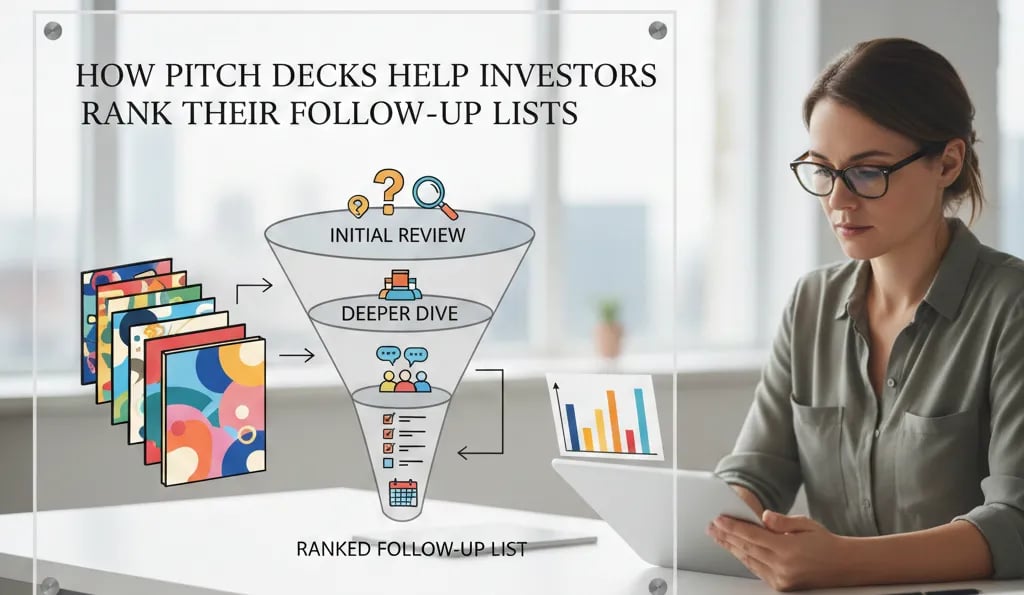
Your Pitch Deck Doesn't Get You Funded-It Gets You Ranked on a Follow-Up List You'll Never See
Most founders think a "good meeting" means the VC is interested. Here's what actually happened: you just got added to a follow-up list with 23 other companies, and your deck determines whether you're ranked #3 or #19. Position #3 gets a partner call within 72 hours. Position #19 gets a "checking in" email in 6 weeks—by which time you've run out of runway or taken a worse term sheet.
This ranking system is part of the deal flow architecture covered in how pitch decks affect the initial screening and follow-up prioritization process, where we dissect how VCs organize their pipeline before anyone talks about "moving fast" or "conviction."
The brutal truth: VCs don't maintain one follow-up list. They maintain five segmented lists, and your deck—not your pitch, not your charisma—determines which list you land on. The gap between List 1 ("Schedule Monday") and List 3 ("Circle back Q2") is often a single slide with missing data. And most founders never know which list they're on until it's too late.
Why VCs Build Follow-Up Lists in Layers-The Triage System You Never See
Here's what happens after your meeting ends. The Associate or Principal doesn't immediately Slack the partners "let's do this deal." Instead, they open a spreadsheet with 40–60 company names and update your ranking score across 4 variables:
The 4-List Segmentation Model:
Active Pipeline (List 1): 3–6 companies. Weekly check-ins. Partner involvement. Diligence requests within 48 hours.
Warm Monitoring (List 2): 8–15 companies. Bi-weekly updates. "Show me next month's numbers." You're being tracked, not actively pursued.
Deferred Interest (List 3): 15–25 companies. "Let's reconnect in Q2/Q3." Translation: You're not ranking high enough to justify diligence time right now.
Archived (List 4): Everyone else. Polite pass. No follow-up.
Your deck determines this ranking before the meeting even starts. Here's how:
The Associate reviews your deck 24–48 hours before the meeting. They're not "getting excited"—they're pre-scoring you on the follow-up prioritization matrix. If your deck has clear revenue traction, unit economics, and a defensible wedge, you enter the meeting already ranked for List 1 or List 2. If your deck is missing these signals, you're pre-ranked for List 3—and the meeting is just due diligence to confirm the decision they've already made.
The Red Flag Scenario: A founder sends a 19-slide deck with traction buried on Slide 14, no unit economics, and vague competitive positioning. The VC reads it, tags it as "unclear business model," and pre-ranks it as List 3. The meeting goes well—founder is articulate, vision is compelling—but the deck never contained the ranking variables needed to move up. Result: "Great conversation, let's stay in touch" = You're List 3, and you'll never get moved up without a major inflection point.
Psychological Audit: Founders assume "good meeting = interest." Wrong. The meeting confirms or overrides the deck's pre-ranking. If your deck pre-ranked you as List 3, you need to 10x their expectations in the meeting to move up. If your deck pre-ranked you as List 1, you just need to not screw up.
The Hidden Scoring Rubric That Determines Your List Placement-Before You Pitch
Let's prove this with the actual variables VCs use to rank follow-up priority. Most funds use a variation of this 3-factor model:
The Follow-Up Prioritization Formula:
Urgency Score (40% weight): How fast is this moving? Is there competitive pressure? Are other VCs circling?
High: You're raising now. You have 2 other term sheets. You're growing 25% MoM. → List 1
Medium: You're "testing the market." Growth is 10–15% MoM. → List 2
Low: You're "exploring options." No deadline. Growth is <10%. → List 3
Conviction Score (35% weight): Does this fit our thesis? Is the data strong enough to take to partners?
High: Clear product-market fit. Revenue proof. Differentiated positioning. → List 1
Medium: Interesting, but missing 1–2 key data points. → List 2
Low: Requires major assumptions to get excited. → List 3
Deck Quality Score (25% weight): Can I extract this company's story in 5 minutes to present to partners?
High: Traction front-loaded. Unit economics clear. Competitive wedge obvious. → List 1
Medium: Information is there, but I have to hunt for it. → List 2
Low: Missing slides. Data buried. Forces me to email for clarification. → List 3
Here's the killer insight: A company with $600K ARR, 18% MoM growth, and a perfect deck (Urgency: Medium, Conviction: High, Deck: High) ranks above a company with $1.1M ARR, 12% MoM growth, and a messy deck (Urgency: Medium, Conviction: High, Deck: Low).
Why? Because the VC can take the first deck to partners this week. The second deck requires 3–4 follow-up emails to get missing data, which delays the partner presentation by 2–3 weeks. In a competitive market, that delay moves you from List 1 to List 2—and someone else closes their round while you're waiting.
How to Engineer Your Deck to Automatically Land on List 1-The Follow-Up Acceleration Protocol
The fix isn't "pitching better." It's building a deck that makes you easy to prioritize. Here's the step-by-step:
Step 1: The "Partner Presentation Test"
After your meeting, the Associate needs to present your company to partners in their Monday meeting. If they can't build that 3-minute summary from your deck alone, you're List 2 at best.
Build your deck to pass this test:
Slide 1: One-line pitch + current traction metric (e.g., "AI Sales Intelligence | $420K ARR, 24% MoM")
Slide 5: Your "ranking slide"—the single chart that shows why you're List 1 material. Revenue growth, retention cohorts, or pipeline expansion. Make it impossible to ignore.
Slide 8: Unit economics in a table. CAC, LTV, Payback Period, Gross Margin. The Associate copy-pastes this into their partner memo.
Before Version (List 3 Deck): Your traction slide says "Strong Growth Trajectory" with a generic upward arrow. No numbers. The Associate has to email you: "Can you send Q4 revenue breakdown?" You've just added 5 days to your follow-up timeline.
After Version (List 1 Deck): Your traction slide is a bar chart: "$420K ARR | 24% MoM | $87K Oct → $108K Nov → $134K Dec." The Associate screenshots this, drops it in the partner memo, and schedules your next call for Thursday.
Step 2: The "Urgency Injection" Framework
VCs rank based on urgency. If you're not raising yet, you're List 3 by default. Fix this by manufacturing timeline pressure in your deck:
Slide 10 (The Ask): Don't write "Raising $3M Series A." Write "Closing $3M Series A by March 15 | $1.8M committed | Final $1.2M allocation."
Slide 6 (Traction): Add a forward-looking metric: "Q1 2026 Pipeline: $840K ARR | 67% Probability-Weighted."
This signals: "If you don't move fast, you'll miss this." List 1 companies have urgency. List 3 companies have "flexible timelines."
Step 3: Build the "Missing Slides" Appendix
List 2 vs. List 1 often comes down to whether the VC has to ask follow-up questions. Anticipate them:
Add an appendix slide: "Competitive Landscape—Full Analysis"
Add an appendix slide: "Go-to-Market Economics—CAC Breakdown by Channel"
Add an appendix slide: "3-Year Financial Model—Revenue Build"
When the partner asks "What's their CAC?" the Associate doesn't email you—they flip to Slide 17. You just saved 3–5 days of follow-up time.
The Three Follow-Up List Death Traps
The "We'll Send More Data" Trap: You tell the VC "I'll send the financial model after this call." You've just moved yourself to List 2. The Associate now has to wait for your email, chase you if you forget, and delay their partner presentation. Put everything in the deck or appendix.
The "Raising When Ready" Trap: You say "We're not actively raising, just taking exploratory meetings." The VC hears "List 3." Even if you're not raising this week, give them a timeline: "Planning to close by Q2 2026."
The "Incomplete Traction Story" Trap: You show revenue growth but don't explain retention. The partner asks "What's churn?" The Associate doesn't know. You're now List 2 until you send cohort data. Front-load the objection-handling data.
Why Your List Ranking Determines Whether You Close Your Round-Not Your Pitch
Here's the economic reality: List 1 companies get term sheets. List 2 companies get "monitoring." List 3 companies get ghosted.
The math: A typical VC fund has 2–3 partners actively reviewing deals. Each partner can only diligence 4–6 companies per quarter. If you're List 2, you're competing with List 1 companies for those diligence slots. List 1 always wins.
And here's the compounding effect: List 1 companies get introduced to co-investors, get fast-tracked to partner meetings, and close rounds in 4–6 weeks. List 2 companies get "let's reconnect next month," which turns into 12–16 week cycles—by which time the market has shifted or your metrics have stalled.
The delta between List 1 and List 2 is often one slide—the unit economics slide you left out, or the traction chart that's missing MoM growth rates.
This entire follow-up list engineering system—how to structure decks for prioritization, which slides trigger urgency, and how to avoid the List 3 death spiral—is fully broken down in the complete framework for how VC pitch decks drive institutional decision-making.
You can spend 8 weeks getting "warm interest" emails while sitting on List 2, or you can structure your deck to force List 1 prioritization from the first meeting. The Slide-by-Slide VC Instruction Guide inside the institutional capital formation system built for execution-focused founders includes the exact "ranking variable" checklist VCs use to segment their follow-up lists—available for $497 to filter founders who understand that fundraising is pipeline management, not performance art.
The difference between List 1 and List 3 is 6 slides with the right data in the right order. Those 6 slides determine whether you raise $3M in 6 weeks or burn 4 months chasing "interest" that never converts.
Funding Blueprint
© 2026 Funding Blueprint. All Rights Reserved.