
Seed vs Series A Pitch Decks: How Slide Structures Must Change
Pitching a Series A with an updated Seed deck kills your raise. Learn why $1.2M ARR requires a complete pitch deck rebuild to survive VC diligence.
3.1 CORE PITCH DECK STRUCTURES: HOW VCS RECOGNIZE SIGNAL VS NOISE
3/5/20266 min read
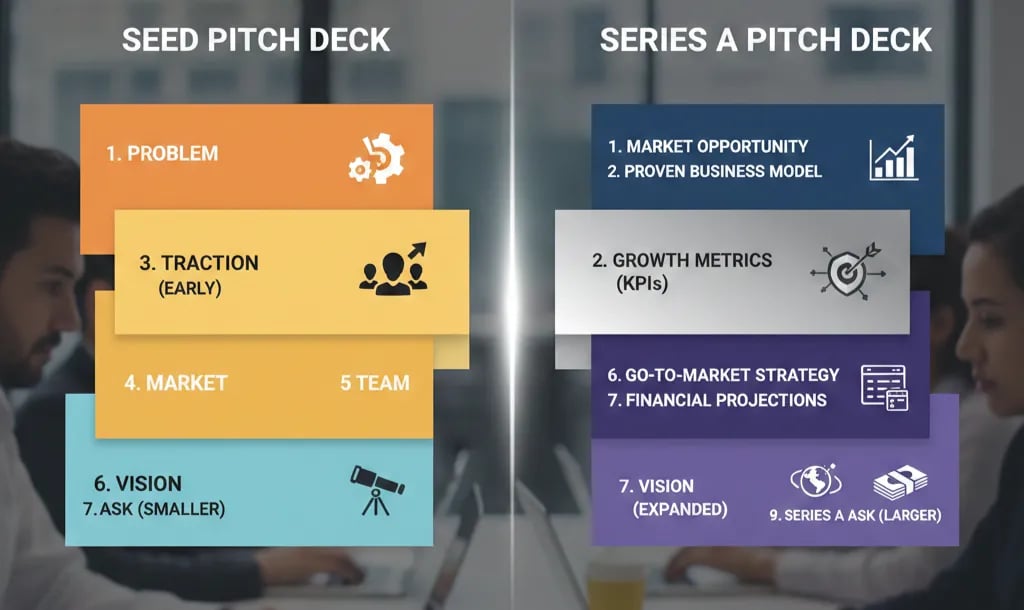
Seed vs Series A Pitch Decks: How Slide Structures Must Change
$1.2M ARR Means You Are Pitching a Different Company — Your Deck Has to Know That
$1.2M in ARR is the structural dividing line between two completely different pitch decks — and most founders do not rebuild when they cross it. They take the Seed deck, update the traction slide with real numbers, add a financial model, and resubmit. The VC sees it immediately: a Seed-stage narrative wearing Series A clothing. The tell is not the numbers. It is the questions the deck is trying to answer. At Seed, you are answering "is this real?" At Series A, you are answering "is this scalable?" Those are not the same question, and no amount of ARR grafted onto the wrong structure will make them converge. Understanding what signals belong at which stage is the core discipline behind Core Pitch Deck Structures: How VCs Recognize Signal vs Noise — and it is exactly what separates the decks that move to partner meetings from the ones that stall with associates.
Why Carrying Seed Deck Architecture Into a Series A Raise Signals the Wrong Founder Judgment
The forensic error here is not cosmetic. It is logical. A Seed deck is built to prove existence — the problem is real, the insight is sharp, the founder is credible. Every slide is a piece of evidence that something worth betting on is present. The VC is making a probabilistic wager on a team and a thesis.
A Series A deck is built to prove repeatability. The VC is no longer asking whether the pain exists. They know it does — you have $1M+ in revenue proving it. The question now is whether your go-to-market motion is a repeatable engine or a collection of founder-led one-off wins. Those are structurally incompatible narratives, and a deck designed to answer Question One cannot simultaneously answer Question Two — regardless of which metrics you drop into the existing slides.
In a deck reviewed last quarter, a founder at $1.6M ARR submitted a pitch structured almost identically to their Seed raise — the Problem slide was still in position two, the Traction slide was still framed as "early proof of concept," and there was no cohort analysis anywhere in the deck. The lead partner closed the document before reaching the financial model.
As of 2025, the median Series A pre-money valuation in the US sits at $22M–$28M, with top-tier funds running formal diligence cycles of 8–12 weeks post-first meeting. At that valuation range and timeline, the partner team is not pattern-matching for potential — they are stress-testing for defensibility and scale velocity. A Seed-framed narrative answers neither.
The psychological cause of this mistake is almost always misplaced loyalty. Founders built the Seed deck through 60+ iterations and it worked. Rebuilding it feels like abandoning something proven. That instinct is exactly wrong. The deck that raised your Seed is a liability in a Series A conversation.
The Stage-Gate Evidence Ladder: Why the Two Decks Are Asking Different Questions
Think of fundraising stages as a sequential evidence ladder. Each rung requires the next layer of commercial proof — not just more data, but different categories of data. Your deck architecture must reflect the rung you are standing on.
Seed Stage — The Questions Being Priced:
Is the problem real and painful enough to pay for?
Does this team have the insight and access to solve it?
Is there any early signal that the market will respond?
Series A — The Questions Being Priced:
Is revenue growing at a rate that justifies a $20M+ pre-money?
Is the go-to-market motion repeatable without founder involvement?
Are the unit economics trending toward a sustainable business?
What is the 24-month path to a Series B on these metrics?
These are not the same audit. Map the evidence categories side by side:
Traction: Seed needs a traction proxy (LOIs, pilots, early users); Series A needs revenue cohorts, MoM growth rate, logo retention.
Go-to-Market: Seed needs hypothesis and early channel tests; Series A needs demonstrated CAC by channel, payback period.
Unit Economics: Seed is not required; Series A needs LTV:CAC ratio (minimum 3:1), gross margin by segment.
Market Sizing: Seed needs TAM framing + beachhead logic; Series A needs bottoms-up capture model with named segment.
Financial Model: Seed is optional/light; Series A requires an 18-month operating plan with burn multiple.
Team: Seed needs founder-market fit proof; Series A needs a hiring plan + org chart for next 18 months.
The burn multiple benchmark has tightened materially post-2022. As of early 2026, top-tier US Series A funds are using a burn multiple of ≤1.5x as a soft threshold — meaning for every $1.50 burned, they expect $1.00 of net new ARR added. A Seed deck structure has no mechanism to show this because it was not built to surface operating efficiency. The Series A deck must be.
The Structural Rebuild Protocol: From Seed Architecture to Series A Architecture
The Weak Version: Updated Seed Deck Submitted as a Series A Pitch
Slide 1: Problem (unchanged from Seed raise)
Slide 2: Solution (product screenshots updated)
Slide 3: Market Size (same TAM pyramid, larger numbers)
Slide 4: Traction ("We've grown to $1.2M ARR!")
Slide 5: Financial Projections ($1.2M → $8M → $22M)
Slide 6: Team (same bios, one new hire added)
Slide 7: Ask ($6M Series A)
What the VC is thinking by Slide 5: The revenue is real, but there is no cohort logic. No CAC. No LTV. No evidence of a repeatable channel. This founder has a revenue line, not a revenue model.
The VC-Ready Version: Series A Architecture That Answers the Right Questions
Slide 1: The Business in One Number — Your best single metric. Not a tagline. ("$1.4M ARR | 22% MoM growth | 94% gross retention — 18 months post-launch.")
Slide 2: The Market We Are Capturing — Bottoms-up: specific segment, named buyer, estimated number of accounts, current penetration rate. Not a TAM pyramid.
Slide 3: Why We Win in This Segment — Your unfair structural advantage. Not "great product." Proprietary data, switching cost architecture, network effect, regulatory positioning.
Slide 4: The Revenue Engine — How a deal is originated, qualified, closed, and expanded. CAC by channel. Sales cycle length. ACV. This is the slide that determines whether you get a second meeting.
Slide 5: Unit Economics — LTV:CAC by cohort. Payback period. Gross margin. Net revenue retention if applicable. Present it as a trend, not a snapshot.
Slide 6: The Operating Model — 18-month plan. Headcount by function. Burn multiple at current and projected run rates. Key hiring milestones tied to revenue targets.
Slide 7: Competitive Moat — Not a feature comparison grid. A structural argument for why you are harder to displace in 24 months than you are today.
Slide 8: Team + Hiring Plan — Who you are, who you are hiring, and why that specific org structure executes this specific go-to-market. Not just bios.
Slide 9: The Ask — Amount, pre-money rationale, use of funds mapped to the 18-month operating model, and the Series B milestone you are building toward.
The Series A Credibility Formula
Apply this as a structural test before submitting:
Series A Readiness = (Revenue Growth Rate × Unit Economics Clarity) + GTM Repeatability Proof
If your GTM Repeatability Proof is low — meaning all your revenue came through founder relationships and warm intros with no documented repeatable channel — no ARR number compensates. The deck cannot hide what the business has not yet built.
Three Series A Structural Death Traps
1. Projecting Off a Seed-Stage Growth Rate. Your first six months of growth are founder-driven and not representative of the business at scale. If your 18-month projections use early growth rates as the baseline without adjusting for channel maturity, every VC analyst in the room will flag it. Build projections off your last 90-day growth rate, not your lifetime curve.
2. Presenting LTV:CAC Without Cohort Data to Anchor It. A 4:1 LTV:CAC ratio is meaningless if it is based on an assumed churn rate you have not yet observed. At Series A, VCs will ask for your cohort retention curves. If you do not have 12 months of cohort data, present what you have and frame it clearly — do not extrapolate and present the extrapolation as a proven ratio.
3. Using the Same Team Slide Architecture From Seed. At Seed, the team slide proves domain credibility. At Series A, it must also prove organizational design thinking. Who are you hiring in the next six hires, into what functions, and why that sequence executes the go-to-market thesis? If your team slide is still just headshots and LinkedIn bios, it was built for a different conversation.
The Structural Upgrade That Directly Impacts Your Pre-Money Negotiation
VCs negotiate pre-money against perceived execution risk. A deck that clearly demonstrates a repeatable go-to-market engine, a tightening burn multiple, and a defensible unit economics trajectory does not just improve your acceptance rate — it reduces the risk premium the VC assigns when anchoring their valuation. A Series A founder who walks in with clean cohort data, a documented CAC by channel, and an 18-month operating plan mapped to specific milestones is a structurally lower-risk investment than one who presents the same ARR with Seed-stage framing. That difference, priced into a pre-money negotiation at the $22M–$28M median range, can represent $2M–$4M in founder equity. The architecture of your deck is not a presentation problem. It is a cap table problem. For the complete system governing how every slide type must evolve across funding stages, Pitch Deck Slides Structure & Frameworks is the full reference.
Founders who have used the Slide-By-Slide VC Instruction Guide inside the $497 $5K Consultant Replacement Kit go into Series A partner meetings with a deck that already maps to the exact evidence architecture a VC analyst will check against — stage-appropriate, metric-grounded, and structured to answer the right questions before they are asked. That is not a marginal edge; at the partner meeting stage, it is often the deciding one.
At Seed, you proved the problem was real. At Series A, you have to prove the machine is real. The deck is not an update — it is a rebuild.
Funding Blueprint
© 2026 Funding Blueprint. All Rights Reserved.