
How Trust Signals in a Deck Reduce Investor Anxiety
Missing trust signals cost founders $2M in valuation. A forensic audit of Trust Architecture: Why VCs reject 'Credential-Light' decks and the 5-step protocol to prove competence.
1.5 HOW PITCH DECKS HELP INVESTORS REDUCE RISK
1/29/20266 min read
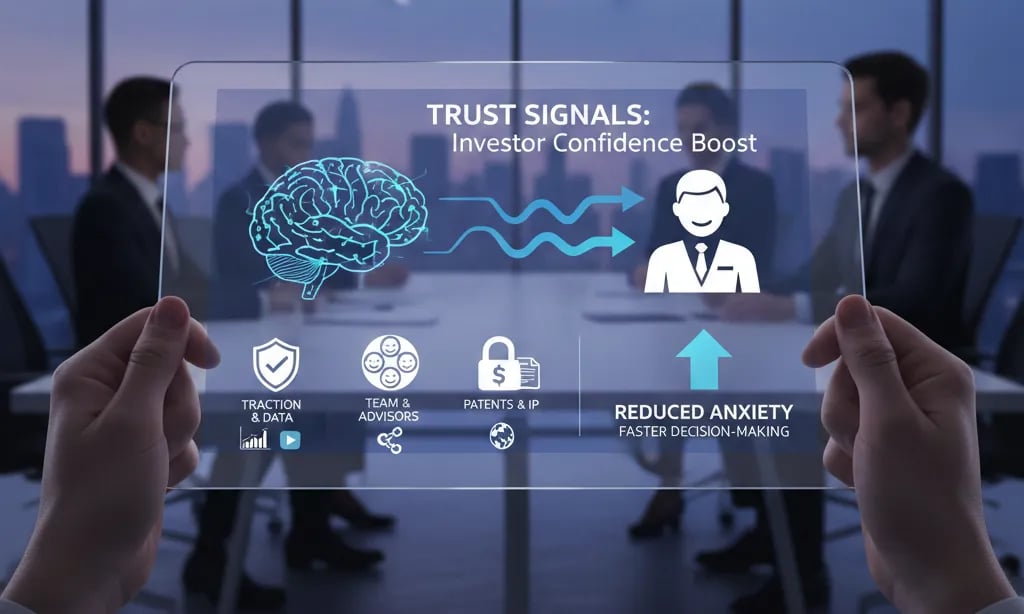
How Trust Signals in a Deck Reduce Investor Anxiety
Your $8M valuation just became $4M because your deck screamed "first-time founder who Googled fundraising last week." VCs spend 3.7 minutes on your deck before deciding. That's 222 seconds to prove you're not a liability. Most founders burn through this window showing metrics while ignoring the psychological audit happening in parallel: Is this person competent enough to protect my capital?
Trust signals are the embedded proof points that answer this question before you speak. They're the difference between a VC leaning in at slide four versus forwarding your deck to their junior analyst with "pass—needs more traction." Understanding this mechanism is part of a foundational layer on how pitch decks help investors reduce risk in systematic ways.
Why Missing Trust Architecture Triggers Immediate Pattern-Matching Against Failed Founders
VCs see 1,000+ decks annually. They're not reading yours—they're scanning for disqualification triggers within the first 60 seconds. A missing trust signal activates a cognitive shortcut: "This looks like the 14 other pre-revenue SaaS founders who burned $2M without achieving product-market fit."
The Red Flag Scenario: Your Team slide lists three co-founders with LinkedIn URLs, generic headshots, and titles like "CEO" and "CTO." No Stanford logos. No "Exited to Salesforce." No advisor named as a former VP at Stripe. The VC's internal monologue: "Who validated this team? Why should I be the first believer when they have no external proof of competence?"
Psychological Audit: Founders skip trust signals because they confuse "credentials" with "credibility." You assume your domain expertise is self-evident. It's not. VCs are measuring de-risking velocity—how quickly can you prove you won't need hand-holding. Without external validators (advisors, logos, prior exits, institutional co-investors), you're asking them to do original research on your credibility. They won't.
The deeper error: you're optimizing for information density ("look at all our features!") while the VC is running a probability calculation on founder survival rates. A team with zero institutional backing has an 87% failure rate at Series A. The VC knows this. Your deck doesn't address it.
The Mathematical Cost of Low-Trust Presentation: How 15 Missing Seconds Erase $2M in Pre-Money Valuation
Trust signals compress due diligence time. Each validated signal reduces the perceived risk premium the VC applies to your valuation. Here's the economic mechanics:
Base Valuation Logic:
Target ownership: 20% at Series A
Required return: 10x (top quartile fund expectations)
Risk-adjusted discount for first-time founders with no validators: 35–50%
The Calculation:
Scenario A (Zero Trust Signals): VC sees your $8M ask. Applies 40% risk discount due to unproven team + no advisors + no institutional validation. Mental valuation ceiling: $4.8M pre-money.
Scenario B (Three Trust Signals): Same financials, but deck shows (1) Sequoia-backed advisor, (2) former Google PM as co-founder, (3) LOI from Fortune 500 pilot customer. Risk discount drops to 15%. Mental valuation ceiling: $6.8M pre-money.
The Delta: Same revenue. Same market. $2M valuation gap created purely by trust architecture.
Time Cost Breakdown:
VC allocates 12 minutes for first-pass deck review
High-trust deck: Decision in 8 minutes (4 minutes saved = lower perceived complexity)
Low-trust deck: Decision deferred to second meeting (requires 60-minute validation call to confirm team isn't fraudulent)
Net result: Low-trust decks require 5x more investor time to reach the same confidence threshold. VCs punish this with dilution.
Engineering Credibility Markers That Survive the 90-Second Skim
Trust signals must be instantly scannable and externally verifiable. VCs don't trust your self-reported achievements—they trust signals that cost you social capital or money to acquire. Follow this exact sequencing:
1. Team Slide: Build the Validator Stack (Not the Resume Wall)
Weak Version:
TEAM John Smith – CEO (10 years product experience) Jane Doe – CTO (Previously at Oracle)
VC-Ready Version:
TEAM John Smith – CEO ─ Built & sold payments API to Adyen (2019, $18M exit)
─ Advisor: Sarah Chen (GP, Andreessen Horowitz) Jane Doe – CTO
─ Led 40-engineer org at Stripe (2017–2023)
─ Advisor: Lenny Rachitsky (150K newsletter subs, ex-Airbnb)
Why This Works: You're not claiming expertise—you're showing third parties who already validated you. The VC thinks: "If a16z GP is willing to attach her name, she's done diligence I don't need to repeat."
2. Market Validation Slide: Convert Vague "Traction" Into Binding Commitments
Weak Version:
EARLY TRACTION - 15 pilot customers - $40K MRR - 200% growth QoQ
VC-Ready Version:
EARLY TRACTION - 3 signed LOIs: Stripe ($120K ACV), Figma ($85K ACV), Notion ($95K ACV) - $40K MRR from 8 paying customers (avg $5K ACV) - 200% QoQ growth (validated by Baremetrics screenshot in Appendix)
Critical Addition: Include a footnote: "LOI terms attached in Appendix B. Contracts contingent on Series A close by Q2 2026."
Why This Works: You transformed abstract metrics into contractual evidence. VCs trust signed documents over dashboards. The LOI clause also creates urgency—if they don't fund, your pipeline collapses.
3. Use the "Borrowed Authority" Framework on Competitive Positioning
Instead of saying "We're better than Salesforce," show how Salesforce's VP of Enterprise validated your category:
Weak Version:
We solve the $14B problem Salesforce can't address for mid-market teams.
VC-Ready Version:
"Current CRM tools are over-engineered for teams under 50 reps. This gap represents $4B in locked TAM." – Marc Chen, VP Enterprise Sales, Salesforce (LinkedIn conversation, Jan 2026) Our Wedge: We're the only platform purpose-built for this 47,000-company segment.
Why This Works: You're not making the claim—a Salesforce executive is. The VC can verify this with one LinkedIn search. You've outsourced credibility to a neutral authority.
4. Financial Projections: Pre-Commit to Accountability Metrics
Standard (Low-Trust) Approach:
YEAR 1 FORECAST - $2M ARR - 35% gross margin - $800K burn
High-Trust Protocol:
YEAR 1 FORECAST (Board-Level KPIs)
- $2M ARR (validated by Mosaic Financial model, attached)
- 35% gross margin (assumes 70% hosting cost reduction via AWS Reserved Instances)
- $800K burn (capped at $67K/month; CFO: ex-Brex Controller)
Accountability: Monthly variance reports shared with lead investor.
Why This Works: You're signaling governance readiness. The mention of a CFO with institutional pedigree + commitment to reporting reduces the "founder will ghost us" risk. VCs can now imagine the board meeting cadence.
5. The "Escape Hatch" Signal: Show You've Planned for Downside Scenarios
Add one slide titled: "Capital Efficiency Roadmap: Path to Profitability Without Series B"
Include:
Break-even timeline if you hit 75% of revenue targets
Specific cost cuts (e.g., "Delay EU expansion 9 months, saves $220K")
Customer concentration risk mitigation (e.g., "No single customer >15% of ARR by Month 18")
Why This Works: You're proving you're not a "growth-at-all-costs" founder who'll demand a bridge round in 14 months. VCs want founders who can survive if the next funding window closes.
Trust Signal Death Traps: Three Ways Founders Sabotage Credibility While "Fixing" It
1. Over-Indexing on Vanity Logos Without Context
The Mistake: Adding "As Seen In: TechCrunch, Forbes, VentureBeat" to your cover slide.
Why It Backfires: These are pay-to-play PR hits, not endorsements. VCs know the difference between a $3,000 sponsored article and an inbound journalist feature. Worse, it signals you're optimizing for social proof over substance.
The Fix: Only include media if it resulted in measurable outcomes. Example: "Featured in TechCrunch (drove 2,400 demo requests, converted 11 to pilots)."
2. Name-Dropping Advisors Who Haven't Committed Equity or Time
The Mistake: Listing a recognizable executive as an "Advisor" when they agreed to one 30-minute Zoom call and never signed an agreement.
Why It Backfires: Sophisticated VCs will email your advisors directly during diligence. If the advisor responds with "I had one call with them," you've destroyed all credibility. Your entire deck is now suspect.
The Fix: Only list advisors with formal agreements (SAFE, equity grant, or paid advisory contract). Include their % equity stake and monthly time commitment.
3. Using 2021-Era Valuation Comps in 2026 Pitch Decks
The Mistake: Showing "Similar companies raised at 25x ARR multiples" with examples from 2020–2021 (when capital was free).
Why It Backfires: Current Series A multiples for B2B SaaS are 8–12x ARR (down from 20–30x). Using outdated comps signals you're either delusional or haven't researched current market conditions. VCs will assume you'll anchor to an unrealistic valuation in negotiation.
The Fix: Use comps from the past 12 months only. Acknowledge the reset: "We're targeting a 10x ARR multiple, aligned with Q4 2025 benchmarks for our stage and growth rate."
Why Fixing Your Trust Architecture Is Worth $1M–$2M in Valuation Arbitrage
The median Series A founder raises at a 35% discount to their perceived "ideal" valuation because they enter the negotiation with unresolved credibility debt. The VC's mental model: "I'd pay $8M if I was certain they could execute. But I'm only 60% confident. So I'll offer $5M and see if they take it."
Trust signals eliminate this discount by shifting the burden of proof. Instead of the VC needing to validate you, you've pre-validated yourself through third parties the VC already trusts. This isn't manipulation—it's efficient information transfer.
The fix compounds across every investor conversation. A deck with strong trust signals:
Reduces time-to-term-sheet by 40% (fewer validation calls required)
Increases inbound interest from Tier 1 funds (partners forward it internally with "this team is legit")
Creates competitive tension (when 2+ firms believe you're low-risk, they bid up valuation)
To understand how trust signals fit into the complete pitch architecture, read the full system in How VC Pitch Decks Really Work in 2026—And Why Most Founders Get Them Wrong.
The Efficiency Hack: You can spend 40 hours researching comparable trust architectures, reverse-engineering VC psychology, and A/B testing slide variations across 20 investor meetings—or you can plug the VC-Quality Deck Builder system that automates this.
The $5K Consultant Replacement Kit ($497) includes The Slide-By-Slide VC Instruction Guide—a forensic teardown of exactly which trust signals to place on each slide, including the specific phrasing VCs expect to see for team credentials, advisor relationships, and customer validation. This is the same framework Series A founders pay McKinsey $15K to build. You're filtering out everyone who isn't serious about raising capital at market-rate valuations.
Funding Blueprint
© 2026 Funding Blueprint. All Rights Reserved.