
Copy-Paste Pitch Deck Templates: How Cheap Problem Slides Destroy Credibility
Is your Problem slide a Canva template? A borrowed layout signals borrowed thinking. Learn why cheap templates kill Series A deals and how to fix yours.
2.6 COMMON FOUNDER MISTAKES ON PROBLEM & SOLUTION SLIDES
2/25/20267 min read
Copy-Paste Pitch Deck Templates: How Cheap Problem Slides Destroy Credibility
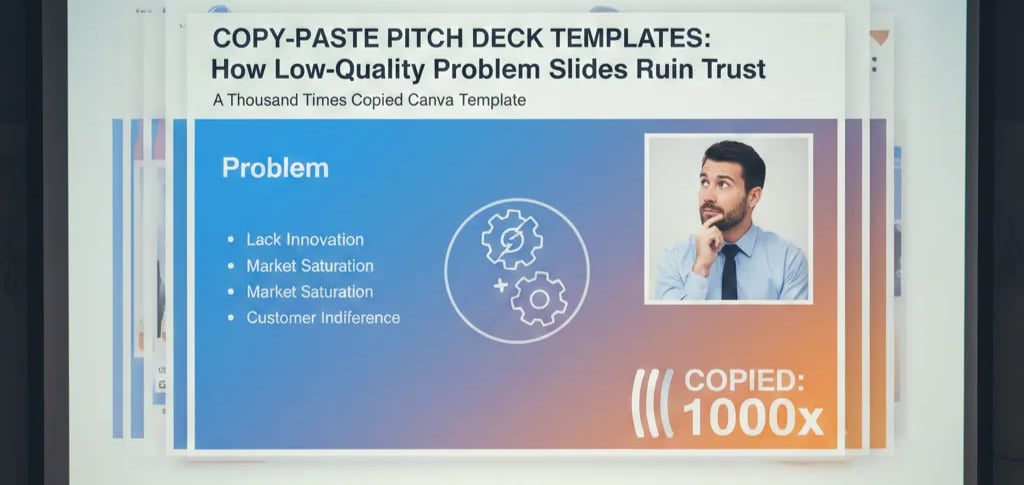
A Series A founder in climate tech downloaded a Canva pitch deck template, swapped in their logo and metrics, and walked into a partner meeting at a $400M fund. They were asked to leave after slide 4. Not because their numbers were wrong. Not because their market was thin. Because the partner had seen that exact slide layout — same icon grid, same three-column pain point structure, same stock photograph of a frustrated office worker — in four other decks that month. The template did not just fail to differentiate. It actively communicated that this founder had not done the work that Series A requires.
Template decks are not a design problem. They are a trust problem — and the Problem Slide is where that trust collapses fastest, because the Problem Slide is the one place in your pitch where originality of insight is the only currency that matters. This is part of the structured breakdown inside the Common Founder Mistakes on Problem & Solution Slides framework — because a borrowed structure cannot carry original thinking, and VCs can tell the difference in under thirty seconds.
Why Template Problem Slides Signal Intellectual Shortcuts to Pattern-Matching Series A Investors
The forensic issue is not aesthetic. A VC partner does not pass on a deck because the font is Lato instead of Söhne or because the slide margins are slightly off. They pass because a template Problem Slide is structurally incapable of containing the specific, first-hand market intelligence that Series A conviction requires.
Here is exactly what a template Problem Slide looks like in a partner review. Three icons in a row — a clock, a dollar sign, a chain link — each sitting above a generic pain statement: "Time-consuming manual processes." "Costly inefficiencies." "Siloed data and poor integration." Below that, a sourced statistic lifted from an industry report the founder has not read past the executive summary. The layout is clean. The logic is borrowed. The VC's analyst has seen this exact construction in eleven decks this quarter alone — I have reviewed seven of them across late 2025 and early 2026, and in every case the template structure masked an identical underlying problem: the founder had not conducted enough primary customer research to fill a slide with original insight, so they borrowed a structure that made the absence invisible. It is not invisible.
The psychological root of this mistake is economic rationalisation dressed as pragmatism. Founders tell themselves that a $29 Canva template or a downloaded Y Combinator slide structure is "good enough for now" and that VCs care about the business, not the design. The first half of that sentence is a budget decision. The second half is factually wrong. At Series A, the Problem Slide is evaluated as a proxy for the founder's depth of market understanding. A template slide communicates, at a structural level, that the founder's understanding of the problem is also templated — assembled from industry reports and peer benchmarks rather than earned through direct customer exposure.
The Pattern-Recognition Mathematics: How Quickly a VC Discounts a Borrowed Problem Slide
The credibility discount from a template Problem Slide is not gradual — it is front-loaded and it compounds.
The recognition timeline:
Research on expert pattern recognition in high-frequency decision environments — which describes a Series A partner reviewing 300+ decks per year — shows that structural familiarity triggers a discount reflex within the first 8–12 seconds of slide exposure. The VC is not consciously thinking "this is a template." They are experiencing a reduction in novelty signal, which their decision-making architecture interprets as a reduction in insight signal. Those two things are not the same, but in a 90-second slide window, the brain does not have time to separate them.
Downstream Audit: Original vs. Template Problem Slides
This outlines how a VC's response changes depending on the depth and originality of the problem slide.
VC Response to Original Problem Slide
Evaluates the content: The focus is on the actual insight presented.
Market Dynamics: Leads to questions regarding how the market operates.
Momentum: Successfully moves the conversation toward evaluating the solution.
VC Response to Template Problem Slide
Founder Audit: The VC begins auditing whether the founder actually possesses original insight.
Stress Testing: Leads to questions designed to see if the founder can speak beyond what is written on the slide.
Bottleneck: The presentation stalls in problem validation, consuming valuable time needed for later slides.
The 2026 funding environment makes this worse, not better. As of early 2026, median Series A diligence timelines at top-tier US funds have extended to 8–12 weeks, with partner meetings now typically preceded by an analyst pre-screen. That analyst pre-screen is specifically designed to filter decks that do not demonstrate proprietary market insight — which is exactly what a template Problem Slide fails to demonstrate before a human being has read a single word on it.
The arithmetic of credibility loss is direct: a template Problem Slide costs you analyst pre-screen passage at an increasing number of top-tier funds, which means the meetings you do get are systematically skewed toward lower-conviction investors who did not run the pre-screen. That is a round composition problem before your valuation negotiation has started.
The Original Problem Slide Protocol: What Proprietary Insight Actually Looks Like on a Single Slide
Replacing a template is not a design exercise. It is an intellectual exercise that forces you to answer one question the template was never designed to ask: What do you know about this problem that no one who has not spoken to your customers would know?
Weak Version (Template Structure):
🕐 Time-Consuming Processes Manual workflows slow down teams and reduce productivity across the organisation.
💸 High Operational Costs Inefficient systems cost businesses an estimated $1.8T annually. (Source: McKinsey, 2022)
🔗 Poor System Integration Disconnected tools create data silos that impede decision-making.
This slide contains zero proprietary information. Every claim is either a generic category descriptor or a sourced statistic that any competitor in your space could paste onto their own deck. The VC learns nothing about your market understanding and nothing about you as an operator.
VC-Ready Version (Proprietary Insight Structure, same market):
"Mid-market HR ops teams at 200–800 headcount SaaS companies spend an average of 14.3 hours per month manually reconciling contractor onboarding data across three disconnected systems — ATS, HRIS, and payroll. In our interviews with 41 HR Directors, 34 cited this as a direct cause of delayed contractor start dates averaging 8.2 business days. Each delayed start costs the hiring manager an estimated $4,100 in project slippage. No existing HRIS vendor has addressed this workflow as a primary product surface."
The structural difference operates across four dimensions:
Step 1 — Replace category language with firmographic precision. "Businesses" becomes "200–800 headcount SaaS companies." The VC now knows you understand your ICP at a level that can support targeted GTM spend.
Step 2 — Replace sourced statistics with primary research data. "41 HR Directors, 34 cited this" is data you own. It cannot be replicated by a competitor. It signals that your understanding of the problem is earned, not assembled.
Step 3 — Quantify the unit-level consequence, not the industry-level cost. "$4,100 in project slippage per delayed start" is a number the buyer's CFO will recognise. The $1.8T McKinsey figure is a number no individual buyer has ever felt.
Step 4 — Close with a competitive gap statement that is specific enough to be falsifiable. "No existing HRIS vendor has addressed this workflow as a primary product surface" makes a claim the VC can test in diligence — which means it signals confidence, not bluster. Template slides never make falsifiable claims because they were not built by someone with enough specific knowledge to risk being wrong.
The governing framework for the original Problem Slide: Primary Data + Firmographic Precision + Unit-Level Cost + Falsifiable Competitive Gap. Every element must be something only a founder with genuine market exposure could produce.
Three Death Traps When Founders Try to Replace Template Problem Slides
1. Reskinning the template instead of replacing it. Changing the icons from Flaticon to custom illustrations, swapping the Canva background for a bespoke colour palette, and replacing the stock photo — while keeping the three-column generic pain structure — does not fix the intellectual problem. A bespoke-looking template is still a template. The VC is reading the logic, not the pixels.
2. Substituting volume of statistics for depth of insight. Founders who recognise that their Problem Slide is too generic often respond by adding more sourced data points — three industry reports instead of one, five statistics instead of two. This produces a denser template, not an original slide. Primary research depth, even from fifteen customer interviews, outweighs forty sourced statistics at Series A.
3. Borrowing the Y Combinator or Sequoia template structure without earning the context it assumes. These templates were designed for founders who already have the primary market intelligence to fill them. Using the structure without that intelligence produces a slide that signals familiarity with VC aesthetics but not with VC expectations — a distinction experienced partners identify immediately.
What Original Problem Slide Construction Recovers in Partner Meeting Conversion Rate
A Problem Slide built on proprietary insight does not just improve your pitch aesthetics — it changes the category of question you receive in the partner meeting. Template Problem Slides generate audit questions: "How did you arrive at this figure?" "Have you validated this with customers?" "What makes you confident this is the primary pain?" Original Problem Slides generate conviction questions: "How large is this segment specifically?" "What did customers say was the second-order consequence?" The first category of question is a credibility test. The second is a market sizing discussion. Only one of those conversations ends with a term sheet.
For the complete framework connecting your Problem Slide to every other structural decision in your Series A narrative, the full architecture is inside the complete Series A Problem & Solution Slide system.
Every week your Problem Slide runs on a borrowed template is a week you are walking into analyst pre-screens at a structural disadvantage you cannot talk your way out of once the pattern has been recognised. The Slide-By-Slide VC Instruction Guide inside the $5K Consultant Replacement Kit is built to close this exact gap — giving you the precise content architecture that forces original insight into every section of your Problem Slide before you enter a partner meeting. The full Kit is $497. Access it at the VC-ready pitch deck credibility system at FundingBlueprint.
Funding Blueprint
© 2026 Funding Blueprint. All Rights Reserved.