
Tech-First vs Problem-First Pitching: Closing the VC Trust Gap
Are you pitching the painkiller before the pain? Leading with technology kills Series A deals. Learn how to sequence your pitch deck to win the room.
2.6 COMMON FOUNDER MISTAKES ON PROBLEM & SOLUTION SLIDES
2/25/20266 min read
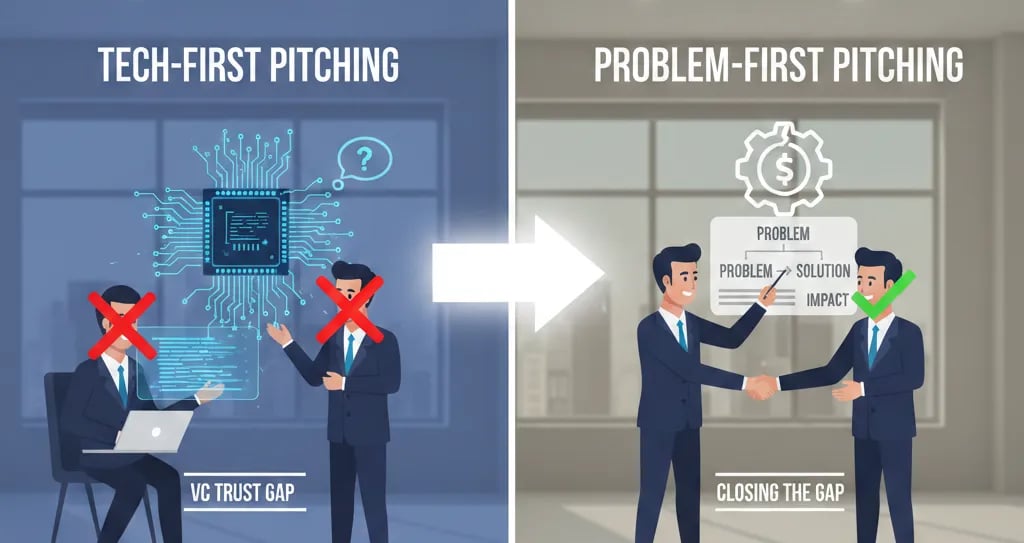
Tech-First vs. Problem-First Pitching: Closing the VC Trust Gap
You will not get a second meeting. And the slide that closed that door was not your financials, your team, or your market size — it was the moment you explained what your product does before you proved why anyone needs it.
That sequence error costs more Series A conversations than almost any other single structural mistake in the pitch. The VC is not following your logic; they are waiting for a reason to believe you understand the market you are entering. When you lead with technology, you signal that your primary frame of reference is the product, not the customer. For an investor who will spend the next seven years betting on whether customers will pay and stay, that is a disqualifying signal — and it arrives before you have said anything technically wrong. This post sits inside the Common Founder Mistakes on Problem & Solution Slides framework, because sequence is not a stylistic choice — it is a trust mechanism.
Why Tech-First Pitch Structure Reads as a Market Validation Gap to Series A Investors
The forensic issue is not that your technology is unimpressive. In most cases, it is genuinely sophisticated. The issue is that leading with it tells the VC, before you have said another word, that you built the solution before you owned the problem. That inference — right or wrong — triggers a specific diligence reflex: did this founder find real customers, or did they find a real engineering challenge?
Here is exactly what a tech-first Problem Slide looks like in practice. Slide 2 opens with an architecture diagram or a product screenshot. The copy reads: "We built a proprietary NLP layer that processes unstructured data 40x faster than legacy systems." The next slide attempts to retroactively justify why that matters. By that point, the VC is not evaluating your solution — they are auditing whether you actually understand the buyer's world, because you have given them no evidence that you do.
The psychological source of this error is almost always founder identity. Technical co-founders — particularly those coming out of engineering, ML research, or deep infrastructure backgrounds — instinctively anchor on what they built, because the build was the hard part. The problem felt obvious to them, so they skipped proving it to the room. I have reviewed this exact sequence in nine decks this cycle; in seven of them, the founding team had no commercial co-founder, and the pitch reflected that gap structurally before anyone opened their mouth.
The VC's internal monologue when they see tech-first framing is not hostile — it is transactional: "Show me the pain before you show me the painkiller." When you invert that order, you are asking them to trust the painkiller before they believe the pain exists.
The Cognitive Load Mathematics of Pitch Sequence: Why Order Is a Conversion Variable
The sequence of your pitch is not a narrative preference — it is a cognitive load calculation with direct conversion consequences.
The trust-building sequence a VC expects:
Problem → establishes that a painful, specific, financially material gap exists
Who it affects → proves the founder knows the buyer at a unit level
Why existing solutions fail → demonstrates market awareness, not just product awareness
Solution → now earns the right to be evaluated on its merits
When you jump to step 4 before completing steps 1–3, the VC must hold an open loop in working memory: "I do not yet know if this problem is real enough to justify caring about this solution." Every feature you describe while that loop is open registers at a fraction of its potential impact.
The math of that discount is not trivial. Consider two identical B2B SaaS products pitched with different sequencing to the same investor:
Tech-First Approach
Structure: Presenting the solution before a validated problem.
VC Trust Score (by Slide 5): Low. The investor is forced to retroactively construct a belief in the problem.
Likelihood of Diligence: Requires the investor to do the narrative work for you.
Problem-First Approach
Structure: Presenting validated pain before the mechanism of the solution.
VC Trust Score (by Slide 5): High. The solution is evaluated within the context of a proven need.
Likelihood of Diligence: High. The investor is already stress-testing the fit of the solution, rather than questioning the existence of the problem.
As of Q1 2026, top-tier US Series A funds report median diligence timelines of 8–12 weeks from first meeting to term sheet — down from the 2021 sprint cycle of 3–4 weeks. That extended window means your pitch must survive multiple internal retelling cycles, where partners relay your story to other partners without you in the room. A problem-first structure is retellable. A tech-first structure is not, because the logic only works when delivered in the original sequence by the founder who understands the internal connections.
The burn multiple implication is direct: A fund stress-testing your GTM efficiency at 1.5x burn or below needs to believe your ICP is clearly defined and urgently motivated. Tech-first pitching structurally delays proof of ICP clarity, which means the burn multiple assumption carries more risk than the same number in a problem-first deck.
The Problem-First Rebuild Protocol: How to Restructure Without Losing Your Technical Credibility
Switching to problem-first does not mean burying your technology or underplaying your IP. It means sequencing the architecture of belief before the architecture of the product.
Weak Version (Tech-First):
"Our proprietary vector database enables sub-10ms query responses across datasets exceeding 1B records. No existing infrastructure solution offers this at this price point."
This is technically impressive and strategically useless at slide 2. The VC has no context for why sub-10ms matters, who is currently suffering because they cannot get it, or what it costs them not to have it.
VC-Ready Version (Problem-First, same product):
"Enterprise fraud teams at mid-market fintechs are making $3M+ annual payout decisions on query responses that take 800–1,200ms — long enough for the fraud event to complete before the flag fires. Existing infrastructure vendors cannot get below 200ms at this data volume without a six-figure custom contract. We solve this at $40K ARR per seat."
The technology is identical. The sequence is inverted. Notice what the VC-Ready version does structurally:
Step 1 — Name the buyer at a firmographic level: "Enterprise fraud teams at mid-market fintechs." Not "financial services companies."
Step 2 — Quantify the consequence of the problem, not the problem itself: "$3M+ annual payout decisions" tells the investor what is at stake financially. "800–1,200ms" gives them a precise, verifiable failure metric.
Step 3 — Disqualify existing solutions with specificity: "Cannot get below 200ms at this data volume without a six-figure custom contract" is a competitive moat statement disguised as a problem slide. It kills two birds — validates the gap and positions your price simultaneously.
Step 4 — Price-anchor your solution inside the problem context: "$40K ARR per seat" lands differently when the reader already knows the problem costs multiples of that annually.
The governing framework here is Pain → Cost of Inaction → Why Nothing Else Works → Solution. Your technology enters the conversation at step 4, where it is welcomed rather than interrogated.
Three Death Traps When Founders Attempt the Problem-First Switch
1. Restating the problem in technical language. "The latency bottleneck in current vector retrieval architectures creates downstream inference degradation" is still a tech-first framing — it just uses the word "problem." If your ICP would not use that sentence to describe their Monday morning, rewrite it.
2. Treating the switch as cosmetic. Moving your product screenshot from slide 2 to slide 5 without rewriting the underlying logic of slides 2–4 does not fix the sequencing problem. The argument must be rebuilt, not just the order of assets.
3. Over-validating to the point of delaying the solution reveal. Problem-first does not mean spending six slides on pain. Two slides of precise, credible problem framing is the ceiling. Beyond that, you signal that you do not have a solution worth rushing to.
What Correct Pitch Sequencing Is Worth at the Pre-Money Negotiation Table
Problem-first structure is not a presentation preference — it is a valuation lever. When a VC believes the problem before they evaluate the solution, the solution is assessed on its merits. When they are still forming problem belief while you are presenting the solution, every feature is discounted by the uncertainty tax on the underlying need.
Founders who close this sequencing gap routinely report fewer "we need more time" deferrals — which, in plain language, means fewer stall cycles eating into their runway while the round drags. The full architecture for how your Problem and Solution Slides connect into a coherent investment narrative is inside the complete Series A Problem & Solution Slide system.
You can reverse-engineer this sequencing manually across forty hours of advisor feedback and pitch iteration, or you can deploy the 16 VC-Quality AI Prompts inside the $5K Consultant Replacement Kit in a single working session — each prompt is structured to force the problem-first logic before it lets you articulate a single product feature. The full Kit is $497. Access it at the VC-ready pitch deck optimization system at FundingBlueprint.
Funding Blueprint
© 2026 Funding Blueprint. All Rights Reserved.