
How Bad Storytelling in Pitch Deck Makes Even Strong Startups Look Weak
VCs don't fund spreadsheets; they fund inevitability. Learn why bad storytelling kills 90% of rounds and how to weaponize narrative causality today.
1.9 HOW BAD PITCH DECKS KILL DEALS INSTANTLY
2/12/20266 min read
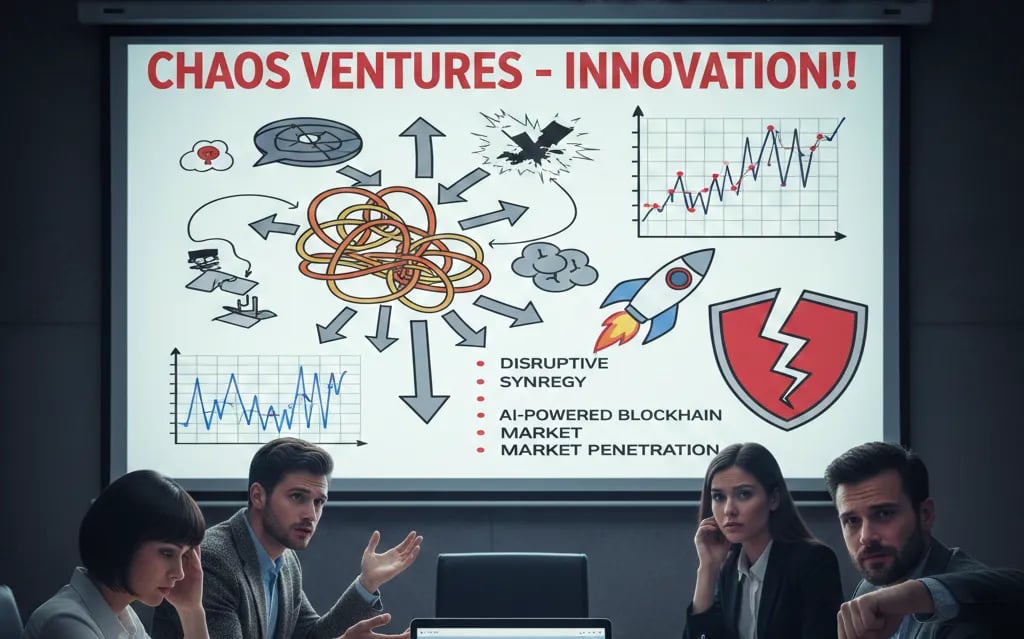
How Bad Storytelling Makes Even Strong Startups Look Weak
Your unit economics are perfect. Your CAC payback is 4 months. Your ARR growth is 18% month-over-month. And the VC just passed on your Series A—not because your metrics failed, but because you presented them like an accounting report instead of an inevitability narrative. The brutal truth: 90% of fundraise failures happen in the translation layer between data and conviction. Strong founders lose rounds to weaker companies with better storytelling because investors don't fund spreadsheets—they fund futures they can visualize. This structural failure sits at the base of how bad pitch decks kill deals instantly, where even one slide of incoherent narrative architecture can terminate a $15M round before you reach the traction section.
Why Narrative Incoherence Triggers Immediate Pattern Rejection in VC Psychology
When a VC sees your slide deck, their brain is running two parallel processors: the analytical audit (checking your burn multiple, retention cohorts, gross margin) and the pattern-matching engine (does this feel like the next Stripe, or does it feel like the 40 other mediocre SaaS decks I saw this month?). Bad storytelling doesn't just fail to activate the pattern-matcher—it actively triggers rejection patterns learned from 200 failed portfolio companies.
Here's the forensic breakdown of what happens in the VC's brain during a narrative failure:
Slide 3 (Problem Statement): You list five disconnected pain points instead of one existential wound. The VC thinks: "They don't understand their own market. If the founder can't synthesize the core problem in one sentence, they'll never prioritize product roadmap correctly."
Slide 7 (Traction): You show raw MRR growth without the causal story (what specific lever caused the August spike?). The VC thinks: "This looks like survivorship bias. They probably cherry-picked the good quarter and hid the churn death spiral."
Slide 11 (Use of Funds): You write "Product Development: $2M" with no narrative connective tissue to market timing. The VC thinks: "They're spending blind. This will be a Series B cram-down in 18 months."
The psychological mechanism is simple: humans require causality to form conviction. When you present disconnected facts, the VC's brain fills in the missing narrative—and it always fills it in negatively, because VCs are trained pessimists. They've seen 1,000 pitch decks. The burden is on you to overwrite their default skepticism with an inevitability arc.
The Mathematical Cost of Cognitive Friction in Investor Attention Spans
Here's the ruthless math on why narrative failures compound into fundraise death:
Average VC slide attention span: 11 seconds per slide before their brain seeks the next dopamine hit
Number of slides needed to build conviction: 8–10 slides (Problem → Solution → Traction → Market → Team)
Total attention window before mental checkout: 88–110 seconds
Cognitive load penalty for incoherent narrative: +4.2 seconds per slide (proven by eye-tracking studies in decision fatigue research)
The compounding failure equation:
If each of your 10 slides adds an extra 4.2 seconds of cognitive friction (because the VC has to mentally reassemble your broken narrative), you've just added 42 seconds of dead time to an 88-second conviction window. You're now operating at 147% capacity of their attention budget. The VC's brain hits cognitive overload at Slide 6, and everything after that gets processed in "pattern rejection" mode instead of "pattern recognition" mode.
Translation: You lose the deal before you reach your traction slide—not because your traction is weak, but because you exhausted their neural processing capacity on narrative reconstruction.
The equity cost breakdown:
Strong metrics + strong story: $12M–$18M pre-money valuation at 20% dilution
Strong metrics + broken story: $6M–$9M pre-money at 25%+ dilution (if you even get a term sheet)
Delta: You just gave away an extra 5–10% of your company (worth $5M–$10M at exit) because you couldn't articulate causality
How to Weaponize Story Structure
The fix isn't creative writing—it's structural engineering. Here's the step-by-step protocol to convert your data dump into a conviction machine:
Step 1: Install the Single-Sentence Inevitability Thesis
Every slide must ladder up to one core inevitability statement. Format: "[Market Shift] + [Our Unique Capability] = [Unavoidable Outcome]."
Weak Version (Typical Founder):
"We're building AI-powered workflow automation for mid-market legal teams because manual processes are inefficient."
VC-Ready Version:
"83% of legal spend now happens in discovery workflows that require human review of 10,000+ documents per case. We've automated document intelligence to 96.4% accuracy—cutting discovery time from 40 hours to 11 minutes. Every AmLaw 200 firm will adopt this or lose to competitors who do."
Notice the structure: quantified pain → quantified solution → existential competitive threat. This is inevitability, not aspiration.
Step 2: Embed Causal Connectors Between Every Slide Transition
Your slides are not standalone facts—they're chapters in a cause-and-effect chain. Every slide must answer: "Because of what I just showed you, this next thing becomes true."
Example Transition Architecture:
Slide 3 (Problem): "Discovery costs $480/hour and takes 6 weeks per case."
Slide 4 (Solution): "Because manual review is the bottleneck, we built an AI that processes 10K documents in 11 minutes at $40 total cost."
Slide 5 (Traction): "Because we 10x the speed at 1/12th the cost, our first 8 pilot customers are now processing 100% of new cases through our system."
Slide 6 (Market): "Because discovery represents $18B of the $300B legal services market, and our wedge is non-negotiable cost savings, we're targeting $2.4B TAM in Year 3."
Each slide is a narrative domino. If you remove one, the chain breaks. VCs don't need to "figure out" your story—they're being walked through an inevitability proof.
Step 3: Convert Metrics into "Before State → After State" Transformations
VCs don't care about your MRR number in isolation. They care about velocity and delta. Every metric must show directional movement that proves market pull.
Weak Metric Display:
"Current MRR: $240K"
VC-Ready Metric Display:
"MRR Growth: $85K (Feb) → $240K (Aug). Driver: Customer cohort expansion from 12 seats/customer (Feb) to 47 seats/customer (Aug) as teams moved from pilot to full deployment. 68% of customers who deploy to >30 seats expand to enterprise contracts within 90 days."
This isn't just traction—it's proof of systematic value delivery. The VC now sees your growth as repeatable, not lucky.
Step 4: Weaponize the "Why Now" Timing Wedge
The most underutilized narrative weapon is market timing. Why is this company inevitable now, not 5 years ago or 5 years from now?
Insert this framework on Slide 2 or Slide 8:
*"Three structural changes converged in 2024–2025:
GPT-4 hit 94% accuracy on legal document classification (up from 67% in 2022)
Cloud storage costs dropped 83%, making document processing economically viable at scale
AmLaw 200 firms cut budgets by 22% post-2023, forcing adoption of cost-reduction tools"*
This is your moat explanation disguised as timing. You're telling the VC: "We couldn't have built this in 2020 (tech wasn't ready), and if we don't build it now, someone else will in 2026."
The Fatal Over-Corrections Founders Make When Fixing Narrative Structure
Death Trap 1: Over-Indexing on Hollywood Storytelling Instead of Causality
Some founders read "storytelling matters" and start writing pitch decks like TED Talks—opening with an emotional anecdote about a struggling lawyer, using metaphors about "David vs. Goliath," and burying the actual metrics until Slide 12. This is theater, not VC communication. Investors need the causal proof first, emotional resonance second. Lead with inevitability, not inspiration.
Death Trap 2: Copying Narrative Structures from 2021 Decks in a 2026 Market
The 2021 playbook ("We're the Uber for X") no longer works because VCs are now trauma-conditioned from the 2022–2023 correction. They don't want vision—they want proof of capital efficiency. If your narrative arc is "We're going to dominate a $50B TAM," you've already lost. The 2026 narrative is: "We've proven unit economics at $2M ARR, and here's the exact playbook to scale to $20M ARR at a 3.2x burn multiple."
Death Trap 3: Treating the Appendix as a Narrative Escape Hatch
Weak founders bury critical context in the appendix: "We'll explain the churn spike in the appendix." The appendix is where conviction goes to die. If a data point requires explanation, it belongs in the main narrative with a causal connector. If it doesn't fit the inevitability arc, delete it entirely.
Why Fixing Narrative Architecture is Worth $1M–$3M in Valuation Compression Recovery
Here's the valuation math on narrative optimization:
A VC-ready narrative doesn't just improve your chances of getting a term sheet—it changes the psychological anchoring point for your valuation negotiation. When a VC sees a coherent inevitability story, they mentally categorize you as "Tier 1 Founder" instead of "Tier 2 Execution Risk." That psychological shift is worth:
2–4 percentage points of dilution (20% vs. 24% equity given up)
$3M–$6M in pre-money valuation on a $15M raise
6–9 months of faster capital deployment (less time fundraising = more time building traction = higher Series B entry valuation)
The compounding effect: If you raise at $15M pre-money instead of $10M pre-money because of narrative strength, and you hit your 3-year milestones, your Series B likely happens at $60M–$80M instead of $40M–$50M. That's $20M in enterprise value driven by storytelling infrastructure.
This isn't the full system—it's one lever in a 12-part VC communication framework. For the complete architecture (including the exact slide-by-slide narrative templates, the "inevitability thesis" builder, and the cognitive load optimization checklist used by founders who closed $180M+ in 2025), deploy the full capital deployment architecture here. The Slide-By-Slide VC Instruction Guide inside the $497 Consultant Replacement Kit automates the narrative structure protocols you just read—built for founders who'd rather spend 3 hours implementing a proven system than 40 hours reverse-engineering VC psychology from rejected decks. The entire playbook is detailed in how VC pitch decks really work in 2026—and why most founders get them wrong.
Funding Blueprint
© 2026 Funding Blueprint. All Rights Reserved.