
Pitch Deck Slide Order: Why Story Matters More Than Design
A $12,000 design won't save a pitch deck with a broken story. Learn why slide order controls 85% of a VC's decision and how to fix your sequence.
3.2 SLIDE ORDER & LOGICAL FLOW: HOW VCS ACTUALLY READ PITCH DECKS
3/6/20268 min read
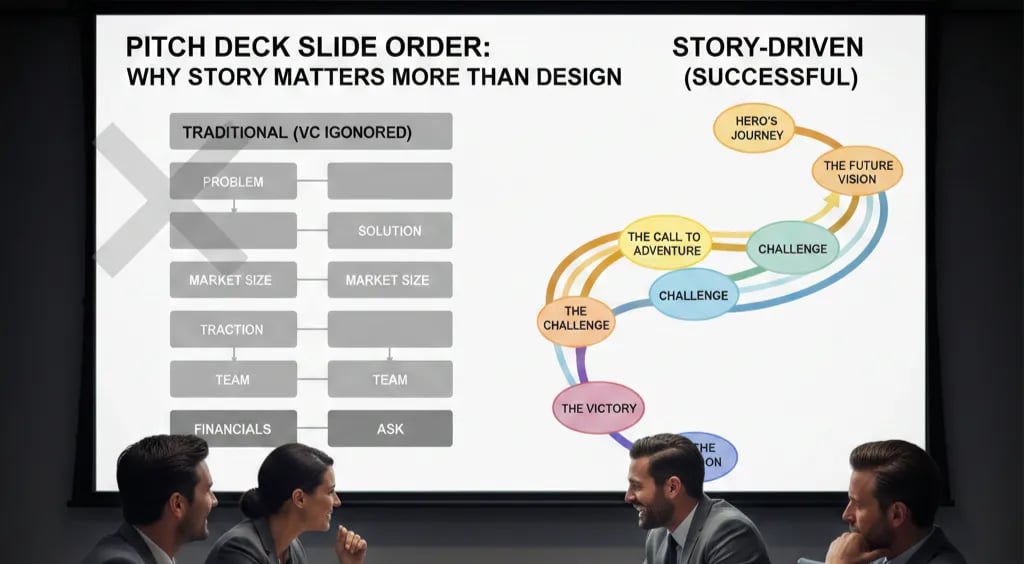
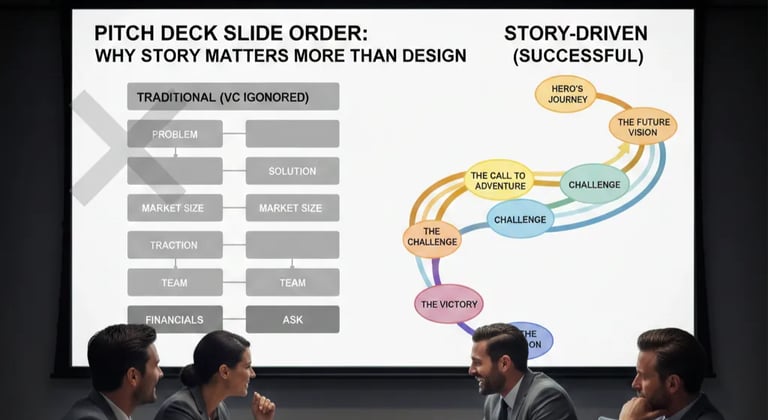
Pitch Deck Slide Order: Why Story Matters More Than Design
A B2B SaaS founder in the Midwest raised a $1.8M seed round, hired a $12,000 deck designer, and walked into four Series A partner meetings in a single quarter. All four passed. The deck was, by any visual standard, exceptional — clean typography, confident data visualisation, brand-consistent throughout. The problem was not the design. The problem was that the story was sequenced in the order the founder found it emotionally comfortable to tell, not in the order the investor needed to receive it. The Business Model appeared at slide 5, before traction had established that the model was proven. The Team Slide opened the deck because the founder believed his background was the strongest asset. The Market Size slide came last, after the Ask, as an afterthought. Four meetings. Four passes. One story problem dressed in exceptional design.
This is the distinction that separates fundable decks from polished ones: story order is not a creative preference — it is an investor psychology decision. The mechanics of how that sequencing decision maps onto how VCs actually process information are covered in detail inside the logical flow and slide order guide built around how VCs read pitch decks. This post addresses the specific question of why story architecture consistently outperforms design investment when the two are not built together.
You can fix design in an afternoon. A story built in the wrong order requires a full reconstruction.
Why Slide Order Is a Fundraising Variable, Not a Presentation Preference
The reason story order matters more than design at the Series A stage is mechanistic, not philosophical. A VC partner evaluating ten decks in a week is running a single continuous background process across all of them: "Does this founder understand their business well enough to be trusted with seven figures of institutional capital?" The answer to that question is derived almost entirely from the sequence in which information is presented — not from whether the slides use a grid layout or a full-bleed image.
Here is the precise mechanism: when a founder presents information in an order that serves their own comfort — leading with team because they are proud of their background, leading with product because they are excited about what they built, leading with market size because they want to establish scale before anything else — the investor receives each of those slides without the context required to evaluate them correctly. A Team Slide without an established problem reads as a credential list. A Product Slide without an established problem reads as a feature demonstration. A Market Size slide without established traction reads as an aspiration.
Design cannot fix context deprivation. A beautifully designed credential list is still a credential list. A visually sophisticated feature demonstration is still a feature demonstration. The slide is not the problem. The position of the slide is the problem — and no design investment resolves a sequencing failure.
The psychological driver behind this error is consistent: founders sequence their decks in the order they discovered the business, not the order an investor needs to evaluate it. They lead with team because the team was the starting point. They lead with product because the product was the breakthrough moment. They lead with vision because vision was what sustained them through the hard early months. All of that is emotionally coherent from the inside. None of it is investor-ready from the outside. I have seen this specific founder-perspective sequencing in over thirty decks reviewed across the last three quarters — in the majority of cases, the underlying business had genuine Series A merit that the story order was actively concealing.
The Story-vs-Design Proof: What Each Variable Actually Controls in a VC's Decision Process
Map both variables against the specific decisions a VC makes during a first-pass deck read:
What Design Controls:
Whether the deck feels like a credible, professional artefact within the first 8 seconds
Whether data visualisations are legible under time pressure
Whether the overall aesthetic signals that the founder takes presentation seriously
Total conviction impact: approximately 15–20% of the first-pass evaluation
What Story Order Controls:
Whether the investor builds progressive belief from slide 1 to the Ask
Whether each piece of information arrives with full context to be received correctly
Whether the deck can make its argument without the founder in the room to narrate it
Whether the investor can reconstruct the investment thesis from memory after closing the deck
Total conviction impact: approximately 80–85% of the first-pass evaluation
This split is not theoretical. As of 2025, the average Series A diligence timeline at top-tier US funds has extended to 10–14 weeks post-first meeting — the deck is reviewed multiple times by multiple people, most of whom were not in the original meeting. A deck that requires the founder's narration to hold together does not survive that multi-reader process. A deck whose story order is self-sustaining does.
The numbers break down further at the slide level:
A well-designed slide in the wrong position loses approximately 60–70% of its potential conviction impact because it arrives without the context that makes it credible
A plainly designed slide in the correct position retains full conviction impact because the investor is ready to receive it and believe it
A well-designed slide in the correct position represents the ceiling — but design is the multiplier on a story foundation that must already exist
The investment implication is direct: a founder who spends $10,000 on deck design before fixing their story order is spending $10,000 to make a sequencing failure look more expensive.
The Story-First Reconstruction Protocol: How to Re-Architect Slide Order Around Investor Psychology
The goal of this protocol is a deck where every slide arrives at exactly the moment the investor has been made ready to receive it — and not one slide earlier.
Step 1 - Identify Your "Comfort Sequence" and Invert It
Print your current deck order. Mark every slide that is positioned early because you find it compelling, rather than because the investor needs it early to maintain belief. Common comfort-sequence errors:
Team at slide 2 or 3 — you are proud of the team
Product demo or screenshots at slide 3 — you are excited about what you built
Vision or mission statement at slide 1 — you want to establish purpose before anything else
Business model at slide 4 or 5 — you want to prove commercial seriousness early
Each of these is a founder-logic placement. None of them are investor-logic placements. Identifying them is the first structural fix.
Step 2 - Apply the "Investor Readiness" Test to Each Slide
For each slide, ask a single question: "Has the investor been given everything they need — context, problem framing, proof — to receive this slide at full value?"
Weak Version (Team Slide at Position 2):
The team credentials are presented before the problem has been established.
The investor reads: "Impressive backgrounds. But I do not yet know what problem these people are solving, whether the market is real, or whether their backgrounds are specifically relevant to this opportunity." The slide is not evaluated — it is filed for later. When "later" arrives, the context has shifted and the team credentials land at a fraction of their potential impact.
VC-Ready Version (Team Slide at Position 9 — after Business Model, before Financials):
The investor now knows the problem, the solution, the traction, the market, and the business model. The team slide now answers the question the investor has been building toward since slide 3: "Is this the specific team qualified to execute this specific plan?"
The identical credentials land with full force because the investor now has the context to evaluate them against a concrete business requirement.
Step 3 - Build the "Belief Progression" Map
Lay out your slide order as a belief progression — a sequence of investor states moving from scepticism to conviction:
Orientation — "I understand what world this deck operates in"
Problem Recognition — "I believe this pain is real and specific"
Structural Urgency — "I understand why this has not been solved before and why now is the moment"
Solution Credibility — "I believe this mechanism addresses the root cause"
Proof Evaluation — "The traction confirms the solution works at early scale"
Market Ambition — "The opportunity is large enough to justify a venture return"
Commercial Logic — "The business model converts the opportunity into scalable revenue"
Execution Confidence — "This team can execute this specific plan"
Capital Clarity — "I understand exactly what I am being asked to fund and what it unlocks"
Each slide in your deck should correspond to exactly one state in this progression. If two slides address the same state, one of them is redundant. If a state is skipped, the investor arrives at the next state without the belief foundation required to hold it.
Step 4 - The "Stranger Test" for Story Independence
Send your deck — without a cover email, without context, without your name — to someone with financial literacy who does not know your company. Ask them one question after reading: "What is this company asking you to fund, and why should you?" If they cannot answer both parts clearly, your story order is not yet self-sustaining. A deck that requires the founder to narrate it is not a Series A deck. It is a presentation that needs a presenter.
Four Story-Order Fixes That Create New Problems
1. Correcting Slide Order Without Updating the Content of Each Slide Moving a slide to the correct position does not automatically update its content to fit the new context. A Team Slide moved to position 9 must be rewritten to answer the question the investor has at position 9 — not the question they had at position 2. Reposition and rewrite.
2. Using "Logical Order" Without Emotional Escalation A perfectly logical sequence that does not build emotional momentum produces a deck that is intellectually credible but not compelling. Logic creates evaluation. Emotion creates conviction. The story order must do both simultaneously — each slide must advance the argument and increase the investor's emotional investment in the outcome.
3. Treating the Problem Slide as a Single Beat One of the most common over-corrections: founders move the Problem Slide to position 1 but compress it to three bullet points in the interest of "getting to the solution faster." The Problem Slide must be given enough space to make the investor feel the pain before you offer relief. A compressed problem produces a solution that lands without urgency.
4. Rebuilding Story Order Based on a Single Investor's Feedback One VC's sequencing preference is not market signal — it is one reader's cognitive pattern. If you rebuild your entire story architecture after a single partner meeting, you risk optimising for one investor while breaking the logic for the next nine. Run story order changes across a minimum of three independent reader tests before finalising.
The Pre-Money Reality of Getting Story Order Wrong
The founder at the top of this post spent $12,000 on a designer and four months on partner meetings. The story order — not the design, not the team, not the metrics — was what closed the door in all four rooms before the ask was made. That is not a cautionary tale. It is a precise description of how capital is lost at the Series A stage by founders who invest in the wrong variable.
Story order is not a secondary consideration to be addressed after design is locked. It is the primary architecture. Design is the finish on a structure that must first be load-bearing. The complete system for building that structure — slide by slide, belief state by belief state — is documented inside the master framework for Series A pitch deck structure and narrative design.
Every week your deck runs on a story order built around founder comfort rather than investor psychology is a partner meeting where the logic breaks before the Ask slide and the follow-up email never arrives. The Slide-By-Slide VC Instruction Guide inside the $5K Consultant Replacement Kit is built specifically to close this gap — it maps the exact investor readiness state required at each slide position so that your story order holds under multi-reader diligence review without you in the room. The full Kit is $497. Access it through the investor-psychology-first pitch deck system for Series A founders.
Story is the structure. Design is the surface. Investors fund structures.
Funding Blueprint
© 2026 Funding Blueprint. All Rights Reserved.