
Pitch Deck Sequence Mistakes: How Founders Ruin Their Pitch Flow
Slide order isn't a stylistic choice; it's a VC conviction test. Learn why misplacing your Traction or Team slide kills your Series A pitch.
3.2 SLIDE ORDER & LOGICAL FLOW: HOW VCS ACTUALLY READ PITCH DECKS
3/6/20266 min read
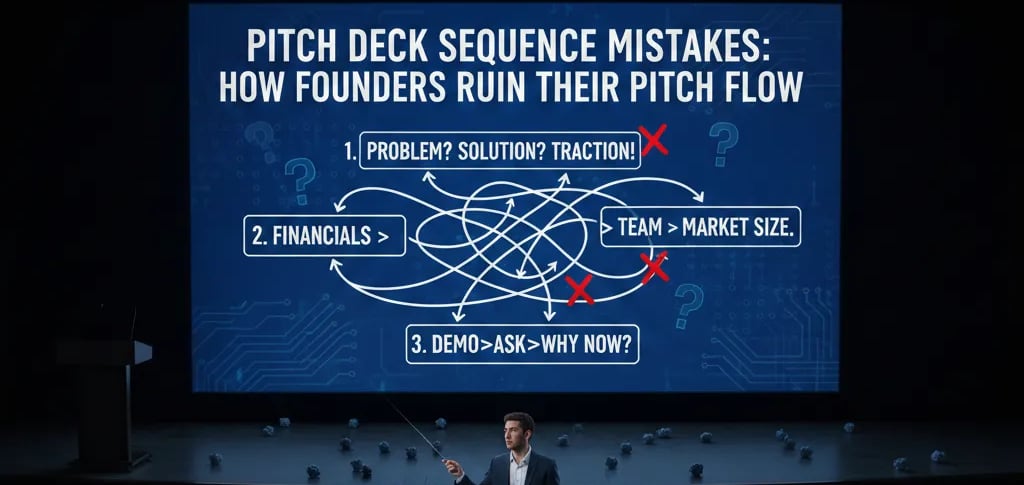
Pitch Deck Sequence Mistakes: How Founders Ruin Their Pitch Flow
Most founders believe slide order is a stylistic preference — something to optimise after the content is locked. It is not. Sequence is the argument. The order in which you present information is the single variable that controls whether a VC builds conviction progressively or hits a logic wall and mentally exits the room while still physically sitting in it.
This matters most at the Series A stage, when you are no longer selling a vision — you are selling a system. A system that does not sequence correctly does not read as a business; it reads as a collection of defensible points that never cohere into a thesis. The deeper mechanics of how investors process deck structure are documented inside the complete VC read-order breakdown for pitch deck slide logic and sequence — that framework is the context for everything in this post.
Sequence errors are not random. They follow four repeatable patterns. All four are fixable. None of them are obvious from inside the deck.
How Pitch Deck Sequence Errors Systematically Destroy Series A Conviction
The reason sequence errors are lethal is structural, not aesthetic. A VC reading a deck is running a continuous background process: "Does this founder understand cause and effect in their own market?" Every slide that appears before the investor is ready to receive it breaks that process — not because the slide is weak, but because it arrives before the context that makes it credible has been established.
The most common sequence error at Series A is placing the Solution before the Problem has been made specific enough to demand it. Founders do this because they are excited about their product. The VC, however, has no emotional investment in the product yet. They need to be forced to want the solution before they are shown it. A Solution Slide that arrives while the problem still feels abstract registers as a sales pitch, not an investment thesis.
The second most common error is presenting Market Size before Traction. This sequencing communicates, unconsciously, that you are leading with potential because you cannot lead with proof. In a 2021 market, potential was sufficient. As of 2025, the median Series A in the US requires demonstrated revenue traction — typically $1M–$2M ARR with a clear growth rate — before market size carries any weight in a partner conversation. Leading with TAM when you have traction is a sequencing error that buries your strongest asset. The last twelve decks I reviewed that opened with Market Size before Traction were structurally penalising founders who actually had strong numbers — the investors had already discounted the deck before reaching the proof.
The psychological driver is almost always template addiction. Founders download a "proven" deck structure from a pitch advice blog written in 2019 and populate it without stress-testing whether the sequence fits their specific narrative. Templates are starting points. They are not architecture.
The Sequence Damage Calculation: What Each Misplaced Slide Actually Costs You
Mis-sequenced slides do not just fail to land — they actively cost conviction that you have to rebuild. Map the damage numerically:
Scenario A — Solution Before Specific Problem:
Problem Slide is generic (industry-wide pain, no specificity on who and how badly)
Solution Slide arrives immediately after
Cost: VC has no emotional anchor. Solution is evaluated as a feature, not an answer. Estimated conviction loss: the investor is now auditing rather than believing
Scenario B — Market Size Before Traction:
TAM/SAM/SOM presented at slide 4
Revenue metrics arrive at slide 8
Cost: The investor has already mentally discounted the market opportunity because it arrived without proof. When traction appears at slide 8, it is too late — it reads as a footnote, not a lead argument
Scenario C — Team Slide Placed at Slide 3 (Pre-Traction):
Team credentials presented before the problem or solution
Cost: Without context for why this team is uniquely qualified for this specific problem, credentials read as generic. A Stanford MBA and a former Google engineer mean nothing before the investor knows what problem is being solved
Scenario D — Business Model After the Ask:
Financials and revenue model presented after the funding ask
Cost: The VC is being asked to commit to a number before understanding the monetisation mechanics. This is the single fastest route to a "we need more information before we can move forward" response — which is a soft no
The pattern across all four: the information arrives before the investor has been given a reason to care about it. That is a sequencing failure, not a content failure.
The Sequence Reconstruction Protocol: The Four-Step Re-Architecture Fix
The goal is not to follow a universal template. The goal is to build a sequence where each piece of information increases the investor's need for the next piece.
Step 1 — Establish the "Conviction Ladder"
Map your slides on a single axis: "At what point does the VC need this information to maintain belief?" Reorder your deck so that every slide arrives at exactly the moment it is most needed — not earlier, not later.
The standard conviction ladder for a Series A deck:
Hook / Framing — What world does this deck operate in?
Specific Problem — Who is suffering, how badly, and why now?
Why Now — What structural shift makes this solvable today?
Solution — What is the specific mechanism that addresses the root cause?
Traction — What does early evidence say about whether it works?
Market Size — Now that we believe the solution works, how large is the addressable opportunity?
Business Model — How does this convert into a scalable revenue engine?
Go-to-Market — How do you capture that market efficiently?
Team — Why are you the team to execute this specific plan?
Financials / Ask — What does the capital deployment look like and what does it unlock?
Step 2 — Apply the "Earned Right" Test
Before each slide, ask: "Has the investor earned the right to see this information — meaning, have I given them everything they need to receive it correctly?" If the answer is no, the slide is mis-sequenced.
Weak Version (Market Size at Slide 4):
The market for enterprise procurement software is $84B globally.
The investor has not yet seen your traction. This number floats without an anchor. It could be the market or it could be a founder inflating the category to justify a weak position.
VC-Ready Version (Market Size at Slide 6, after Traction):
We have $1.4M ARR across 18 enterprise accounts in 14 months. The addressable market for the specific procurement workflow we replace is $11B in the US alone — and we have penetrated 0.01% of it.
The same market number lands completely differently because the investor has already been given a reason to believe you can capture it.
Step 3 — Fix the Team Slide Placement
Move your Team Slide to after the Business Model and before the Financials. At that point, the investor knows exactly what the company needs to execute — and your team's credentials map directly onto those requirements. Before that point, credentials are abstract. After that point, they are evidence.
Step 4 — The "One Question" Sequencing Check
Read each slide. State the single question it should make the investor ask. Confirm that the next slide answers it. If it does not, swap slides until the question-and-answer chain is unbroken from slide 1 to the Ask.
Three Sequence Over-Corrections That Create New Problems
1. Over-compressing the Problem Slide to "Get to the Product Faster" Founders who recognise the Solution-before-Problem error sometimes respond by cutting the Problem Slide to two bullet points. A thin problem means a thin solution. Give the problem room to land before you answer it.
2. Moving Team to Slide 2 Because an Advisor Told You "VCs Back People First" This is true in seed rounds where there is no product. At Series A, where there is traction and a business model, leading with team before context signals that you know the company is not yet strong enough to lead with the business.
3. Resequencing Based on Feedback From One VC One investor's preference is not market signal. If you rebuild your entire sequence after a single partner meeting, you are optimising for one reader. Run at least three separate feedback cycles before restructuring the deck order.
The Fundraising Cost of a Mis-Sequenced Series A Deck
A sequence error does not reduce your valuation in negotiation. It prevents you from reaching negotiation. The founder who places Market Size before Traction, or Solution before a specific enough Problem, does not receive a lower offer — they receive a pass email that cites "not the right fit for our current thesis." The sequence was the thesis problem. The VC will not tell you that.
The four-step Sequence Reconstruction Protocol above — Conviction Ladder, Earned Right Test, Team Slide repositioning, One Question Check — is the structural fix. The complete system for every slide, including sequencing logic, narrative architecture, and investor framing, is inside the master framework for Series A pitch deck structure and slide design.
Founders who have used the 16 VC-Quality AI Prompts inside the $5K Consultant Replacement Kit go into partner meetings with a deck sequence that has already been stress-tested against the exact conviction ladder a VC analyst runs during first-pass review. That is not a marginal improvement — it is the difference between a deck that earns a second meeting and one that earns a polite pass. The full Kit is $497. Access it through the pitch deck system built to match what VC analysts are trained to look for.
Sequence is not structure. It is strategy. Build it with the same rigour you apply to your financial model.
Funding Blueprint
© 2026 Funding Blueprint. All Rights Reserved.