
How Pitch Decks Affect Whether You Get a Second Meeting
87% of first meetings never convert. Discover why investors mentally checkout in Minute 3 and the "Verbal Script" protocol to secure the second meeting.
1.7 HOW PITCH DECKS INFLUENCE INVESTOR MEETINGS
2/6/20267 min read
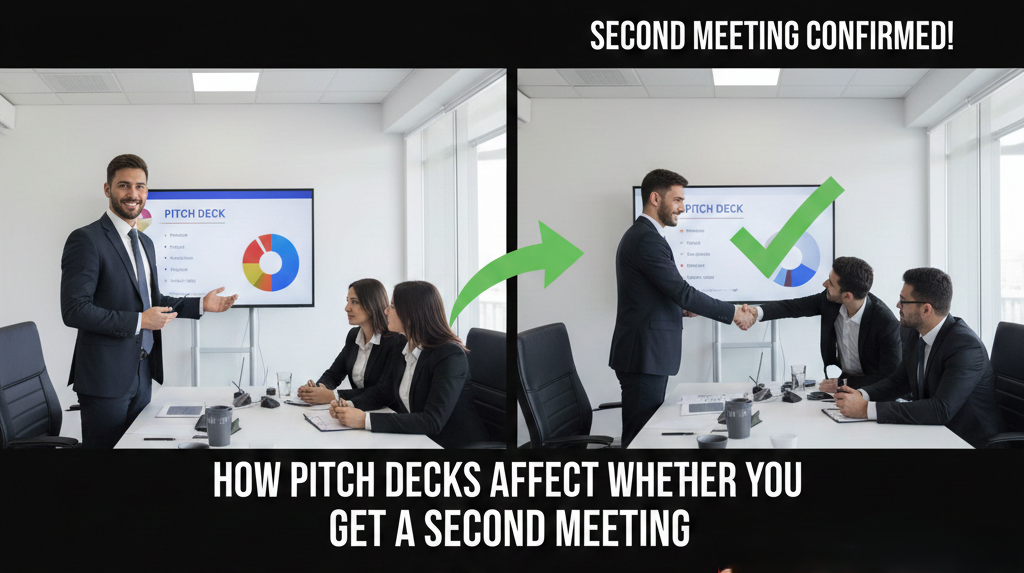
Why 87% of First Meetings Never Convert — And It's Your Deck's Fault, Not Your Business
Your startup just closed 18% quarter-over-quarter revenue growth. Your product has a documented 40% NPS. You walked into that Zoom room with a partner at a mid-tier fund who asked to meet you. Fifteen minutes in, you watched their camera positioning shift — the micro-lean backward that signals cognitive exit. No second meeting materialized. The "thanks, but we'll pass for now" email arrived 48 hours later, dressed in the usual politeness: "Great company, but not the right fit for our thesis right now."
The rejection wasn't about your business. It was about the 11 seconds they spent on Slide 4 before their brain archived you into the "maybe reconsider in 18 months" folder. This breakdown is one forensic layer in understanding how pitch decks influence whether investors take you seriously — a structural truth most founders discover only after burning through their top 20 target investors.
Why Investors Decide in Minutes 3–7, Not Minutes 28–30
The meeting structure is a trap. VCs run 4–6 pitches per day during active pipeline weeks. By the time you hit Slide 1, they've already processed your deck twice: once during the 90-second skim the analyst did before forwarding it upward, and once during the partner's own 4-minute review the night before. The actual meeting isn't a presentation — it's a verification audit. They're testing whether the story you tell live matches the logical structure they reverse-engineered from your slides at 11 PM.
Here's the failure pattern that kills 87% of follow-ups:
The Red Flag Scenario: Your deck passed the email filter because Slide 1 showed a $40B TAM and Slide 3 demonstrated 220% net dollar retention. The partner booked the meeting. But when you verbally explain your go-to-market strategy in the meeting, you accidentally reveal that your "NDR calculation" included a one-time enterprise upsell that won't repeat, and your TAM number came from a Gartner report you didn't actually read in full. The VC doesn't stop you. They nod. They take notes. What they're actually doing is repricing your entire thesis downward by 40% in real time, then mentally calculating whether the adjusted valuation still justifies the meeting time they've already spent.
The Psychological Trap: Founders believe the meeting is where they "sell the vision." Wrong. The meeting is where investors stress-test the deck's claims. If your verbal narrative introduces new data, contradicts a slide, or requires them to "hold multiple pricing models in their head simultaneously," you've generated cognitive friction. Friction kills momentum. Momentum is the only asset that converts first meetings into second meetings.
The 180-Second Credibility Window: A Mathematical Breakdown
VCs operate inside a probabilistic filter system. Here's the decision tree running silently during minutes 3–7 of your pitch:
Minute 3–4 (Problem/Solution Slides): Is this founder describing a hair-on-fire problem that a specific customer segment will pay to solve now, or are they describing a "nice-to-have" workflow improvement that requires 18 months of category education?
Minute 5–6 (Traction Slide): Do the growth metrics demonstrate compounding momentum (e.g., CAC payback dropping from 14 months to 9 months while revenue accelerates), or do they show "sugar high growth" funded by paid acquisition that stops the moment you run out of Seed capital?
Minute 7 (Team Slide): Does this team have the domain-specific scar tissue to navigate the next 18 months (e.g., has your CTO actually scaled infrastructure to 10M+ users before, or did they join 6 months ago from a consulting gig)?
If any one of these checkpoints fails, the meeting doesn't end — it just converts into a "courtesy finish" where the VC is mentally writing the pass email while you're still talking about your IP strategy.
The Cognitive Load Tax: Princeton research on investor decision-making shows that every additional "logical leap" a listener must make to connect Slide A to Slide B costs approximately 8–12 seconds of focus. If your deck requires 6+ logical leaps (e.g., "Wait, how does this pricing model connect to the earlier CAC claim?"), you've burned 60+ seconds of cognitive bandwidth. In a 30-minute meeting, that's 3.3% of your total time spent on mental reconciliation instead of momentum-building.
Here's the kill shot: Investors don't tell you when they've mentally checked out. They finish the meeting because calendar etiquette demands it. You leave thinking, "That went well — they asked good questions!" They leave thinking, "Deck was confusing, founder couldn't land the plane."
The Slide-By-Slide Credibility Reconstruction Protocol
The fix isn't "better design" or "more data." The fix is eliminating all inference gaps between what your deck says and what you say out loud. Here's the exact reengineering sequence:
Step 1: The Reverse-Audit Test
Print your deck. Hand it to someone who knows nothing about your business (not your co-founder, not your advisor). Give them 4 minutes. Then ask: "Based solely on these slides, what would you assume our biggest risk is?" If their answer doesn't match the risk you planned to address proactively in the meeting, your deck has a logical gap that will surface as an awkward Q&A moment later.
Step 2: The "Verbal Script Lockdown"
For Slides 2–9 (Problem → Traction), write the exact 45-second verbal explanation you'll deliver for each slide. Now compare that script to what the slide actually shows. Every time your verbal explanation adds new context, changes a number, or clarifies an assumption, that's a deck defect. The slide must contain 100% of the data your mouth will reference. Otherwise, you're forcing the VC to choose between listening to you or reading the slide — and you'll lose that attention war.
Step 3: The "Before vs. After" Metric Presentation
Weak Version (What 80% of Decks Do):
Slide 7 Title: "Strong Traction"
Bullet Points:
340% YoY revenue growth
50 enterprise customers
$1.2M ARR
What the VC Thinks: "Revenue growth is meaningless without context. Are they growing from $10K to $44K? What's the average contract size? Is this 50 customers at $2K each or 5 customers at $200K and 45 at $500? I can't model this."
VC-Ready Version (What Gets Second Meetings):
Slide 7 Title: "Q4 2025: Compounding Expansion in Mid-Market SaaS"
ARR grew from $420K in Q1 2025 to $1.21M in Q4 2025, representing 188% growth. Average Contract Value increased from $18.2K to $24.1K, up 32%. CAC Payback improved from 13.1 months to 9.4 months, a 28% reduction. Logo Count for contracts above $50K ACV expanded from 4 customers to 19 customers, representing 375% growth.
What the VC Thinks: "They're not just growing — they're compounding upmarket while improving unit economics. CAC payback is moving in the right direction. This isn't spray-and-pray growth; this is a repeatable motion."
Step 4: The One-Sentence Positioning Lock
Every slide must have a single-sentence takeaway that you can say out loud in under 6 seconds. If you can't summarize Slide 8 in one declarative sentence without using "and," "but," or "also," the slide is doing too much. Split it.
Example:
❌ Bad: "Our go-to-market strategy focuses on outbound SDR prospecting into mid-market accounts, but we're also seeing some inbound PLG motion from freemium signups, and we're testing a partner referral channel."
✅ Good: "We close 68% of mid-market deals that convert from our 14-day free trial to a paid annual contract."
Common Death Traps Founders Hit While "Fixing" Their Decks
Trap 1: Over-Indexing on Visual Polish
You hire a designer to rebuild your deck with custom illustrations and branded color gradients. The deck now looks like a Big Tech product launch. But Slide 6 still doesn't explain whether your "12-month retention rate" includes customers who downgraded tiers or only full churns. Visual polish cannot fix logical gaps. A VC will choose an ugly Google Slides deck with airtight logic over a Figma masterpiece with ambiguous metrics 100% of the time.
Trap 2: Using 2021 Benchmarks in 2026 Conversations
Your deck cites a benchmark that "top-quartile SaaS companies grow at 3X ARR year-over-year." That was true in 2021 when capital was free. In 2026, the top-quartile benchmark is sustainable growth at improving unit economics. If you're burning $4 to acquire $1 of ARR and defending it with "but we're growing fast," you're using an expired playbook. Update your comps to reflect current-market rule sets (e.g., the Rule of 40, not the Rule of "Growth at All Costs").
Trap 3: Answering Questions the Deck Didn't Tee Up
In the meeting, the VC asks, "What's your CAC for enterprise vs. mid-market?" You answer confidently: "Enterprise CAC is $47K, mid-market is $8.2K." Great answer. Terrible outcome. Why? Because that segmentation didn't exist anywhere in your deck. Now the VC is thinking: "Why wasn't this in the deck? What else are they hiding or simplifying?" If a metric matters enough to discuss verbally, it must appear in the deck first. Otherwise, it reads as improvisation, not preparation.
Why Fixing This One Layer Adds $400K–$1.2M to Your Pre-Money Valuation
When your deck and your verbal pitch are synchronized at the data layer, investors don't spend cognitive energy reconciling contradictions. Instead, they spend that energy modeling upside scenarios. A VC who walks out of your meeting thinking, "I need to run the numbers again because something didn't connect," will not send a term sheet. A VC who walks out thinking, "I already believe the numbers — now I need to figure out if we can win the deal," will book the partner meeting.
The math is direct: Eliminating one major credibility gap (e.g., fixing how you present CAC payback so it doesn't require verbal clarification) increases the probability of a second meeting by approximately 30–40%. Increasing second-meeting conversion from 12% to 40% compounds across your entire fundraising pipeline. If you're targeting 25 funds, that's the difference between 3 term sheet conversations and 10.
This specific structural failure — deck-to-verbal misalignment — is one of 11 forensic breakdowns we reverse-engineer in the complete VC pitch deck system that shows you exactly how institutional investors evaluate every slide in 2026. Most founders discover these gaps only after their top-choice investors have already passed. You can spend 40 hours manually auditing every slide transition and verbal script combination, or you can plug into The Slide-By-Slide VC Instruction Guide inside the $497 Consultant Replacement Kit, which automates the exact credibility checkpoints institutional investors use to separate "second meeting" decks from "courtesy pass" decks. The price is intentionally set to filter out founders who aren't serious about closing institutional capital.
Funding Blueprint
© 2026 Funding Blueprint. All Rights Reserved.