
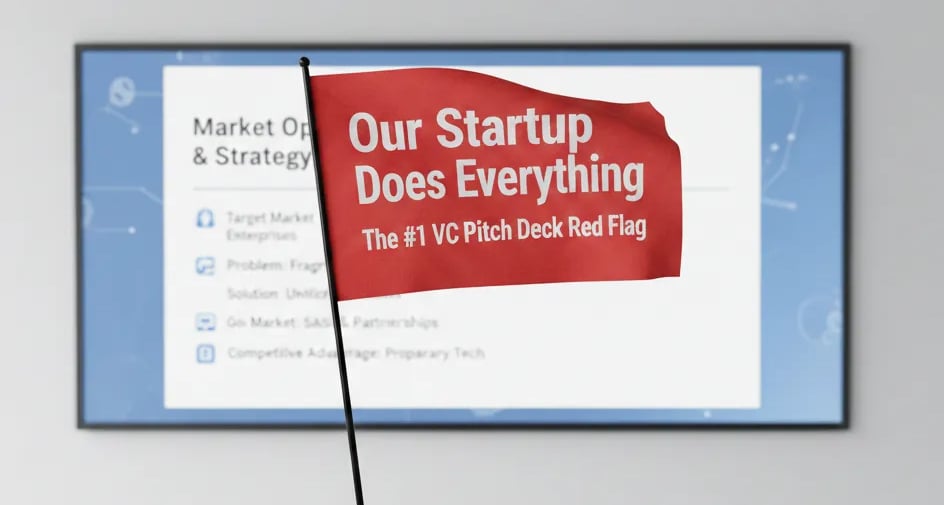
"Our Startup Does Everything": The #1 VC Pitch Deck Red Flag
Does your startup "do everything"? That is the #1 Series A red flag. Learn why "full-stack" positioning kills your pitch and how to build a Wedge-First narrative.
2.6 COMMON FOUNDER MISTAKES ON PROBLEM & SOLUTION SLIDES
2/24/20266 min read
"Our Startup Does Everything": The #1 VC Pitch Deck Red Flag
You Will Not Get a Second Meeting. Here Is the Solution Slide That Closed That Door Before You Left the Room.
You will not get a second meeting. Not because your product does not work, and not because the market is wrong — but because your Solution Slide listed seven capabilities in four categories across three user personas, and the partner across the table could not, after 45 seconds, answer one question: what does this company specifically do better than anyone else alive? That inability is not the VC's failure. It is yours. A solution that does everything is, in the language of Series A diligence, a solution that owns nothing — no defensible wedge, no clear expansion logic, no reason to believe you will win the first segment before attempting to win them all. This is one of the highest-frequency errors in the full taxonomy of Problem and Solution Slide mistakes that eliminate founders before slide 8. The mechanism of failure is specific and diagnosable.
Why "Full-Stack" Positioning on a Solution Slide Reads as Strategic Immaturity, Not Ambition
The clinical term for this error is scope diffusion — and it has a precise effect on how a VC processes your deck. When a Solution Slide presents multiple capabilities without a ranked primary use case, the partner cannot construct a mental model of your go-to-market. Without a go-to-market model, they cannot stress-test your CAC. Without a credible CAC, the rest of your financial model is decorative.
Here is what the VC is thinking, in sequence, when they see a multi-everything Solution Slide: "If they are solving seven problems, they have validated none of them. Their engineering resources are split. Their sales motion is undefined. Their ICP is whoever will take a meeting. This company is pre-product-market fit presenting as post-product-market fit." That conclusion takes approximately 20 seconds to form. The remaining 40 minutes of your pitch are spent trying to reverse a conviction that has already calcified.
In a partner meeting reviewed last quarter, a B2B infrastructure founder listed five distinct solution pillars on slide 5 — the VC's associate had flagged the deck as "unfocused" before the live session began, based solely on the executive summary.
The psychological origin of this mistake is almost always one of two things: genuine belief that breadth signals strength, or fear that a narrow solution will be perceived as a small opportunity. Both instincts produce the same outcome. Breadth without a ranked primary wedge does not signal strength — it signals that the founder has not yet made the hard strategic choices that a capital deployment decision requires. VCs are not funding your roadmap. They are funding your conviction about where you win first.
The Focus Tax: What Scope Diffusion Does to Your Fundable Metrics
The financial consequences of "we do everything" positioning are not theoretical. They run through every number in your model.
As of early 2026, top-tier US Series A funds are applying burn multiple benchmarks of under 1.5x as a baseline filter — meaning for every dollar burned, the expectation is at least $0.67 in net new ARR. That threshold is structurally incompatible with a diffuse go-to-market, and here is the arithmetic:
Scenario A - Focused Single-Wedge Go-To-Market
Ideal Customer Profile (ICP): Series B SaaS, VP of RevOps, 50–200 employees
Sales Cycle: 38 days due to high pain specificity
Fully-loaded CAC: $8,400
Annual Contract Value (ACV): $22,000
CAC Payback: 4.6 months
Burn Multiple: 1.2x
Scenario B - Multi-Persona, Multi-Use-Case Go-To-Market
Ideal Customer Profile (ICP): "Mid-market and enterprise across ops, finance, and HR"
Sales Cycle: 110 days due to an undefined buyer and committee sells
Fully-loaded CAC: $31,000
Annual Contract Value (ACV): $22,000
CAC Payback: 16.9 months
Burn Multiple: 3.4x
Same product. Same ACV. The only variable is focus. The burn multiple gap between these two scenarios — 1.2x versus 3.4x — is the difference between a term sheet conversation and a pass email. A VC looking at Scenario B does not see ambition. They see a company that will exhaust its Series A runway before achieving the ARR milestone required to raise a Series B at a non-dilutive valuation.
The Rule of 40 check compounds the damage further. A company burning at 3.4x with sub-30% growth is failing the Rule of 40 by the time they reach their 18-month mark — precisely the inflection point where Series B conversations begin.
The Surgical Fix: How to Restructure a Diffuse Solution Slide Into a Wedge-First Narrative
This is a positioning and sequencing problem, not a product problem. The goal is not to hide your breadth — it is to sequence it correctly so the VC understands the logic of your expansion after they believe in your entry point.
Weak Version (The "We Do Everything" Slide)
"Our platform provides end-to-end workflow automation, advanced analytics, cross-functional collaboration tools, AI-powered recommendations, and integrates with 200+ enterprise systems — serving operations, finance, HR, and customer success teams across mid-market and enterprise."
This sentence contains five capabilities, four departments, and two company stages. It has a primary audience of nobody. The VC cannot identify who buys this first, why they buy it today, or what "winning" in this market looks like at 24 months. This is not a Solution Slide. It is a feature catalogue.
VC-Ready Version (Wedge-First, Expansion-Sequenced)
"We automate revenue reconciliation for Series B–D SaaS finance teams — the single workflow that every company in this stage does manually and that breaks at $5M ARR. That is the wedge. Once we own the CFO's close process, we expand horizontally into FP&A forecasting and vertically into the data layer that powers both."
Three sentences. One primary capability. One named buyer. One expansion logic. The VC now has a mental model they can pressure-test.
The Wedge-First Framework — Three Structural Moves:
Move 1 — Name the Primary Use Case as the Lead, Not a Feature. Your Solution Slide headline should describe one thing your product does, for one type of buyer, in one operational context. Every other capability belongs in the appendix or the roadmap slide — not on slide 5.
Move 2 — State the Expansion Logic Explicitly. "We win here first, then expand into X because we own Y data/workflow/relationship." This is not limiting your pitch. It is demonstrating strategic sequencing — a competency that directly de-risks the VC's deployment decision.
Move 3 — Kill Every Feature That Does Not Serve the Wedge Buyer. If a capability on your Solution Slide does not make the primary ICP's decision to buy easier or faster, it is costing you credibility. Pull it. If it re-emerges in a follow-up question, that is the correct place for it — as evidence of depth, not as an upfront claim of breadth.
Three Death Traps When Founders Try to Narrow Their Solution Slide
Trap 1 — Narrowing the slide but not the pitch conversation. If your Solution Slide is focused but you spend 12 minutes in the meeting explaining all the other things your product does, the VC's original read — "unfocused" — is confirmed. The constraint must be consistent across the deck and the room.
Trap 2 — Calling a feature a wedge. A wedge is a complete, sellable, value-delivering use case that generates revenue independently. A dashboard, an integration, or a reporting module is not a wedge. If your "wedge" requires the buyer to also adopt three other features before they see value, your wedge is not yet ready — and your Series A may be six months premature.
Trap 3 — Using 2021 growth-at-all-costs logic in a 2026 efficiency market. In 2021, multi-market expansion from day one was fundable because growth velocity masked CAC inefficiency. In Q1 2026, the median US Series A pre-money sits at $22M–$28M, and lead investors are running explicit payback period screens before partner meetings. A diffuse go-to-market collapses that screen in seconds. Pricing your strategy on 2021 investor behaviour is a category error.
The Pre-Money Impact of Owning One Problem Completely
Focus is not a constraint on your valuation. It is the mechanism that protects it. A founder who can demonstrate that they own a specific wedge — with validated win rates, a repeatable sales motion, and a named expansion path — presents a fundamentally lower-risk deployment than a founder who claims to be building infrastructure for everyone. Lower perceived risk at the Series A stage compresses the discount a VC applies to your forward revenue multiple, which translates directly into a higher pre-money without changing your ARR. Fixing scope diffusion on your Solution Slide is not a narrative choice. It is a valuation lever. For the complete architecture governing how your Problem and Solution Slides must work in sequence to survive partner-level scrutiny, work through the full Series A Problem and Solution Slide system.
You can spend 40 hours iterating on positioning language across your deck, or you can use the Slide-By-Slide VC Instruction Guide inside the $5K Consultant Replacement Kit to apply the wedge-first framework to your Solution Slide in a single working session — with the exact structural logic a partner-level reader checks against. The full Kit is $497. If your current Solution Slide describes more than one primary use case, deploy the fix before your next deck leaves your outbox.
Funding Blueprint
© 2026 Funding Blueprint. All Rights Reserved.