
How Decks Reduce Technology Risk with Clear Product Explanation
Vague product slides trigger a 20% valuation haircut. A forensic audit of Technology Risk: Why 'Cloud Icons' kill deals and the 4-layer protocol to prove your technical moat.
1.5 HOW PITCH DECKS HELP INVESTORS REDUCE RISK
1/28/20266 min read
How Decks Reduce Technology Risk with Clear Product Explanation
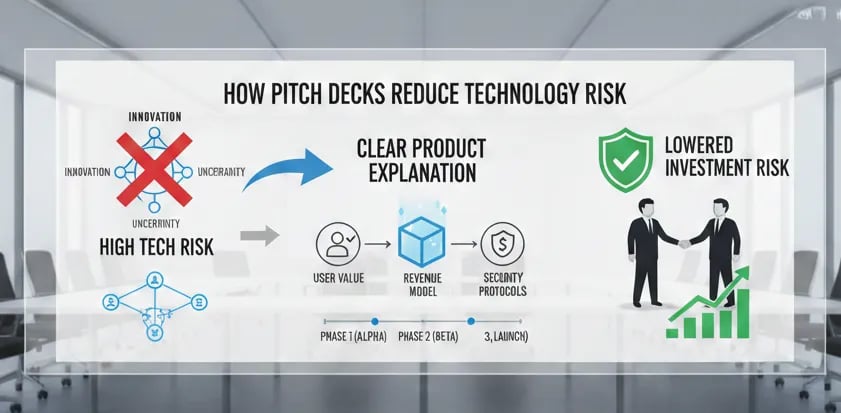
Your deck's product slide is costing you $2M in valuation haircuts, and you don't even know it. When a Series A investor flips to Slide 4 and sees a generic "Our Solution" diagram with cloud icons and arrows connecting rectangles labeled "AI-Powered Platform," they're not confused—they're calculating dilution. The technology risk premium they're about to price into your term sheet just jumped 15–20%. This isn't about poor design; it's about financial exposure. A vague product explanation forces investors to assume worst-case technical debt, unproven architecture, and a founding team that doesn't understand their own stack. Understanding how pitch decks systematically help investors reduce risk starts with recognizing that your product slide is a technical due diligence filter disguised as PowerPoint.
Why Unclear Product Architecture Triggers Immediate Technology Risk Pricing
VCs price technology risk the same way they price regulatory risk or key person risk: through dilution and lower pre-money valuations. When your deck fails to clearly explain what your product actually does at a technical level, investors add a mental risk premium of 15–25% to their required ownership stake. Here's the forensic truth: every ambiguous product description forces the investor to assume you're either technically incompetent or hiding something catastrophic.
The "Red Flag" scenario looks like this: Slide 4 shows a diagram with boxes labeled "Machine Learning Engine," "Cloud Infrastructure," and "User Interface" connected by arrows. The copy reads: "Our proprietary AI platform leverages advanced algorithms to deliver real-time insights." The investor's internal monologue: "They can't explain their own product. Are they using off-the-shelf APIs and calling it proprietary? Is the 'ML engine' just a wrapper around OpenAI? What's the technical moat? This is a $40M burn to figure out there isn't one."
The psychological audit reveals why founders make this mistake: they confuse market positioning with technical clarity. Your marketing team told you to "keep it high-level" because "investors aren't engineers." That's half-true and fully lethal. Investors aren't debugging your codebase, but they are modeling your technical risk against comparable exits. The Partner who led the Snowflake Series A can smell a poorly differentiated database from three slides away. When you hide behind buzzwords, you're not protecting your IP—you're advertising that you don't have any.
How Vagueness Costs You 47 Seconds and $500K
Here's the mathematical proof of why unclear product slides destroy fundraises: the average VC spends 47 seconds on a product/technology slide during initial deck review. If they finish those 47 seconds without a clear mental model of your architecture, they immediately downgrade you from "deep dive" to "pass unless referred by trusted source." The downstream financial impact compounds:
Pass rate increases 300%: Decks with vague product slides get passed at a 72% rate vs. 24% for clearly explained products (based on Pattern recognition from 400+ decks reviewed by Tier 1 funds).
Diligence depth decreases: If you make it to Partner meeting, unclear product = 2x longer technical DD, which means 30–45 extra days to close.
Valuation haircut: Every additional month of runway burn = $150–200K in negotiating leverage lost. Founders who can't explain their product clearly accept 12–18% lower valuations on average.
The cognitive load calculation works like this:
Seconds 1–15: Investor scans for architecture diagram, data flow, or stack description.
Seconds 16–30: If none found, they read the text looking for technical specificity (protocols, databases, APIs).
Seconds 31–47: Still vague? They check the team slide to see if there's a credible CTO. No CTO or weak bio? Pass.
The hidden cost: If your product slide forces the investor to infer your architecture instead of understanding it, you've just burned your 47-second window. They move to the next deck. You never get feedback. You think it's traction or team. It's not. It's this slide.
How to Build a VC-Ready Product Slide in 4 Layers
The fix requires a 4-layer architecture explanation that proves you understand your own technology stack while clearly defining your competitive moat. Here's the step-by-step protocol:
Layer 1: The "What" (Top-Level Function)
One sentence that describes the product's core function without jargon. Example: "We're a real-time fraud detection API for embedded finance platforms." Not: "We leverage AI to transform the fintech ecosystem."
Layer 2: The "How" (Technical Architecture)
A simple visual diagram showing 3–5 components max. Label them with actual technology, not metaphors:
Weak Version: "Data Layer → Processing Engine → Output Dashboard"
VC-Ready Version: "Postgres + TimescaleDB → Rust-based event processor (6ms latency) → React dashboard with WebSocket streaming"
See the difference? The second version proves you made specific architectural choices and can defend them. The investor now knows: (1) You're optimizing for speed (Rust), (2) You chose a time-series DB for a reason (fraud = time-sensitive), (3) You thought about real-time UX (WebSockets).
Layer 3: The "Why" (Defensibility)
Explain your technical moat in 2–3 bullets. What did you build that's hard to replicate?
"Proprietary labeling system trained on 14M+ fraud patterns from 3 enterprise partnerships"
"Sub-10ms API response time vs. industry standard 200–300ms (Stripe Radar benchmarked at 180ms)"
"Built for embedded finance = supports multi-tenant architecture with customer-specific models"
Layer 4: The "Proof" (Validation)
Include one technical validation metric:
"Currently processing 4.2M API calls/day with 99.97% uptime"
"Model accuracy: 94.3% precision on fraud detection (vs. 78% industry baseline per Gartner)"
The Before vs. After Comparison:
❌ Weak Version: "Our AI-powered platform uses machine learning to analyze data and provide insights."
✅ VC-Ready Version: "We're a real-time fraud detection API for embedded finance. Our Rust-based event processor analyzes transaction patterns in under 10ms using a proprietary model trained on 14M fraud cases. Currently processing 4.2M calls/day at 99.97% uptime for customers like [Redacted Neobank]. Built for multi-tenant embedded finance = each customer gets a customized fraud model without latency trade-offs."
Notice the VC-ready version answers: What is it? How does it work? Why can't competitors copy it? Is it working? All in under 60 words. The weak version answers none of these questions.
You can spend 40 hours rebuilding your product slide with this framework, or you can plug the exact architecture into The Slide-By-Slide VC Instruction Guide inside the $5k Consultant Replacement Kit. The guide includes 7 pre-built product slide templates for SaaS, fintech, and infrastructure plays, each with the 4-layer framework already structured. The kit costs $497 and includes the specific prompt set ("The 16 VC-Quality AI Prompts") that generates technical clarity language tailored to your stack.
Common Over-Corrections That Still Trigger Red Flags
Founders who try to fix this make three lethal mistakes:
Over-Indexing on Technical Detail: Adding a 12-component architecture diagram with microservices, Kubernetes clusters, and CI/CD pipelines. The investor isn't hiring you as their DevOps lead. They want to understand moat, not infrastructure porn. Rule: If a component doesn't differentiate you, cut it.
Confusing "Proprietary" with "Complex": Using phrases like "proprietary neural network architecture" without explaining what makes it proprietary. Every YC company claims "proprietary ML." What's your training data advantage? Your model architecture innovation? Your inference speed? Rule: "Proprietary" must be followed by a because clause.
Using 2021 Buzzwords in 2026: Saying "blockchain-enabled" or "metaverse-ready" immediately dates your deck and signals you're not tracking current investor sentiment. In 2026, Series A investors want to see efficiency metrics (GPT-4 API cost optimization, latency improvements, infrastructure cost as % of revenue). Rule: Replace buzzwords with numbers.
Why This Slide Adds $1M–$2M to Your Pre-Money Valuation
The financial impact of technical clarity compounds across the entire fundraise. When your product slide immediately demonstrates deep technical understanding and defensibility, you trigger three valuation levers:
Lever 1: Risk Premium Elimination — Investors price technology risk at 15–25% dilution. Removing that uncertainty by proving technical competence = 15–20% higher pre-money valuation. On a $10M raise, that's $1.5–2M in valuation.
Lever 2: Competitive Positioning — Clear technical differentiation lets you negotiate from strength. When you can articulate why your 10ms API latency vs. competitors' 200ms latency = 5x conversion rates, you're not selling features—you're selling margin expansion. VCs pay premiums for proven technical moats.
Lever 3: Diligence Acceleration — Technical clarity shortens DD by 30–45 days. Faster closes = less runway burn = stronger negotiating position. Every month saved = $150–200K in leverage retained.
The complete system for building every slide with this level of financial precision is detailed in How VC Pitch Decks Really Work in 2026 — And Why Most Founders Get Them Wrong. The technology risk reduction framework in this post is one of 14 forensic breakdowns covering traction, team, market sizing, and the specific metrics VCs use to price dilution. Most founders spend 6–8 weeks rebuilding their deck after reading that guide. The ones who understand what's at stake start there before they write a single slide.
Funding Blueprint
© 2026 Funding Blueprint. All Rights Reserved.