
The Problem-Solution-Traction Pitch Deck Structure That Converts
VCs don't read slides; they read causal chains. Learn how a broken Problem-Solution-Traction sequence gets your Series A deck archived by analysts.
3.1 CORE PITCH DECK STRUCTURES: HOW VCS RECOGNIZE SIGNAL VS NOISE
3/4/20266 min read
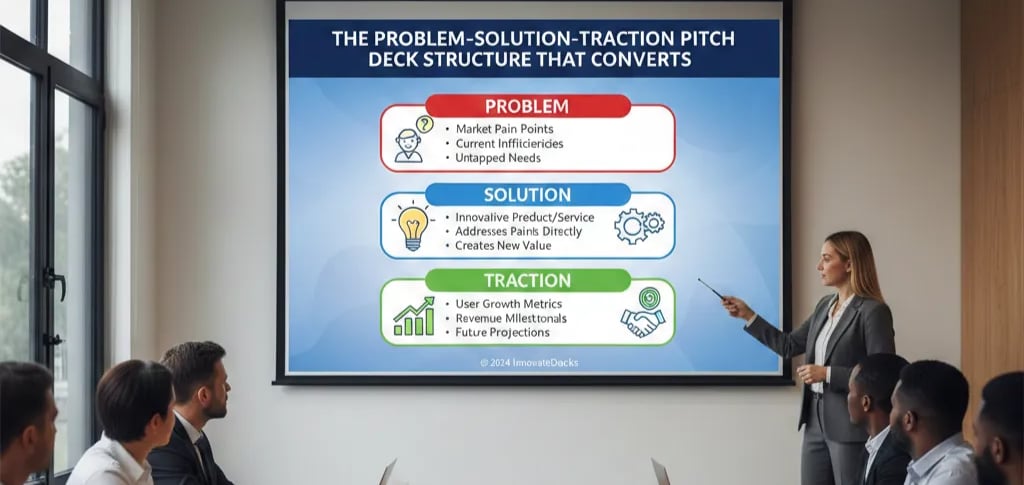
The Problem-Solution-Traction Pitch Deck Structure That Actually Converts at Series A
$3.2M in seed funding is the average amount raised by founders who never reach a Series A close. Most of them had a working product. Several had revenue. What they did not have was a pitch structure that moved a VC from "interesting" to "convinced" inside a single sitting.
The Problem-Solution-Traction sequence is not a storytelling preference. It is a belief-transfer mechanism — and when it is constructed incorrectly, even a strong business reads as a weak opportunity. The mechanics of why that happens, and how to fix it, are covered inside the broader framework of Core Pitch Deck Structures: How VCs Recognise Signal vs Noise. What follows is a forensic breakdown of exactly where this specific structure fails, and the precise architecture that makes it convert.
Why the Problem-Solution-Traction Arc Collapses Before the VC Reaches Your Revenue Slide
The failure is not usually in the data. It is in the causal chain.
Most founders treat Problem, Solution, and Traction as three separate slides making three separate arguments. A VC reads them as a single logical sequence: here is a real pain, here is our answer to it, and here is the market confirming we are right. If that chain breaks at any link, the entire structure loses its persuasive force — and the VC does not keep reading to find where the logic recovers.
The most common break point is the Problem slide. Founders write problem slides that are either too broad ("SMBs struggle with cash flow") or too product-adjacent ("existing tools don't integrate well with our workflow"). The first tells the VC nothing specific enough to price the opportunity. The second tells them you are building a feature, not a company. In both cases, the Solution slide that follows is already floating without an anchor — because the VC has not yet accepted that the problem is expensive, urgent, and structurally unsolved.
In a deck reviewed last quarter, a B2B SaaS founder framed the Problem slide around a workflow inefficiency that affected 15% of their target users — the VC passed before reaching the Traction slide, noting the problem "lacked sufficient pain intensity to justify the acquisition cost at scale."
The psychological driver behind weak problem framing is almost always founder proximity. You have lived inside this problem for two years. You stopped needing to be convinced of its severity before you wrote the first line of code. The slide inherits that assumption — and the VC does not share it yet.
The Belief-Transfer Equation: Why PST Math Only Works in One Direction
The Problem-Solution-Traction structure has a directional logic that cannot be reversed or compressed without destroying its conversion power. Here is why, expressed as a decision sequence:
Step 1 — The Problem must establish three things simultaneously:
The pain is real and affects a definable population
The cost of the pain (in dollars, time, or strategic risk) is quantifiable
No adequate solution currently exists at scale
If any one of these three is absent, the VC's internal risk model does not activate in your favour. A problem that is real but cheap gets no capital. A problem that is expensive but already solved gets no capital. A problem that is unsolved but affects a population too diffuse to reach efficiently gets no capital.
Step 2 — The Solution slide must answer a specific question the Problem slide created:
Problem Statement
Weak: Simply states that invoicing is slow for SMBs.
VC-Ready: Uses specific data, noting that US SMBs lose $1.1T annually in delayed receivables, with 60% concentrated in manual-process businesses with under 20 employees.
Solution Statement
Weak: Describes the product as a "faster invoicing tool".
VC-Ready: Specifies that they automated the collections layer (rather than the invoice) and reduced DSO from 47 days to 11 days for sub-20-employee service businesses.
Traction Statement
Weak: Mentions having "200 customers, growing fast".
VC-Ready: Highlights hard metrics: $61K MRR, 22% MoM growth, an average DSO reduction of 36 days within 90 days of activation, and NRR at 124%.
The VC-ready version does not contain more information. It contains causally linked information. The Solution slide is answering the specific quantified cost established on the Problem slide. The Traction slide is confirming the Solution actually delivers the outcome the Problem demanded. That is the chain. Break it, and you have three strong individual slides that do not build into a conviction.
As of early 2026, top-tier US Series A funds are running structured analyst pre-screens that score decks on "narrative coherence" before escalating to partners — a shift driven by higher inbound volume post-2024 and tighter partner bandwidth. A structurally incoherent PST sequence is filtered at the analyst layer. It never reaches the room where the capital decision is made.
The Burn Multiple Implication: A traction slide that does not directly confirm the problem costs you credibility on your burn figures. If your burn multiple is 1.8× and your traction slide shows revenue growth without linking it to problem resolution, the VC cannot assess whether your CAC is justified. The PST chain is not just narrative — it is the backbone of your unit economics story.
The VC-Ready Problem-Solution-Traction Build Protocol
This is the construction sequence. Follow it in this order.
Phase 1: Reverse-Engineer the Problem Slide from Your Best Customer Data
Do not write the problem from your hypothesis. Write it from the three customers with the highest NPS and the fastest time-to-value. Ask them: what was the cost of this problem before you found us? What had you already tried? What would you have paid to fix this permanently?
The answers give you the quantified pain, the failed alternatives, and the urgency signal. Those three elements are the entire content of a VC-ready Problem slide.
Weak Version: "Marketing teams waste time on manual reporting."
VC-Ready Version: "Mid-market B2B marketing teams spend an average of 14 hours per week on manual attribution reporting. At a fully-loaded cost of $85/hour for a senior analyst, that is $61K per year, per team — for a function that produces no revenue and is wrong 40% of the time due to attribution model gaps."
Phase 2: Write the Solution Slide as a Direct Response, Not a Feature List
Every word on your Solution slide should be answering the specific cost or failure mode named on your Problem slide. If your Problem slide quantified a $61K annual cost, your Solution slide must tell the VC how that cost is eliminated, reduced, or converted to revenue.
Weak Version: "Our platform automates marketing reporting with AI-powered dashboards."
VC-Ready Version: "We eliminated the attribution gap by building a first-party data layer that auto-reconciles across all paid channels. Implementation takes four hours. Reporting time drops to under 20 minutes per week in the first month."
Phase 3: Build the Traction Slide as Outcome Confirmation, Not Activity Proof
Traction slides fail when they report activity (customers, downloads, signups) instead of outcomes (revenue growth, retention, payback period, NRR). A VC does not want to know how many people tried your product. They want to know whether the people who tried it experienced the outcome your problem slide promised.
Your Traction slide must answer: Did your solution actually solve the problem at the cost structure the model requires?
The specific metrics that convert at Series A in 2025–2026: MRR with a 3-month growth rate, NRR above 100%, CAC payback under 18 months, and at least one cohort retention chart showing behaviour over 12+ months. A Traction slide with all four of these, causally linked to the Problem slide's quantified pain, is structurally difficult for a VC to pass.
Four Death Traps Inside the PST Build That Silently Kill Conversions
1. The "Problem-Solution Gap." Your Solution does not directly address the specific cost or failure mode named in your Problem. You quantified pain on slide 2 and then described features on slide 3. The VC sees a founder who does not understand their own value proposition.
2. Traction Without Attribution. Reporting $80K MRR without connecting it to the problem resolution mechanism. The VC cannot assess whether your growth is signal or noise. "Customers pay us" is not traction. "Customers pay us to eliminate a cost they can measure" is.
3. Sequencing Traction Before Market Size. Some founders move Traction immediately after the Problem to front-load credibility. This collapses the Solution's role in the chain and forces the VC to evaluate your revenue without knowing why the market is large enough to justify scaling it.
4. Over-Quantifying the Problem, Under-Proving the Solution. A precision mismatch — a Problem slide that cites three industry studies followed by a Solution slide with two bullet points and a screenshot — signals that you understand the market better than your own product. That is a team confidence risk at Series A.
What a Structurally Sound PST Sequence Is Worth at Pre-Money Negotiations
A coherent Problem-Solution-Traction chain does not just get you into the room. It compresses the diligence timeline, which directly affects your negotiating leverage. When a VC's analyst can reconstruct your causal logic from the deck alone, there are fewer open questions in the partner meeting. Fewer questions means a faster path to term sheet. A faster path to term sheet means less time in a process where competing founders are also pitching into the same fund's allocation.
The full system for building pitch sequences that survive partner-level scrutiny is inside the Pitch Deck Slides Structure & Frameworks resource — the architecture is there for founders who are building for capital efficiency, not just capital access.
Every week your PST structure remains disconnected is a week you are sending a deck that cannot transfer belief — only report facts. The Slide-By-Slide VC Instruction Guide inside the $5K Consultant Replacement Kit maps the exact causal logic each of these three slides must satisfy before the VC advances your file. Founders who have used it walk into partner meetings with a PST chain already calibrated to what the analyst pre-screen is checking for. That is not a marginal improvement. The full Kit is $497. Access it at the Slide-By-Slide VC Instruction Guide for PST Deck Structures.
The VC does not need to believe in your product. They need to believe in your chain. Build the chain correctly, and the product sells itself.
Funding Blueprint
© 2026 Funding Blueprint. All Rights Reserved.