
Premature Monetization: Why Pricing Doesn't Belong on the Solution Slide
Is there a pricing table on your Solution slide? That sequence error kills Series A deals. Learn why VCs hate premature monetization and how to fix it.
2.6 COMMON FOUNDER MISTAKES ON PROBLEM & SOLUTION SLIDES
2/25/20266 min read
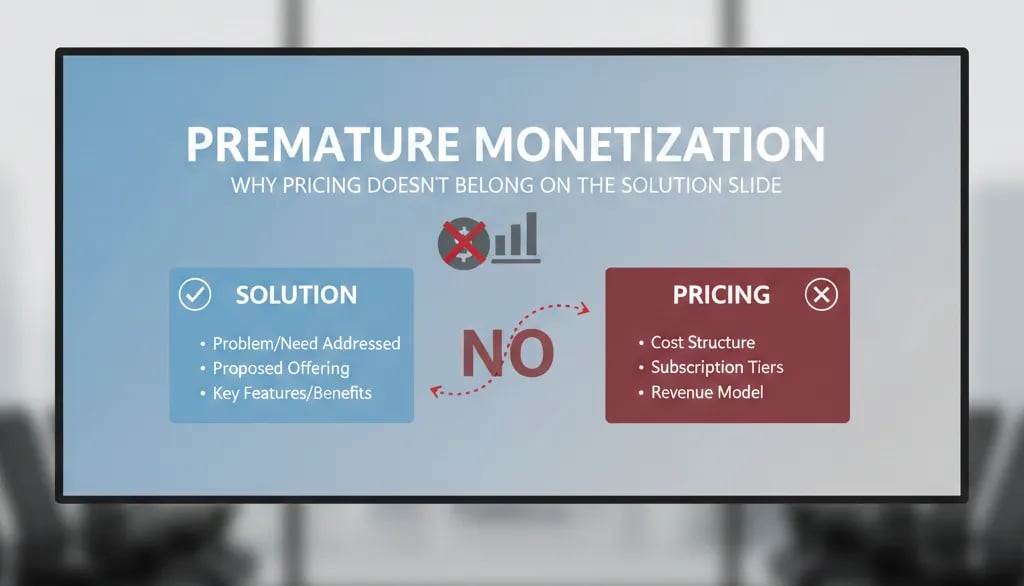
Premature Monetization: Why Pricing Doesn't Belong on the Solution Slide
$180,000. That is the approximate cost — in dilution, lost valuation headroom, and wasted runway — of a single pricing line appearing on the wrong slide at the wrong moment in a Series A pitch.
A founder in B2B SaaS raised a $2.8M seed round, built to $310K ARR, and arrived at Series A conversations with a deck that by every structural measure was competent. Problem Slide: specific. Market Sizing: defensible. Team: credible. Then, on slide 6 — the Solution Slide — sat a pricing table. Three tiers. Monthly and annual toggles. A "most popular" badge on the middle column. The VC partners read it, exchanged a look the founder did not catch, and spent the next four minutes asking questions about pricing rationale instead of product differentiation. The round took nine months to close at a pre-money $4M below the founder's initial anchor. The pricing table on slide 6 is where that gap began. This is part of the forensic breakdown inside the Common Founder Mistakes on Problem & Solution Slides framework — because premature monetization is not a pricing mistake, it is a sequencing mistake with valuation consequences.
Why a Pricing Table on the Solution Slide Signals Strategic Immaturity to Series A Investors
The Solution Slide has one job at Series A: make the VC believe your mechanism is the right answer to the problem you just proved. Pricing is not part of that job. When it appears there, it does not demonstrate commercial sophistication — it demonstrates that the founder has not separated the concepts of product value and product economics in their own thinking.
Here is the precise failure mode. The founder places pricing on the Solution Slide because they want to signal traction and commercial readiness. The logic feels sound internally: "We have paying customers. That proves validation. Showing the price proves we are not pre-revenue hand-waving." What the VC reads instead is: "This founder does not know what this slide is for."
The moment pricing appears on the Solution Slide, the VC's attention fractures. Instead of evaluating whether the solution mechanism is credible and defensible, they are now running a parallel mental audit: Is this price too low for enterprise? Too high for SMB? Does this pricing model suggest they have not figured out their ICP yet? Is the middle tier priced by cost-plus or by value? Every one of those questions pulls cognitive bandwidth away from the architecture of belief the slide was supposed to build. In a deck reviewed in Q4 2025, a vertical SaaS founder included a three-tier pricing grid on the Solution Slide alongside a product screenshot — the lead partner flagged it in the debrief as evidence the team was "still thinking like a product company, not a market company."
The psychological error underneath this mistake is the conflation of proof with persuasion. Founders put pricing there to prove they are real. But at Series A, what persuades is narrative sequence — and pricing, introduced before the VC has fully bought the solution logic, reads as anxiety, not confidence.
The Cognitive and Financial Mathematics of Slide Sequencing: What Premature Pricing Actually Costs
The damage from a pricing table on the wrong slide operates on two levels simultaneously: cognitive disruption in the room and valuation compression downstream.
The cognitive disruption calculation:
A VC partner's average attention budget per slide in a first meeting is approximately 90–120 seconds. That budget is finite. When pricing appears on the Solution Slide, that time is redistributed as follows:
Problem-Solution Slide Without Pricing
Solution mechanism evaluation: Receives the majority of attention at ~80%.
Competitive differentiation assessment: Receives ~20% of the attention.
Pricing model interrogation: Receives 0% attention.
Solution Slide With Premature Pricing
Pricing model interrogation: Becomes the primary focus at ~45%.
Solution mechanism evaluation: Drops significantly to ~35%.
Competitive differentiation assessment: Remains steady at ~20%.
The VC is now spending nearly half their Solution Slide attention on a question you were not ready to answer in that moment — because you have not yet established the value context that makes your price defensible.
The valuation compression mechanism:
As of early 2026, top-tier US Series A funds are applying revenue multiple ranges of 6x–10x ARR for B2B SaaS — a significant compression from the 15x–20x multiples of 2021. In that environment, every piece of evidence that introduces uncertainty into your pricing model directly affects the multiple a VC is willing to apply. A founder who cannot defend why their pricing is structured the way it is — because the question arrived before the value narrative was complete — hands the VC a compression argument before the negotiation has formally started.
The sequencing equation is precise:
Solution Slide = Mechanism + Differentiation + Proof of Fit. Pricing belongs in: Business Model Slide (slide 8–10 in a standard Series A deck), where it is evaluated in the context of your unit economics, CAC payback period, and gross margin architecture — not against a half-formed understanding of your product.
The Solution Slide Rebuild Protocol: Separating Mechanism from Monetization Without Losing Commercial Credibility
The fix is not removing all evidence of commercial reality from the Solution Slide. It is replacing pricing with the commercial signals that actually serve the slide's purpose.
Weak Version (Premature Monetization):
[Product screenshot] "InvoiceIQ automates three-way matching across ERP, PO, and invoice data in real time. Starter: $299/mo | Growth: $799/mo | Enterprise: Custom"
The pricing is doing no work here. The VC does not yet know who the buyer is at a unit level, what the competitive landscape looks like, or why the mechanism is defensible. The price floats in a vacuum and creates questions it cannot answer.
VC-Ready Version (Mechanism-First, Commercial Signals Intact):
"InvoiceIQ eliminates manual three-way matching for AP teams processing 500+ invoices monthly — reducing close cycle time by an average of 6.2 days, validated across 18 mid-market customers. Deploys via API into NetSuite and SAP in under 72 hours. No professional services required."
Notice what this version does and does not include:
Step 1 — Name the precise mechanism: "Eliminates manual three-way matching" tells the VC exactly what the product does operationally, not just what category it sits in.
Step 2 — Quantify the outcome, not the feature: "6.2 days reduction in close cycle time" is a business metric the buyer's CFO cares about. It is also the foundation of your pricing justification — which you will build on the Business Model Slide, in context.
Step 3 — Prove deployment credibility: "72 hours, no professional services" eliminates a specific Series A objection — implementation risk — without requiring a separate slide.
Step 4 — Anchor customer validation here, price elsewhere: "18 mid-market customers" signals commercial traction. The VC now knows you have paying customers. They do not need the price on this slide to believe that. The price will land harder on the Business Model Slide, where you can pair it with LTV, CAC payback, and gross margin — the context that makes it defensible.
The governing framework: Your Solution Slide should make the VC want to know what you charge. Your Business Model Slide should answer that question with a number they cannot argue with.
If a VC finishes your Solution Slide and their first question is "what does it cost?" — that is a win. It means the mechanism was compelling enough to trigger commercial curiosity. If their first question is "why is the Growth tier $800?" — you have given them the price before they believed the value, and you will spend the rest of the meeting defending a number instead of selling a thesis.
Three Death Traps When Founders Try to Fix Premature Monetization
1. Removing pricing but leaving pricing language. Replacing a pricing table with phrases like "affordable enterprise-grade solution" or "accessible pricing model" is not a fix — it is a vague price signal that triggers the same interrogation without giving the VC anything concrete to evaluate. Either price it in context or omit the reference entirely on this slide.
2. Moving the pricing table to slide 7 without rebuilding the business model narrative. Pricing does not become defensible by changing its slide number. It becomes defensible when it is surrounded by gross margin data, CAC payback periods, and customer cohort behaviour. If your Business Model Slide is just a relocated pricing table, the underlying problem is intact.
3. Anchoring price to cost-plus logic in 2026. In the current funding environment, VCs are stress-testing value-based pricing as a signal of market understanding. If your pricing rationale, when asked, is "we looked at our costs and added a margin" — that is a strategic red flag at Series A, regardless of which slide the table lives on.
What Correct Slide Sequencing Recovers at the Pre-Money Valuation Anchor
Separating your Solution Slide from your monetization argument is not a presentational preference — it is a valuation recovery mechanism. When the VC fully believes your solution mechanism before they evaluate your price, the price is assessed against demonstrated value. That assessment consistently produces higher multiple applications than price evaluated against incomplete solution belief.
Founders who rebuild this sequencing correctly report materially shorter pricing negotiation cycles in term sheet discussions — because the VC has already constructed the value case internally before the number appears. The complete architecture for how every slide in your problem-solution narrative connects into a fundable investment thesis is inside the complete Series A Problem & Solution Slide system.
Founders who have used the Slide-By-Slide VC Instruction Guide inside the $5K Consultant Replacement Kit go into partner meetings with a Solution Slide that already matches what the VC's analyst will benchmark against — including the explicit separation of mechanism logic from monetization architecture that prevents the pricing interrogation from landing on the wrong slide. That is not a marginal edge in a 2026 funding environment where diligence timelines have doubled. The full Kit is $497. Access it at the Series A pitch deck system built for VC-ready sequencing at FundingBlueprint.
Funding Blueprint
© 2026 Funding Blueprint. All Rights Reserved.