
Overselling Market Pain: Why VCs Distrust Exaggerated Problem Slides
Are you overselling your Problem slide? Exaggerated market pain kills Series A deals instantly. Learn why VCs distrust drama and how to fix your pitch.
2.6 COMMON FOUNDER MISTAKES ON PROBLEM & SOLUTION SLIDES
2/25/20265 min read
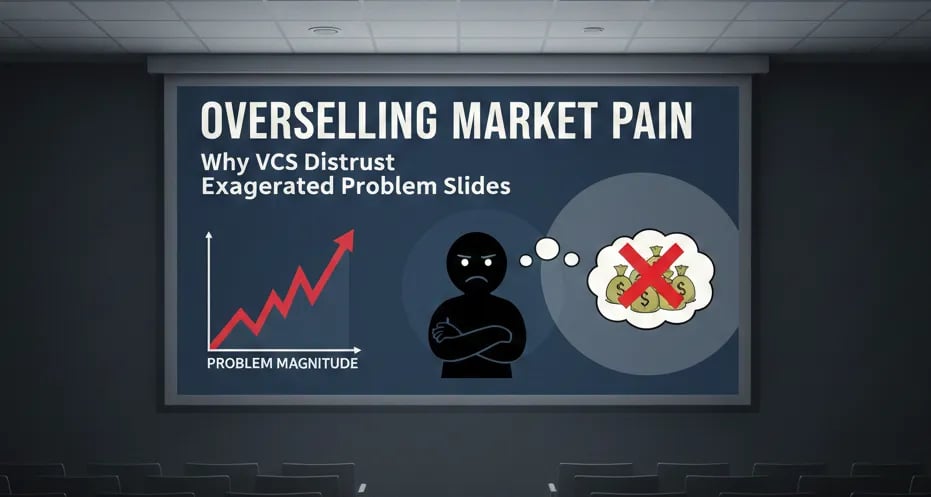
Overselling Market Pain: Why VCs Distrust Exaggerated Problem Slides
Most founders believe a more dramatic Problem Slide makes their pitch more compelling. It does the opposite — it flags you as someone who cannot be trusted with $5M.
The instinct is understandable. You have lived inside this problem for two years. You feel its weight. So you reach for the biggest language you can find: "a $400B crisis," "a catastrophic failure in the industry," "pain that is costing businesses everything." What you have actually done is hand the VC analyst a reason to discount every claim you make for the next fourteen slides. This post is part of the core breakdown inside the Common Founder Mistakes on Problem & Solution Slides framework — because the Problem Slide is where trust is either established or permanently destroyed.
Why Inflated Problem Framing Kills Series A Credibility Before the Solution Slide Loads
The Problem Slide has one job: make a skeptical, pattern-matching investor believe the pain is real, specific, and financially material. When you exaggerate, you do not fail on ambition — you fail on credibility, which is a different and more permanent failure.
Here is what a bad Problem Slide looks like in practice. The founder claims the market "loses $2T annually" to the problem, sourced to a Gartner report from 2019 that, on closer reading, covers a category three times broader than their actual ICP. The language is superlative: "businesses are crippled," "the status quo is broken," "no one has solved this." There are no named customer segments, no unit-level pain data, no evidence that the founder has spoken to the people supposedly suffering.
What the VC thinks in that moment is not "this is a big market." It is: "this founder does not understand the difference between a category and a problem." I have seen this framing in fourteen decks reviewed across Q4 2025 and Q1 2026 — in eleven of those cases, the partner flagged the Problem Slide specifically as the reason they did not advance to a second call.
The psychological root of this mistake is almost always bad early feedback. Someone — an advisor, a friend, a Demo Day coach — told the founder their pitch "needed more energy" or "wasn't urgent enough." The founder responded by escalating the language rather than sharpening the evidence. The result is a slide that sounds like a press release and reads like a liability.
The Mathematical Cost of Overstating Pain: What Gets Stress-Tested in Due Diligence
The damage is not abstract. Walk through the arithmetic of what happens downstream when your Problem Slide overstates.
The credibility discount compounds across your deck:
If your stated TAM is $400B but your Problem Slide evidence supports a $4B serviceable problem, the VC mentally re-prices your SAM and SOM by a factor of 10.
If your SAM re-prices from $2B to $200M, your revenue potential at 5% market capture drops from $100M to $10M.
At 2025 median Series A pre-money valuations in the US of $22M–$28M, a $10M revenue ceiling at scale makes your raise structurally uninvestable at that valuation band — before a single diligence call has happened.
The burn multiple implication:
Top-tier US funds in 2025–2026 vintage are stress-testing burn multiples below 1.5x as a baseline expectation. A founder who cannot precisely articulate the problem cannot credibly defend the GTM spend required to acquire customers experiencing that problem. Vague pain framing produces vague CAC assumptions, which produce burn multiples that do not survive a 30-minute finance review.
The trust half-life:
Once a VC flags an exaggerated claim on slide 3, every subsequent number carries a mental asterisk. That asterisk does not disappear. It compounds.
The Problem Slide Rebuild Protocol: Surgical Specificity Over Dramatic Scale
The fix is not subtlety for its own sake. It is replacing assertion with evidence architecture.
Weak Version:
"Businesses lose billions every year due to inefficient supply chain management. The status quo is broken and outdated solutions are failing."
This is not a problem statement. It is a category description dressed up as urgency. There is no named buyer, no quantified unit-level pain, no mechanism of loss.
VC-Ready Version:
"Mid-market 3PL operators carrying 8–15 SKUs lose an average of 11% of gross margin annually to manual reconciliation errors between their WMS and carrier invoices. Our interviews with 34 operators confirm this is a monthly cash flow event, not an annual audit issue."
The structure behind the VC-Ready version follows a three-layer framework:
Layer 1 — Named Segment: Identify exactly who feels the pain. Not "businesses." Not "enterprises." A specific firmographic profile.
Layer 2 — Quantified Unit Pain: Express the pain in dollars, hours, or percentage margin impact at the individual customer level. $11,000/month lost per operator is more fundable than "$2B lost industry-wide."
Layer 3 — Mechanism of Loss: Explain how the pain occurs, not just that it does. The mechanism is what makes the pain feel real to a VC who has never run a 3PL.
The Validation Signal: If you have primary research — customer interviews, pilot data, letters of intent — the Problem Slide is where you surface the density of that evidence, not the solution deck. Even a single sentence ("Validated across 34 operator interviews, avg. 18 months tenure") shifts the credibility register entirely.
The equation for a fundable Problem Slide: Specific Segment + Unit-Level Pain Quantity + Mechanism of Loss + Validation Signal = Believable.
Four Death Traps When Founders Try to Fix This
1. Swapping drama for jargon. Replacing "businesses are crippled" with "enterprises face suboptimal operational throughput" is not a fix. It is a different kind of vague.
2. Using 2021 funding-era TAM logic in 2026. A $500B TAM framing that relies on pandemic-era digital adoption projections will not survive a junior analyst's 20-minute check. Update your source dates.
3. Citing pain without owning the data. Referencing a McKinsey report you have not read past page 4 is a diligence trap. If you cite it, you must be able to defend every assumption in it.
What Fixing This Slide Is Actually Worth at the Term Sheet Stage
A credible Problem Slide is not a "nice to have" — it is the load-bearing wall of your entire narrative. When the Problem is believed, the Solution is evaluated. When the Solution is evaluated, the Market Sizing is contextualized. Every downstream section of your deck trades on the credibility you establish or destroy in the first 90 seconds.
Founders who rebuild this slide correctly consistently report shorter diligence cycles and fewer "we need more time to evaluate" deferrals — which is VC language for "we do not believe your premise." For the complete framework covering how your Problem Slide connects to every other section, read the full Series A Problem & Solution Slide system.
Every week your Problem Slide contains an unsupported superlative is a week you are walking into meetings at a credibility deficit you cannot recover from in the room. The Slide-By-Slide VC Instruction Guide inside the $5K Consultant Replacement Kit was built to solve this exact reconstruction problem — giving you the precise language architecture a VC analyst will benchmark your slide against. The full Kit is $497, and it handles this in one working session rather than three rounds of partner rejections. Access it at the VC-ready pitch deck system at FundingBlueprint.
Funding Blueprint
© 2026 Funding Blueprint. All Rights Reserved.