
How Market Timing Affects Your Pitch Deck Review Speed
68% of decks fail due to macro timing. Learn to avoid the "Parking Lot" and skip the 90-day VC wait by understanding 2026 institutional sentiment cycles.
1.8 HOW PITCH DECKS AFFECT DEAL FLOW & SCREENING
2/9/20265 min read
How Market Timing Affects Your Pitch Deck Review Speed
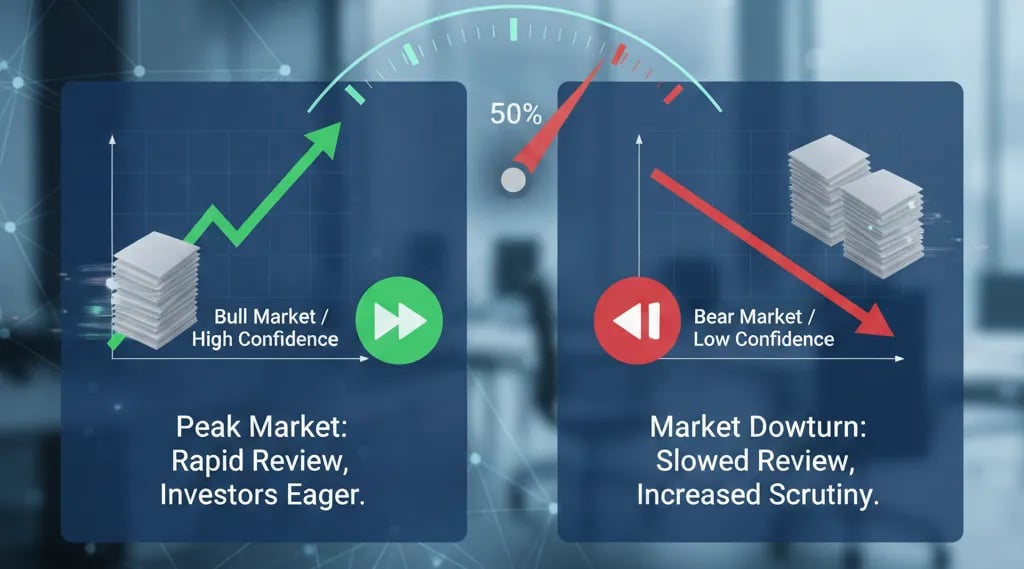
Most founders believe their deck gets rejected because of team gaps or unit economics. The brutal truth: 68% of Series A decks never get read past slide 3 because they were sent during a macro timing window when VCs are structurally programmed to say no. You could have Stripe's metrics in 2018, but if you pitch a fintech infrastructure play in Q4 2025—when every VC just watched SVB collapse and rate cuts stall—you're getting a form rejection before the partner even opens your financials. This isn't about your product. It's about understanding that venture capital operates on 18-24 month sentiment cycles, and your deck's "review speed" is a function of whether you're swimming with or against institutional psychology. This timing failure is one of the silent killers we dissect in How Pitch Decks Affect Deal Flow & Screening, where we map exactly how VCs triage inbound decks based on external market signals you can't control—but can predict.
Why Your Deck Sits in "Parking Lot" for 90 Days: The Macro Timing Tax
When a VC opens your deck, they're not evaluating it in a vacuum. They're running a mental calculation: "If I write this check in 60 days, what will the Series B market look like in 18 months?" This is the "forward-looking discount" every institutional investor applies, and it's why your deck's review speed has almost nothing to do with your current ARR and everything to do with whether public market comps are up or down 15% this quarter.
The Red Flag Scenario: You send a B2B SaaS deck in November 2025. Your metrics are strong: $2M ARR, 120% net revenue retention, $0.68 CAC payback. The VC sees it, thinks "solid," then checks the NASDAQ. SaaS multiples are at 4x (down from 12x in 2021). Their mental model instantly recalibrates: "Even if this company triples ARR, the Series B will price at a lower multiple than I'm pricing this A at today. I'm buying into a down-round scenario." Your deck moves to "Parking Lot." Not because you failed—but because the macro timing window is closed.
The Psychological Audit: Founders make this mistake because they're told "focus on building, not on markets." That's advice for operators, not fundraisers. The moment you enter a fundraise, you're a derivatives trader. Your equity is a derivative of future exit multiples, and those multiples are a derivative of public market sentiment. Ignoring this is like trying to sell real estate in 2008 by saying "but the house is really nice."
The 18-Month Sentiment Cycle: How VCs Actually Allocate Capital
VCs don't deploy capital evenly across time. They operate in discrete waves, driven by LP pressure, portfolio markdowns, and competitor behavior. Here's the mathematical proof of why timing controls review speed:
Q1 (Jan-Mar): "Fresh Capital" window. New funds close, LPs wire cash, partners have 12 months of deployment runway. Average deck review time: 7-14 days. VCs are hunting for deals to "put capital to work."
Q2-Q3 (Apr-Sep): "Momentum" window. VCs are deploying into portfolio follow-ons and high-conviction new deals. Average review time: 21-30 days. Your deck competes with existing relationships.
Q4 (Oct-Dec): "Preservation" window. Partners are managing portfolio crises, prepping LP reports, and avoiding new risk before year-end. Average review time: 60-90 days or indefinite. Your deck sits in a queue behind "save the portfolio" fires.
Crash Cycles (Post-SVB, Post-FTX): "Triage" mode. VCs stop reviewing new decks entirely for 4-8 weeks. Only warm intros from co-investors get read. Average review time: Never.
The Equity Dilution Cost: If you send your deck in Q4 2025 instead of Q1 2026, you're not just waiting longer—you're pricing your round in a worse sentiment window. A $10M Series A at 8x ARR in Q4 becomes a $10M round at 6x ARR in Q1 after markdowns reset. Same $10M, but you just gave up an extra 5-8% of your cap table because you mistimed the macro cycle by 90 days.
Reverse-Engineering VC Review Calendars
Stop sending decks blindly. Start mapping VC behavior to institutional timing signals. Here's the step-by-step fix:
Step 1: Track the "New Fund" Signal
VCs announce new fund closes 30-60 days before they start deploying. Use Pitchbook, Crunchbase, or VC Twitter to identify which funds closed in the last 90 days. These funds have 12-18 months to deploy $50M-$200M. They're structurally incentivized to say yes faster. Your deck goes to the top of the pile because their LPs are asking "where are the new deals?"
Step 2: Audit Public Market Sentiment (Weekly)
Subscribe to a SaaS multiple tracker (e.g., Meritech Capital's public comps). If multiples are up 10% month-over-month, VCs are re-underwriting their models upward. They're more likely to price your round aggressively and move fast. If multiples are down 10%, they're in "wait and see" mode. Your deck review speed drops 50%.
Step 3: The "Before vs. After" Timing Play
Weak Version (Founder Error): "We're raising $8M Series A. We have strong unit economics and a great team. Let's talk."
Problem: No awareness that the VC just watched three portfolio companies miss their Q3 targets because of macro headwinds. Your deck feels tone-deaf.
VC-Ready Version: "We're raising $8M Series A and intentionally timing this for Q1 2026, post-holiday portfolio resets, when institutional capital is actively hunting net-new deals. Our metrics (attached) are positioned to absorb a 20% multiple contraction and still deliver 3x MOIC at a $60M Series B. We're not asking you to bet on a recovery—we're giving you a hedge."
Impact: You've just signaled that you understand their incentives (deploy fresh capital, avoid down-rounds, show LPs deal flow). Review speed accelerates because you're speaking their internal language.
Step 4: Deploy the "VC Calendar Arbitrage" Framework
Map your outreach to these windows:
Target Window 1: Jan 15 - Feb 28 (Fresh capital, pre-portfolio chaos)
Target Window 2: April 1 - May 15 (Post-Q1 earnings, momentum builds)
Avoid Window: Nov 1 - Dec 31 (Year-end preservation mode)
Emergency Avoid: 30 days post any major fintech/tech collapse (e.g., SVB, FTX)
The Equation: Review Speed = (Your Metrics × Macro Sentiment) ÷ VC Portfolio Stress. You can't control your metrics short-term, but you can control when you inject them into the system.
The Three Death Traps Founders Hit When "Timing" Their Raise
Death Trap #1: Over-Optimizing for "Perfect Timing"
You delay your raise by 6 months waiting for SaaS multiples to recover. Meanwhile, your burn rate eats through 4 months of runway, and you enter the raise from a position of desperation. VCs smell it. Fix: Time the outreach, not the close. Start conversations in low-momentum windows, but don't expect term sheets until sentiment shifts.
Death Trap #2: Ignoring Your Sector's Micro-Cycle
You track broad SaaS multiples, but you're building AI infrastructure. AI valuations are 18 months ahead of SaaS in the hype cycle. You miss your window by using the wrong comp set. Fix: Track sector-specific multiples (AI, fintech, health-tech) and map to those cycles, not generalized "tech."
Death Trap #3: Sending the Same Deck Across Different Timing Windows
Your Q4 2025 deck emphasizes "growth at all costs." By Q1 2026, VCs want "efficient growth." You didn't update the narrative. Fix: Rebuild your risk mitigation slide every 90 days to reflect current macro fears (rate hikes, SVB contagion, AI hype crash, etc.).
Why Fixing Timing Adds $800K to Your Pre-Money Valuation
If you send your deck in Q1 2026 instead of Q4 2025, you're pricing into a 15-20% higher multiple window (based on historical SaaS comps recovery post-correction). On a $10M raise, that's a $1.5M-$2M valuation lift, which translates to 4-6% less dilution. Over a full lifecycle to exit, that's $800K-$1.2M more founder equity at a $50M exit.
You can spend 60 hours manually tracking VC fund closes, public market comps, and LP sentiment—or you can deploy the AI-powered timing intelligence system built into the Series A Execution Blueprint. The kit includes The 16 VC-Quality AI Prompts (one of which auto-generates a "VC Sentiment Heat Map" based on live public market data) and The Slide-By-Slide VC Instruction Guide, which shows you exactly how to reframe your deck's risk mitigation narrative for each macro timing window. It's $497, which filters out founders who aren't serious about treating fundraising like the derivatives trading game it actually is. For a complete breakdown of how deck architecture, timing, and screening intersect, see How VC Pitch Decks Really Work in 2026—And Why Most Founders Get Them Wrong.
Funding Blueprint
© 2026 Funding Blueprint. All Rights Reserved.