
Pitch Deck Logical Flow: Keeping VC Investors Engaged
A single logical break in your pitch deck forces VCs to stop believing and start auditing. Learn how to engineer seamless logical flow for your Series A.
3.2 SLIDE ORDER & LOGICAL FLOW: HOW VCS ACTUALLY READ PITCH DECKS
3/6/20268 min read

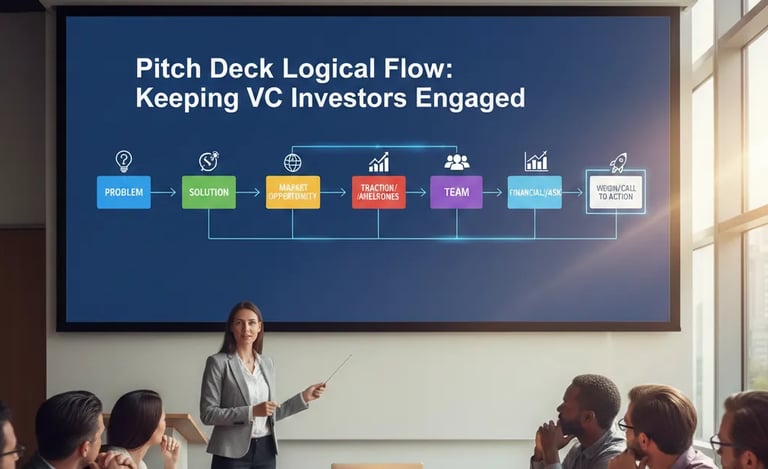
Pitch Deck Logical Flow: Keeping VC Investors Engaged
The investor stopped reading at slide 7. Not because the business was weak. Not because the numbers were thin. Because the logical thread connecting slide 6 to slide 7 snapped — and the moment it did, the investor's brain shifted from belief-building mode into audit mode. In audit mode, the investor is no longer asking "should I fund this?" They are asking "what is wrong with this?" Those are not the same question, and they do not produce the same outcome. One leads to a term sheet conversation. The other leads to a pass email that cites fit rather than the real reason.
Logical flow is the mechanism that keeps a VC in belief-building mode from the first slide to the Ask. It is not a design property, a tone property, or a length property. It is a structural property — and it operates below the level of conscious perception. The investor does not notice good logical flow. They notice when it breaks. The complete architecture for how investors move through a deck is documented in the VC read-order and logical sequence guide for pitch deck construction. This post focuses on the specific mechanics of maintaining engagement — not as a presentation skill, but as an engineering discipline.
When logical flow holds, the investor arrives at your Ask with momentum. When it breaks, they arrive with doubt. Doubt at the Ask is a structural death sentence.
Why Logical Flow Breakdown at the Series A Stage Is a Capital Problem, Not a Storytelling Problem
The reason logical flow matters disproportionately at Series A — compared to seed, where relationship and vision carry more weight — is that Series A investors are making a decision that requires institutional defensibility. They are not just deciding whether they believe in you. They are deciding whether they can explain why they believe in you to their partners, their LPs, and their internal investment committee. A deck with broken logical flow makes that explanation impossible.
Here is exactly what a flow breakdown looks like in practice: a Traction Slide that presents impressive month-over-month growth, followed immediately by a Market Size slide that uses a TAM figure from a category three times broader than the product being demonstrated. The investor's brain registers an inconsistency — the traction suggests one market, the TAM claims another. That inconsistency does not read as ambition. It reads as either intellectual sloppiness or deliberate misdirection. Neither interpretation keeps the investor in belief-building mode.
The psychological mechanism behind this is what cognitive scientists call coherence monitoring — the continuous background process by which a reader tracks whether new information is consistent with the model they have already built. When new information is consistent, it integrates silently and strengthens the model. When it is inconsistent, it triggers a conscious flag that interrupts the reading process and pulls the reader out of absorption. In a VC context, that flag produces scepticism, and scepticism is extraordinarily difficult to reverse within a single deck read. In the last two quarters, I have reviewed decks where a single coherence break — one slide that contradicted the framing established two slides earlier — was sufficient to produce a pass from a fund that had initially flagged the deal as high-priority.
The root cause is almost always slide-level optimisation instead of system-level thinking. Founders polish each slide to be as strong as possible individually, without checking whether each strong slide is consistent with the model the preceding slides have built. A deck of individually strong, mutually inconsistent slides is not a strong deck. It is a collection of strong slides that collectively undermine each other.
The Engagement Decay Model: How Logical Flow Breaks Kill VC Attention Across a 12-Slide Deck
Model investor engagement as a capital account. It starts at 100 at slide 1. Every logical connection that holds makes a deposit. Every logical break makes a withdrawal. The account cannot go negative without triggering an exit.
The Engagement Decay Sequence — Common 12-Slide Failure Pattern:
Slides 1–3 (Problem, Why Now, Solution): Flow holds. Strong opening. Engagement account: 100 → 115. The problem is specific, the why now is credible, the solution directly addresses the root cause named in the problem. Deposits made.
Slide 4 (Product Demo / Screenshots): First minor break. The product demo shows features that were not mentioned in the Solution Slide. The investor now has to reconcile two slightly different framings of what the product does. Engagement account: 115 → 105. Small withdrawal.
Slide 5 (Traction): Flow partially recovers. The numbers are strong. But the metrics presented — DAUs, feature adoption rate — do not directly prove the core claim made in the Solution Slide (that procurement cycles are shortened). The investor notes the gap. Engagement account: 105 → 95.
Slide 6 (Market Size): TAM is presented at $84B for "enterprise software." The Solution Slide described a specific procurement workflow tool. The category mismatch is visible. Engagement account: 95 → 75. Significant withdrawal.
Slide 7 (Business Model): The revenue model is subscription-based, but the pricing structure was never referenced in the Traction Slide — the investor does not know if the traction numbers are from paid customers or free users. Engagement account: 75 → 55. The investor is now in audit mode.
Slides 8–12: The investor is no longer building belief. They are looking for the information that resolves the inconsistencies already flagged. They may finish the deck. They will not remember it as a coherent investment thesis.
As of 2025, median Series A pre-money valuations in the US sit at $22M–$28M — a range that requires an investor to build and defend a conviction thesis internally. A deck that produces audit mode before slide 8 cannot support that internal defence, regardless of the underlying business quality.
The withdrawal triggers, ranked by severity:
A metric in Traction that does not prove the specific claim made in the Solution Slide
A TAM figure that does not correspond to the market implied by the product being demonstrated
A Business Model that introduces pricing logic not anchored to the value proposition already established
A Team Slide that presents credentials without mapping them to the specific execution requirements of the plan just described
An Ask that arrives without a capital deployment narrative connecting the funding amount to the growth outcome
Each withdrawal is a coherence break. Each coherence break is a logical flow failure. Each logical flow failure moves the investor further from the conviction required to champion the deal internally.
The Logical Flow Engineering Protocol: How to Build Engagement That Holds Under Multi-Reader Review
The test of logical flow is not whether it holds when you are in the room narrating it. It is whether it holds when an analyst reads it alone at 11pm before a partner meeting the next morning. Build for that reader.
Step 1 - Run the "Consistency Audit" Across Every Adjacent Slide Pair
Take each pair of consecutive slides and answer three questions:
Does the second slide use the same terminology as the first for the same concepts?
Does the second slide's core claim assume information established in the first?
Does the second slide contradict any framing built in the first?
Any "no" to the first two questions, or "yes" to the third, is a flow break that must be resolved before the deck is presented.
Step 2 - Lock the "Core Claim Chain"
Every deck has a core claim — the single most important assertion the entire pitch is built to prove. Identify it. Then audit every slide to confirm it contributes to proving that claim.
Weak Version (Broken Claim Chain):
Core claim: "We reduce enterprise procurement cycle time by 60%."
— Traction Slide metric: Monthly Active Users = 4,200 — Market Size: "Enterprise software market = $84B" — Business Model: "SaaS subscription at $299/seat/month"
None of these three slides directly prove the core claim. The traction metric measures adoption, not outcome. The market size describes a category, not the specific problem being solved. The business model describes a pricing structure, not a value delivery mechanism. The claim chain is broken at three consecutive slides.
VC-Ready Version (Locked Claim Chain):
Core claim: "We reduce enterprise procurement cycle time by 60%."
— Traction Slide metric: "18 enterprise customers have reduced procurement cycle time by an average of 58% within 90 days of deployment" — Market Size: "The $11B market for procurement workflow automation in North America is defined by cycle time as the primary cost driver" — Business Model: "We price on outcomes — $X per cycle completed, with an average customer saving $Y per cycle — giving us an LTV/CAC of 6.2x at current scale"
Every slide advances the same claim. The investor is never asked to hold two different framings of what the company does simultaneously.
Step 3 - Apply the "Terminology Lock" Rule
Choose one term for each core concept and use it identically across every slide:
If the problem is "procurement cycle time," it is never called "purchasing lead time," "acquisition latency," or "sourcing delay" elsewhere in the deck
If the customer is "mid-market enterprise," they are never called "SMB," "growth-stage companies," or "scaling businesses" on a different slide
If the solution is "workflow automation," it is never described as "AI-powered procurement" on the product slide and "process optimisation" on the business model slide
Terminology inconsistency is a coherence break that the investor may not be able to name but will feel as confusion. Confusion produces the audit-mode shift.
Step 4 - The "Flow Stress Test" - Three Independent Readers, One Specific Question
Send the deck to three people with financial literacy who do not know your company. Ask each of them one question only: "After reading this deck, what is the single core claim this company is making, and what is the strongest piece of evidence for it?"
If all three answers align — same claim, same evidence — your logical flow is holding. If the answers diverge, the flow is breaking somewhere between the claim and the proof. Identify the divergence point and rebuild from there.
Three Flow-Fixing Mistakes That Reintroduce Coherence Breaks
1. Fixing Terminology Inconsistency With a Glossary Slide Adding a definitions slide to resolve terminology confusion does not fix a flow problem — it institutionalises it. The investor should never need a glossary to follow your argument. If they do, the terminology lock has failed and must be rebuilt at the slide level.
2. Resolving TAM Mismatch by Expanding the Category When an investor flags that your TAM does not match your product, the instinctive founder response is to reframe the TAM to include more categories. This makes the mismatch worse. The fix is to narrow the TAM to match the product precisely — a smaller, credible TAM that locks with your traction is worth more conviction than a large TAM that the investor cannot connect to what you have built.
3. Adding Transition Slides to "Bridge" Logical Gaps Inserting an explanatory slide between two slides that do not connect is not a flow fix — it is an admission that the two slides do not belong adjacent to each other. The fix is to rewrite the closing frame of slide N and the opening frame of slide N+1 so that the connection is direct. Bridges are structural workarounds that signal the underlying logic has not been resolved.
The Fundraising Arithmetic of Broken Logical Flow
A deck with broken logical flow does not receive a lower valuation. It does not receive a revised term sheet with tighter protective provisions. It receives a pass — and the founder spends the next three months in a second round of meetings trying to understand why a business with genuine traction cannot close a Series A. The answer, in the majority of those cases, is a coherence break between slides 5 and 8 that moved the investor from belief-building into audit mode before the Ask was reached.
The Consistency Audit, Core Claim Chain, Terminology Lock, and Flow Stress Test described above are not polish exercises. They are the engineering work that makes an investment thesis defensible without the founder in the room — which is the precise condition under which Series A deals are won or lost. The complete system for building a deck that holds logical flow from hook to Ask is inside the definitive Series A pitch deck structure and framework system.
Founders who have built their deck using the AI Financial System inside the $5K Consultant Replacement Kit go into partner meetings with a logical flow architecture that has already been stress-tested against the coherence checks a VC analyst runs during pre-screen — the claim chain is locked, the terminology is consistent, and the TAM maps directly to the traction being claimed. That is not a marginal presentation improvement. That is the structural difference between a deck that survives multi-reader diligence review and one that does not. The full Kit is $497. Access it through the logical flow and claim-chain system built for Series A pitch decks.
Engagement is not a function of how interesting your business is. It is a function of how consistently your argument holds. Build the argument first.
Funding Blueprint
© 2026 Funding Blueprint. All Rights Reserved.