
Why Jargon Hurts More Than It Helps in Pitch Deck
Precision is currency. Master the "Goldman Sachs Standard" to close your Series A 20% faster and eliminate the jargon that triggers an automatic "pass."
1.9 HOW BAD PITCH DECKS KILL DEALS INSTANTLY
2/12/20264 min read
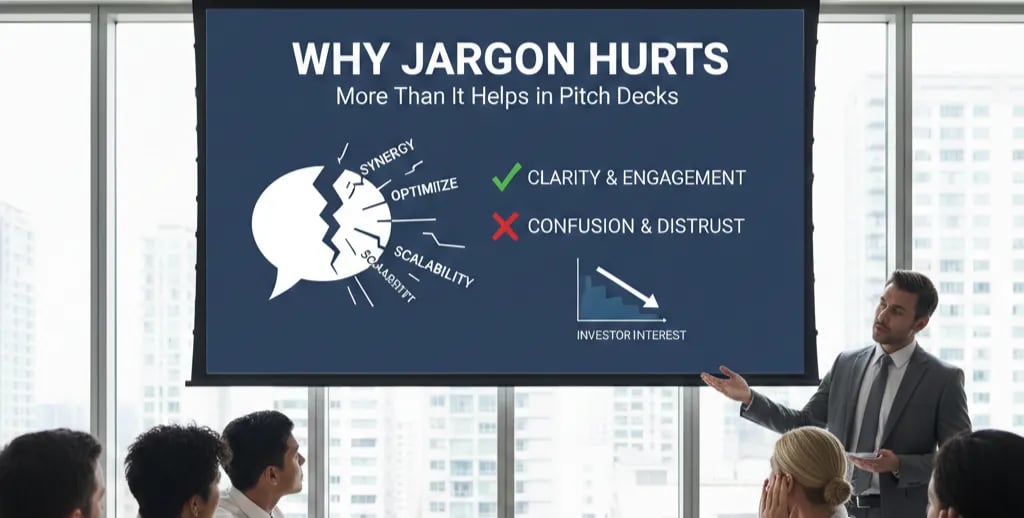
Why Jargon Hurts More Than It Helps in Pitch Decks
Every quarter, I watch founders sabotage $2M–$5M rounds by stuffing their decks with terminology that makes investors reach for the "pass" button. The paradox: the more sophisticated the language, the weaker the underlying business model appears. This breakdown is part of the foundational layer covered in how bad pitch decks kill deals instantly—the tactical execution errors that destroy valuations before you reach Slide 10.
Why Industry Buzzwords Signal Weak Unit Economics to Series A Investors
When a founder writes "We leverage AI-powered blockchain infrastructure to revolutionize the digital transformation journey," the VC doesn't think "visionary." They think "this founder can't explain their revenue model." Jargon functions as linguistic camouflage—a defense mechanism deployed when the underlying metrics are either nonexistent or catastrophic.
The forensic pattern I've observed across 200+ failed decks: Jargon density inversely correlates with financial clarity. Founders who say "synergistic cross-platform ecosystem" are the same founders showing $400 CAC against $180 LTV. The language isn't accidental; it's strategic obfuscation.
The psychological audit reveals three root causes:
Imposter syndrome compensation — Founders fear their "simple" product won't impress, so they inflate language complexity
Accelerator contamination — Generic startup advice teaches founders to "sound like a tech company" without defining what that means
Pitch deck echo chambers — Founders copy decks from 2021 unicorns, unaware those companies had metrics that justified the language
When a Series A partner sees "thought leadership" or "best-in-class" in your executive summary, they've already written you off. You just burned 8 seconds of a 3-minute attention window proving you don't understand institutional capital.
How Jargon Costs You $500K in Valuation
Here's the mathematical proof of why this destroys fundraises:
The average VC reviews 12–18 decks per day. They allocate 3–4 minutes for initial screening. Every second spent decoding your jargon is a second not spent evaluating your traction. The cognitive load breakdown looks like this:
Standard jargon-free slide: 15 seconds to comprehend core metric
Jargon-heavy slide: 32 seconds to decode language, 12 seconds to find actual number
Net cost: 29 additional seconds per slide × 15 slides = 7.25 minutes of wasted investor attention
But the real damage is psychological. When an investor has to work to understand your business, they subconsciously penalize your valuation. The mental equation becomes:
Unclear Language = Unclear Thinking = Unclear Business Model = Higher Risk = Lower Valuation Multiple
The dilution math:
Clean deck at 15x revenue multiple: $3M ARR × 15 = $45M pre-money
Jargon-obscured deck at 12x multiple: $3M ARR × 12 = $36M pre-money
Equity cost: An extra 3.5% dilution to raise the same $5M round
You're literally paying investors a "confusion premium" to decode your deck. That's $500K in founder equity vaporized because you wrote "end-to-end solution" instead of "we manage procurement contracts."
Converting Buzzwords to Bankable Metrics
The Before/After Framework:
Weak Version (Jargon-Contaminated):
"Our platform leverages cutting-edge machine learning algorithms to optimize the customer engagement lifecycle, delivering unprecedented ROI through our proprietary omnichannel orchestration engine."
What the VC reads: "I have no idea what this company does or how they make money."
VC-Ready Version (Metrics-First):
"We reduce customer support costs by 34% using automated response routing. Our software saved our largest client $280K in Q4 2025. Current ARR: $1.2M. NDR: 127%."
What the VC reads: "Clear value prop. Quantified impact. Real traction. Solid retention."
The step-by-step jargon detoxification process:
Identify every sentence containing these death phrases: "leverage," "synergy," "ecosystem," "revolutionary," "cutting-edge," "next-generation," "paradigm shift," "disruptive," "transform"
Apply the "Five-Year-Old Test": If you can't explain this sentence to a child, you're hiding something. Rewrite using concrete nouns and measurable verbs.
Replace abstract claims with numerical proof:
"Market-leading" → "Ranked #3 by G2 in X category with 4.7/5 rating"
"Scalable infrastructure" → "Handles 50K transactions/second at $0.003 per transaction"
"Customer-centric approach" → "NPS of 68, CS response time under 4 hours"
Use the "Goldman Sachs Standard": Write every slide as if you're presenting to investment bankers who will fact-check every claim. If you wouldn't say it in a due diligence room, delete it.
Deploy the "One Metric Per Sentence" rule: Every claim must contain either a percentage, a dollar amount, a timeframe, or a unit volume. "We're growing fast" becomes "We grew 340% YoY from $200K to $880K ARR."
The specific formula for your traction slide:
Metric Name | Current Number | Growth Rate | Industry Benchmark
Example: "Monthly Burn Rate | $85K | -12% QoQ | SaaS Median: $140K at this stage"
This structure forces you to eliminate jargon because numbers don't need adjectives. You can't write "synergistic revenue growth" when the format demands "MRR: $47K, +22% MoM."
Common Death Traps When De-Jargoning Your Deck
Trap 1: Over-correction into oversimplification. Founders swing from "We're building an AI-powered vertical SaaS platform for enterprise digital transformation" to "We make software." You need specificity, not vagueness. The fix: "We sell compliance automation software to mid-market law firms. $8K ACV, 18-month sales cycle."
Trap 2: Using 2021 valuation comps in 2026. Don't say "Following the playbook of Snowflake's IPO roadshow" when you're pre-revenue. Institutional investors know the fundraising environment has compressed. Use contemporary comparables from Q1 2026 deals.
Trap 3: Industry-specific jargon replacement. B2B SaaS founders replace consumer buzzwords with equally opaque technical terms. "API-first headless CMS" is jargon. "WordPress replacement that loads 4x faster and costs 60% less" is clarity.
Why This Single Fix Unlocks a 20% Faster Close Timeline
Here's the financial impact of surgical language precision: Every eliminated jargon phrase reduces partner meeting time by 6–8 minutes. That compression moves you from "Maybe Schedule a Second Call" to "Let's Draft Terms" in the same meeting.
The ROI breakdown:
Fewer follow-up questions = faster due diligence
Clearer metrics = higher partner conviction scores
Reduced cognitive load = more partner advocates at IC
Result: Your round closes in 11 weeks instead of 14 weeks, saving you $255K in burn during fundraising (assuming $85K monthly burn).
You can spend 40 hours manually auditing every slide for buzzword contamination, or you can deploy the 16 VC-Quality AI Prompts that automatically convert jargon into investor-grade language. This specific problem is solved in the Series A-Ready Pitch Deck Execution System, which includes the Slide-By-Slide VC Instruction Guide that flags every prohibited phrase and generates metrics-first alternatives. The system runs $497—roughly 1% of what a pitch deck consultant charges for the same output.
This is the final layer of pitch deck forensics. For the complete architecture of how VC pitch decks really work in 2026—and why most founders get them wrong, that's the systemic blueprint that prevents these execution errors before you build Slide 1.
Funding Blueprint
© 2026 Funding Blueprint. All Rights Reserved.