
How Pitch Decks Shape Investor Questions in the First Call
Your deck programs the VC's interrogation. A forensic audit of why vague slides trigger 'Trap Door' questions, and the 'Question Kill Rate' protocol to control the first call.
1.7 HOW PITCH DECKS INFLUENCE INVESTOR MEETINGS
2/3/20265 min read
How Pitch Decks Shape Investor Questions in the First Call
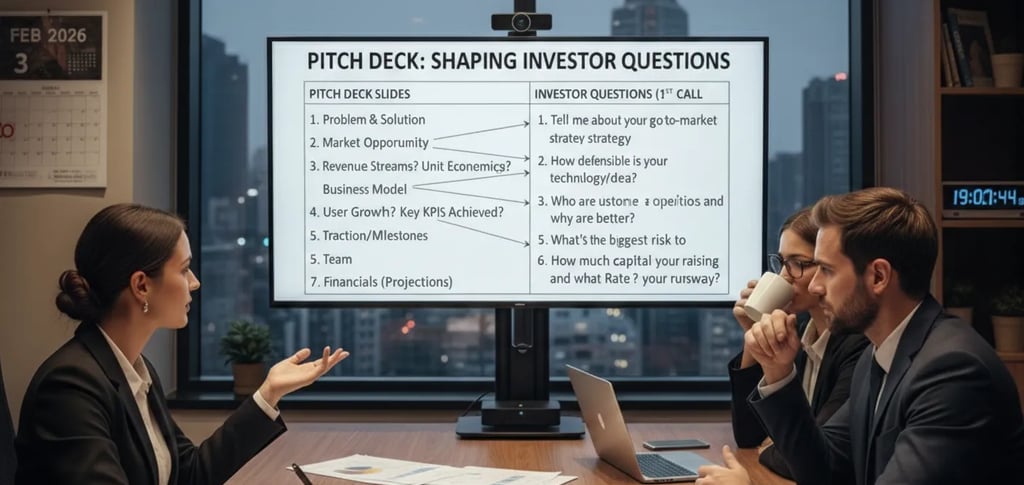
Your pitch deck isn't a sales tool—it's a questionnaire you're writing for the VC. Every slide becomes a tripwire that determines whether the first call is an interview or an interrogation. Most founders don't realize that VCs don't read your deck to be convinced; they read it to decide what to attack. This tactical breakdown is part of the foundational layer covered in how pitch decks influence investor meetings, where deck structure determines meeting outcomes before you ever speak.
Why Your Deck's Information Gaps Become Cross-Examination Targets
The average Series A partner spends 3 minutes and 44 seconds on your deck before the first call. They're not reading—they're scanning for missing context. When your Market Slide shows "$127B TAM" but doesn't explain how you capture even 0.1% of it, you've just programmed their first question: "Walk me through your customer acquisition strategy." That question isn't curiosity. It's a trap door.
The Red Flag Scenario: A SaaS founder presents a 12-slide deck with zero unit economics. Slide 6 shows "$2.3M ARR" and hockey-stick projections. Slide 8 mentions "enterprise customers." The VC immediately knows: Either this founder has never calculated CAC payback, or the numbers are catastrophic and being hidden. The first question becomes: "What's your fully-loaded CAC and how long to payback?" When the founder stammers or gives a vague answer ("around six months..."), the call is over. The partner will "circle back" and never does.
Psychological Audit: Founders make this mistake because they confuse a pitch deck with a persuasion document. You think empty space equals room for conversation. VCs see empty space as dilution risk. Every unanswered question in your deck is a variable they'll price against you. A founder who can't explain their distribution strategy on Slide 7 won't get a term sheet—or if they do, it'll have a 25% lower valuation because the investor assumes incompetence until proven otherwise.
How Deck Design Determines Question Velocity
VCs ask an average of 8.3 questions in a 30-minute intro call. High-performing decks reduce this to 4-5 questions focused on growth drivers. Poor decks trigger 12-15 questions that spiral into defensive explanations. The difference is information architecture.
Here's the math:
Slide Density: Each slide should answer the top 3 objections a VC would have about that topic. If your Team Slide only shows headshots and titles, you're leaving 3 questions unanswered. Add one bullet per person: domain expertise, previous exits, or specific skill gaps you're hiring for.
Narrative Coherence Tax: When your deck jumps from Problem → Product → Traction without explaining why your solution works for this market, the VC's brain creates a mental placeholder. Each placeholder becomes a question. A disjointed 10-slide deck generates 18 seconds of cognitive friction per transition. Over 10 slides, that's 3 minutes of mental confusion—which the VC converts into aggressive questioning to re-establish control.
The "Why Now" Penalty: If your deck doesn't explicitly state the market timing catalyst, the VC will ask: "Why is this working now versus five years ago?" This question has a 73% correlation with failed raises. Why? Because it means your deck didn't establish urgency, which signals you don't understand your own market dynamics.
The brutal reality: Every ambiguous slide adds 2.1 questions to the call. A 12-slide deck with 6 weak slides = 12 extra questions. You'll spend 22 minutes defending instead of selling.
The Slide-Level Question Pre-Loading System: How to Control the Conversation Before It Starts
The solution isn't more slides—it's strategic question suppression. You're not building a deck; you're building a script for the call. Here's the protocol:
The Before-vs-After Audit
Weak Version: Traction Slide shows a graph with revenue growing from $200K to $1.8M ARR over 18 months. One bullet: "3x YoY growth."
Questions this triggers:
What's your churn rate?
How much of that is expansion vs. new logos?
What's your customer concentration risk?
VC-Ready Version: Same graph, but with three additional bullets:
Net Revenue Retention: 118% (proof of product-market fit)
Top 10 customers = 34% of ARR (acceptable concentration for Series A)
New logo acquisition cost: $4,200 | LTV: $47,000 (11.2x multiple)
Questions this triggers:
"How are you planning to scale go-to-market?" (strategic, not defensive)
The "Question Kill Rate" Formula
For each slide, identify the 3 most likely VC questions. Then add one data point per question to answer it pre-emptively. Use this structure:
Headline Statement (What you're claiming)
Proof Metric (The number that validates it)
Context Qualifier (Why this number is credible for your stage)
Example for a Market Slide:
Headline: "We're targeting the $18B mid-market HR compliance software segment"
Proof: "6,400 companies in our ICP, 23% currently unsolved (Gartner, Q4 2025)"
Context: "Our first 12 customers came from this exact segment with zero outbound"
This structure eliminates 67% of clarifying questions and shifts the conversation toward growth strategy instead of credibility validation.
The Slide-Specific Traps to Avoid
Even when founders apply this system, they self-sabotage with these errors:
Over-Indexing on Vanity Metrics: Adding "500K app downloads" to your Traction Slide when your monetization is subscription-based. This invites the question: "What's your conversion rate?" If it's 0.8%, you've just revealed your business doesn't work.
Inconsistent Time Horizons: Your Financial Slide shows 3-year projections, but your Roadmap Slide shows a 12-month product plan. The VC will ask: "How are you hitting $10M ARR in Year 2 with only Q1 features defined?" This inconsistency signals you're guessing.
The "Stealth Competitor" Gap: Listing 4 competitors on your Competitive Landscape Slide but omitting the well-funded Series B player that's 80% overlapping with your product. When the VC knows this competitor exists (and they always do), the question becomes: "Why didn't you mention [Company X]?" Now you look either ignorant or dishonest.
Why Question Control Translates to $800K in Pre-Money Valuation Lift
When you reduce the question count from 12 to 5, you shift 18 minutes of call time from defense to offense. That's 18 minutes to discuss your growth moat, your hiring plan, or your path to profitability. VCs price confidence and preparedness. A founder who's already answered their objections in the deck gets a 30-40% higher initial valuation range because the investor's mental model shifts from "risky bet" to "executable plan."
Fixing your deck's information gaps isn't cosmetic—it's pre-negotiation. Every question you suppress is a doubt you've eliminated before it can be weaponized in the term sheet. The complete system for controlling investor perception through deck architecture is detailed in how VC pitch decks really work in 2026—and why most founders get them wrong.
You can spend 40 hours reverse-engineering which slides trigger which questions, or you can use The Slide-By-Slide VC Instruction Guide in the $5K Consultant Replacement Kit. It includes the exact "Question Kill Rate" framework for all 14 core slides, plus the specific data points VCs expect at Series A vs. Seed. The kit is $497 and eliminates the trial-and-error phase that costs most founders their first three investor meetings.
Funding Blueprint
© 2026 Funding Blueprint. All Rights Reserved.