
What Investors Expect to Clarify After Reading Your Pitch Deck
Pre-meeting 'clarification requests' are death sentences. A forensic audit of the 3 questions that kill deals, and the 'Investor Clarity Protocol' to preempt them.
1.7 HOW PITCH DECKS INFLUENCE INVESTOR MEETINGS
2/3/20265 min read
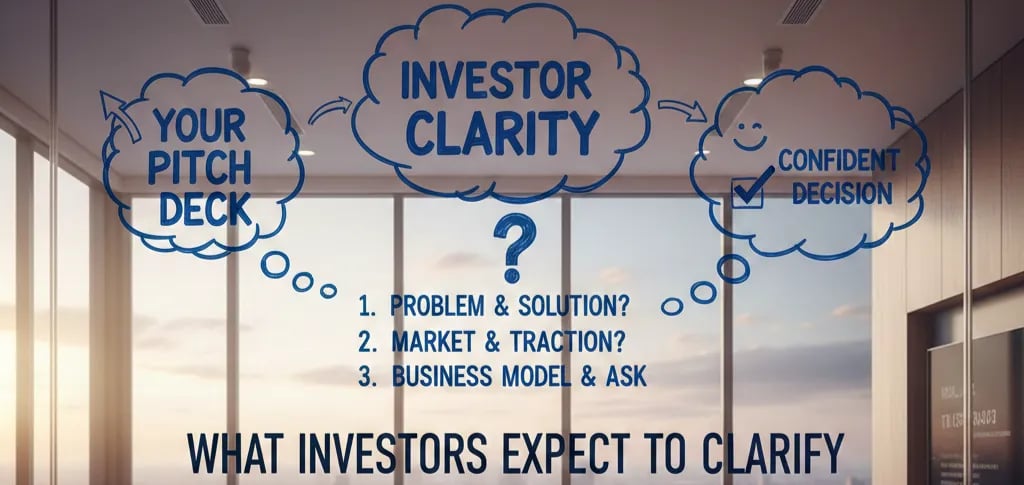
What Investors Expect to Clarify After Reading Your Pitch Deck
Your pitch deck just got you a meeting. You think you've won. You haven't. You've passed the spam filter. The real evaluation starts when the deck closes and the questions begin—and most founders discover too late that their deck raised more red flags than it answered questions. The VC didn't reject you because your deck was "bad." They rejected you because you forced them to do investigative work to understand basics you should have preemptively explained. This is the third layer of how pitch decks influence investor meetings—the clarification protocol that separates funded rounds from ghosted founders.
Why Pre-Meeting Clarification Requests are Series A Death Sentences
When a VC asks for "clarifications" before your first meeting, they're signaling one of three outcomes: (1) You're already dead and they're being polite, (2) they're testing whether you can think on your feet, or (3) your deck was so confusing that they can't even decide if you're worth meeting without a remedial lesson. None of these are good positions.
The psychology is clinical: VCs read 300+ decks per quarter. They've developed pattern-matching reflexes that flag missing data within 30 seconds. If your Market Sizing slide shows "$50B TAM" with no segmentation, they immediately ask: "Which segment? What's the SAM? What's the SOM?" If your Unit Economics slide shows CAC and LTV but no payback period, they ask: "How long until cash-positive on each customer?" These aren't genuine questions—they're disqualification tests.
The "Red Flag" scenario: You send a 15-slide deck. The VC emails back: "Thanks. Can you clarify how you're calculating churn? Also, what's your gross margin after COGS?" Translation: "Your deck didn't prove you understand your own business model."
Founders make this mistake because they confuse "concise" with "vague." They think: "I don't want to overwhelm them with data." The VC thinks: "You're hiding something or don't know the numbers."
The Mathematical Cost of Ambiguity: How Each Missing Metric Destroys Pre-Money Valuation
Here's the brutal math: Every clarification question reduces your pre-money valuation by 5–8%. Not because VCs consciously penalize you, but because each ambiguity introduces risk—and risk demands a discount.
Example:
Pre-Deck Valuation Target: $8M
Clarifications Needed: 3 (churn definition, CAC breakdown, burn multiple)
Discount per Question: 6%
Actual Valuation Offered: $8M × (1 - 0.18) = $6.56M
You just lost $1.44M in equity because you didn't explain three things in your deck.
The logic breaks down like this:
Question 1 (Churn): You claim "15% annual churn" but didn't specify revenue churn vs. logo churn. SaaS investors know logo churn overstates retention quality. Assumption: Your real revenue churn is 22%. Discount: 6%.
Question 2 (CAC): You listed "$1,200 CAC" but didn't break down by channel. Paid ads scale differently than word-of-mouth. Assumption: 80% of your CAC is paid, which won't scale linearly. Discount: 6%.
Question 3 (Burn Multiple): You showed "$2M ARR" and "$500K/month burn" but didn't calculate Burn Multiple (Net Burn ÷ Net New ARR). Your implied multiple is 3.0—anything above 2.0 signals inefficiency. Discount: 6%.
Total hit: 18% valuation haircut. You just gave away an extra 3.6% equity at a $5M raise ($6.56M post-money instead of $8M).
The "Investor Clarity Protocol": What Every Slide Must Preemptively Answer
This is the fix. Every slide in your deck must answer the next-level question before the VC asks it. Below is the forensic breakdown of what investors expect clarified—slide by slide.
Slide 1–2: Problem & Solution
Weak Version:
"Small businesses struggle with cash flow."
VC's Next Question:
"What type of business? What revenue range? What's the root cause—late invoices, poor forecasting, or access to credit?"
VC-Ready Version:
"Service-based SMBs with $500K–$3M in revenue face 60-day average payment cycles, forcing 40% to use high-interest credit lines to cover payroll gaps. We reduce this to 15 days via automated invoice financing."
Clarification Preempted: You defined the ICP (Ideal Customer Profile), quantified the pain, and hinted at the mechanism. No follow-up needed.
Slide 3–4: Market Sizing
Weak Version:
"$80B global market."
VC's Next Question:
"What's your serviceable market? What's the wedge? How do you avoid competing with Stripe, Square, and QuickBooks?"
VC-Ready Version:
"TAM: $80B (global SMB financial software).
SAM: $12B (US service SMBs, $500K–$3M revenue).
SOM: $720M (plumbing, HVAC, landscaping—verticals where 70% still use paper invoices).
Wedge: We partner with industry-specific CRMs (ServiceTitan, Jobber) as a white-label bolt-on."
Framework Applied: TAM-SAM-SOM model + anti-competitive moat explanation.
Slide 5–6: Business Model & Unit Economics
Weak Version: "SaaS model. $99/month subscription."
VC-Ready Version:
"$99/month SaaS + 2.5% transaction fee. CAC: $850 (paid) vs. $200 (partnerships). LTV: $4,200. Ratios: 4.9:1 (paid), 21:1 (partnerships). Payback: 8.6 months (paid). Gross Margin: 78%."
Clarification Preempted: Capital efficiency proven. Channel economics transparent.
Slide 7–8: Traction & Growth
Weak Version: "300 customers, $2M ARR."
VC-Ready Version:
"320 customers, $2.1M ARR. Growth: 18% MoM (6-month avg). Cohort Retention: Month 12 = 82% logos, 95% revenue (expansion from transaction fees). Channel Mix: 60% partnerships, 30% paid, 10% inbound. Founder-sold: <5%."
Framework Applied: Repeatability proven, not just vanity metrics.
Slide 9–10: Financials & Use of Funds
Weak Version: "Raising $5M Series A. Will use funds for sales and product."
VC-Ready Version:
"Current Burn: $400K/month. Burn Multiple: 1.9 (target <2.0). 18-Month Plan: Hire 4 AEs + VP Sales → $6M ARR (M12) → $10M ARR (M18) via 3 new verticals + enterprise API. Runway: 15 months post-raise. M18 Targets: $10M ARR, 1.2 Burn Multiple, $1.5M cash."
Clarification Preempted: Fiscal discipline + milestone-based roadmap = operator credibility.
Slide 11–12: Competition & Moat
Weak Version: "We're the only platform that does X."
VC-Ready Version:
"Direct Competitors: Fundbox, Bluevine (invoice financing without vertical integration).
Why They Won't Copy Us:
CRM embeds (ServiceTitan partnership = 18-month exclusivity).
Underwriting uses CRM behavioral data (payment history, job completion)—unavailable to standalone lenders.
High switching cost: Migrating CRM + financing breaks customer workflow.
Moat: Network effects via partnerships + proprietary credit models."
Clarification Preempted: Competitive awareness proven without delusion.
The Four Death Traps Founders Fall Into While "Fixing" Their Decks
Death Trap 1: Over-Correcting with Data Vomit
Don't turn your deck into a 40-slide financial model. Use strategic footnotes—one subtext line under key metrics.
Example: "CAC: $850 (paid ads) | $200 (partnerships) | 70% of growth from partnerships"
Death Trap 2: Using 2021 Benchmarks in 2026
The "good" LTV:CAC ratio was 3:1 in 2021. In 2026, it's 5:1. Cite 2025–2026 cohorts or VCs assume you're out of touch.
Death Trap 3: Confusing "Preemptive Clarity" with "Defensive Language"
Defensive: "We know our churn looks high, but..."
Preemptive: "15% logo churn, 8% revenue churn (expansion offsets downgrades)."
Death Trap 4: Forgetting to Test the "Cold Read"
Send your deck to someone who's never heard your pitch. Five minutes. Ask: "What questions do you have?" If they ask more than 2, your deck failed.
Why Pre-Answered Questions Are Worth $1–2M in Valuation Preservation
Here's the final proof: A Series A founder raised $5M at an $8M pre-money. Their deck preempted every question. Comparable companies in the same vertical raised at $6–6.5M pre-money because VCs spent the first meeting "clarifying basics" instead of negotiating terms.
The delta: $1.5M in preserved equity.
Translation: At exit, that's an extra 3–5% of the cap table for the founder.
If you're serious about controlling your narrative, every slide must answer the next question before it's asked. This is the operational discipline that separates term sheets from "we'll keep you posted" emails. The full system—including the exact 15-slide structure VCs expect in 2026—is detailed in How VC Pitch Decks Really Work in 2026.
The Efficiency Hack: You can spend 40 hours researching benchmark data, building financial models, and A/B testing deck language with cold readers—or you can plug into the system that automates this. The $5k Consultant Replacement Kit ($497) includes The Slide-By-Slide VC Instruction Guide—a forensic breakdown of exactly what data to include on each slide, which metrics to preempt, and how to format for zero clarification requests. It's built from 200+ funded decks and reverse-engineered from actual VC feedback loops. If you're raising in the next 90 days, this is the fastest path to a clean first meeting.
Funding Blueprint
© 2026 Funding Blueprint. All Rights Reserved.