
How Pitch Decks Reduce Perceived Founder Risk
VCs don't reject decks; they reject founders. A forensic audit of Founder Risk: Why 73% of decks fail the 'Competence Test' and the 8-slide protocol to de-risk your valuation.
1.5 HOW PITCH DECKS HELP INVESTORS REDUCE RISK
1/27/20266 min read
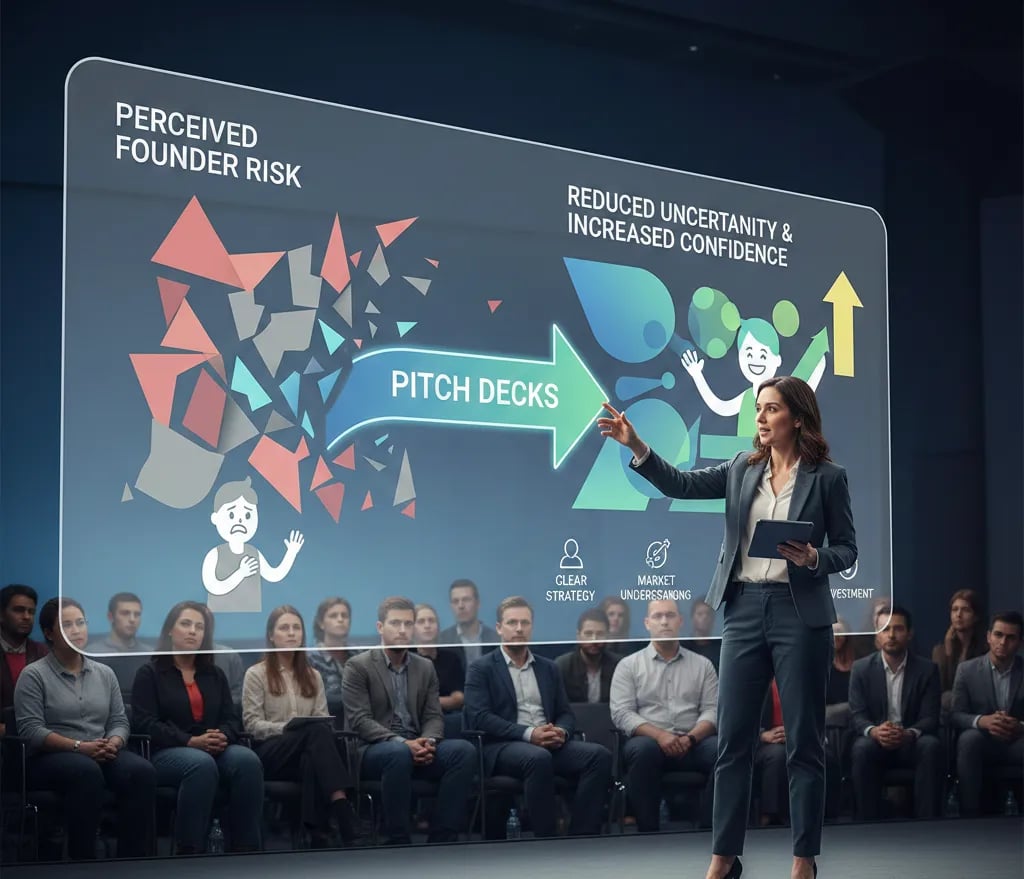
How Pitch Decks Reduce Perceived Founder Risk (And Why 73% of Series A Founders Fail This Test)
Your pitch deck isn't a marketing tool. It's a risk assessment instrument for investors evaluating whether you'll waste their $3M. Most founders treat it like a sales brochure. VCs treat it like a stress test. This misalignment costs you 18–24 months of runway before you realize your deck was pre-rejected in the first 4 minutes.
This breakdown is part of the foundational system that determines whether VCs see you as investable or irrelevant. For the full framework on how pitch decks help investors systematically reduce risk at every evaluation stage, start there. What follows is the surgical analysis of why your deck either de-risks you as a founder or amplifies every doubt the GP already has.
Why "Founder Risk" Kills More Raises Than Bad Metrics
VCs don't reject you because your TAM slide is weak. They reject you because your deck signals you don't understand how capital compounds risk. Every investor evaluates three layers:
Market Risk — Can this category generate venture returns? (Easiest to de-risk via narrative)
Execution Risk — Can this team build the product and capture the market? (De-risked via traction)
Founder Risk — Will this founder survive the 7-year gauntlet without imploding? (Only de-risked via the deck itself)
The "Red Flag" Scenario: A pre-seed founder sends a 22-slide deck with no financial model, a "vision" slide with abstract metaphors, and a competitor slide that says "No Direct Competitors." The VC thinks: "This founder has never built anything at scale, doesn't understand unit economics, and is either lying or delusional about competition. Pass."
Psychological Audit: Founders make this mistake because they confuse "storytelling" with strategy. They've been told to "sell the vision," so they over-index on narrative and under-index on proof systems. The deck becomes a TED Talk instead of a Due Diligence preview. Ego compounds this — founders assume their charisma will carry the pitch, so they don't stress-test whether their slides prove competence under interrogation.
The Mathematical Cost of Unmitigated Founder Risk
When a VC sees founder risk in your deck, they don't just reject the deal. They mentally re-price your valuation downward by 40–60% to compensate for the "idiot tax" they'll pay if they're wrong about you. Here's the exact math:
Pre-Money Valuation Ask: $10M
VC's Internal Risk Adjustment for Founder Uncertainty: 50% discount
VC's Actual Mental Valuation: $5M
Implied Dilution Gap: You think you're raising $3M at 23% dilution. They think they're buying 37.5% of a $5M company.
This isn't negotiation leverage. This is a cognitive filter. If your deck doesn't actively reduce founder risk, the GP won't counter-offer. They'll ghost you.
Specific Metrics That Prove Founder Risk:
CAC Payback > 18 months with no articulated plan to compress it → Signals you don't understand burn efficiency
Gross Margin < 60% on a SaaS product → Signals you're subsidizing growth with investor capital
Monthly Burn > $150K pre-Series A with no revenue milestones tied to the raise → Signals you're building a consulting firm, not a scalable business
No cohort retention data after 12+ months of operation → Signals you're afraid to show the math or don't know how to measure it
Each of these flags increases the perceived "Founder Risk Premium" by 10–15%. Stack three of them, and you're functionally uninvestable at the valuation you're asking.
The De-Risking Protocol: How to Build a VC-Stress-Tested Deck
The solution isn't "make prettier slides." It's to architect your deck as a Due Diligence firewall that pre-answers the 8 questions VCs use to disqualify founders in the first pass.
Before vs. After Comparison
Weak Version (High Founder Risk):
Slide 3: "Our Market" → TAM slide with a $47B Gartner number and no segmentation
Slide 6: "Traction" → Line graph showing "users" going up with no unit economics
Slide 9: "Team" → Headshots with LinkedIn bios and no operational proof
VC-Ready Version (Founder Risk Mitigated):
Slide 3: "Our Wedge Into a $47B Market" → SAM/SOM breakdown showing you're targeting a $320M segment with 3 referenceable customers already in it
Slide 6: "Capital-Efficient Growth Engine" → Cohort analysis showing CAC payback in 11 months, 118% NDR, and marginal CAC improvement from $1,420 → $890 over 6 months
Slide 9: "Operational Kill Team" → Founder bios that highlight previous scale experience (e.g., "Scaled X from 0 to $12M ARR in 18 months") + Advisor slide with names that VCs recognize as domain validators
The "Rule of 8" De-Risking Framework
Your deck must answer these 8 questions in order, or the GP stops reading:
What wedge are you attacking? (Market slide with segmentation, not TAM theater)
Why does this wedge exist now? (Timing/catalyst slide proving the window is open)
Who is already paying you to solve this? (Customer logos + ACV data)
What's your acquisition cost per dollar of LTV? (Unit economics slide with payback period)
How do you retain customers once you acquire them? (Cohort retention or NDR proof)
What's your unfair advantage that compounds over time? (Moat slide — network effects, data, regulatory capture, etc.)
Why are you the only founder who can execute this? (Team slide with operational credentials, not résumé padding)
What's the capital plan to reach breakeven or the next fundable milestone? (Use of Funds slide tied to revenue milestones, not vague "team scaling")
Each question maps to founder competence, not founder charisma. If your deck skips question 4 or 5, you've told the VC you don't know how businesses work.
Specific Slide-by-Slide Execution
Slide 1 (Cover): Company name, one-line value prop in the format: "We help [ICP] achieve [outcome] by [method]." No fluff.
Slide 2 (The Problem): Quantify the pain. Not "Small businesses struggle with cash flow." Instead: "74% of SMBs that fail cite cash flow as the primary cause. The average small business loses $47K/year to payment delays."
Slide 4 (Solution): Show the product in action. Screenshots, not abstract diagrams. VCs want to see you've built something real.
Slide 6 (Business Model): Pricing tiers, gross margin breakdown, and CAC/LTV ratio. This is where 80% of founders fail because they've never calculated these numbers.
Slide 8 (Traction): Logos + $X ARR or MRR + growth rate. If you don't have revenue, show usage metrics tied to a monetization hypothesis (e.g., "6,400 MAUs, converting at 12% to paid at $49/mo = $37K MRR at full conversion").
Slide 10 (Financials): 3-year projection with the "Rule of 40" formula embedded. Growth Rate + Profit Margin > 40%. If you're burning $200K/month to grow at 15% MoM, you're at 180% annual growth with -60% margin = 120% Rule of 40 score. Show this math.
Slide 11 (The Ask): "Raising $3M to hit $X ARR in 18 months. Capital will fund: (1) Sales team scale (5 AEs, $800K), (2) Product expansion (2 eng hires, $400K), (3) 18 months runway ($1.8M opex)." Precision matters.
Fatal De-Risking Errors That Re-Introduce Founder Risk
Even when founders attempt to de-risk via the deck, they often over-correct in ways that trigger new flags:
1. Over-Indexing on Credentials, Under-Indexing on Execution
Listing "Harvard MBA, ex-McKinsey" on your Team slide doesn't de-risk founder risk if you've never shipped a product. VCs want proof of builder competence, not institutional prestige. The fix: Add one line per founder that proves they've operated at scale (e.g., "Built 0–$8M ARR growth engine at Startup X").
2. Using 2021 Comparables in a 2026 Market
Showing a competitor that raised at a 50x revenue multiple in 2021 doesn't validate your valuation in 2026. It signals you're anchored to a dead market. The fix: Use current trading multiples. SaaS companies in 2026 trade at 6–10x ARR, not 30–50x.
3. Hiding Churn in "Gross User Growth" Vanity Metrics
If your Traction slide shows "10,000 users" without cohort retention data, VCs assume you're hiding 60%+ monthly churn. The fix: Show cohort retention explicitly. "Month 1 → Month 6 retention: 78%" or "NDR: 115%" (net dollar retention, the gold standard).
The Valuation Arbitrage: How De-Risking Your Deck Adds $1M+ to Pre-Money
When you systematically de-risk founder risk via your deck, you don't just improve your odds of closing. You compress the VC's internal risk discount from 50% to 10–15%, which directly translates to valuation arbitrage:
Before: VC mentally prices your $10M pre-money ask at $5M due to founder risk → You raise $3M at 37.5% dilution
After: VC mentally prices your $10M pre-money ask at $8.5M due to reduced founder risk → You raise $3M at 26% dilution
That 11.5% dilution gap compounds over 3 funding rounds. By Series B, it's the difference between owning 18% of your company vs. 32%. The deck is the only artifact you control that directly influences this spread.
To see how this de-risking layer integrates with the full pitch deck architecture—including the psychological sequencing, the VC evaluation rubric, and the exact slide formats that pass institutional filters—read the complete breakdown: How VC Pitch Decks Really Work in 2026 — And Why Most Founders Get Them Wrong.
The Efficiency Bypass: You can spend 40 hours reverse-engineering which slides de-risk founder perception by watching your deck get rejected 12 times, or you can plug in the exact system VCs expect to see. The $5K Consultant Replacement Kit ($497) includes The Slide-By-Slide VC Instruction Guide, which maps each of the 8 de-risking questions to the exact slide format, data structure, and phrasing that passes institutional diligence. It's the difference between "hoping your story lands" and "knowing your deck already passed the stress test before you sent it."
Funding Blueprint
© 2026 Funding Blueprint. All Rights Reserved.