
Pitching Features vs Solutions: A Common Pitch Deck Trap for Founders
Stop pitching features. A capability matrix kills your Series A. Learn how the Outcome-First Framework shifts VCs from skepticism to instant conviction.
2.6 COMMON FOUNDER MISTAKES ON PROBLEM & SOLUTION SLIDES
2/24/20267 min read
Pitching Features vs Solutions: A Common Pitch Deck Trap for Founders
A Series A Founder in B2B SaaS Raised $1.8M in Seed Funding and Still Could Not Get a Partner Meeting. Here Is Exactly Why.
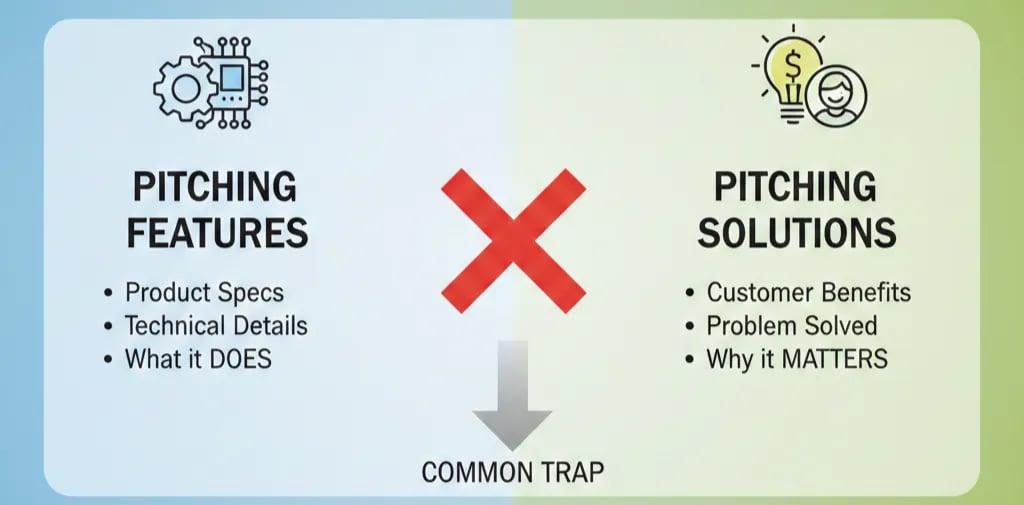
A Series A founder in B2B SaaS came into a partner meeting with a product that worked, a team with two prior exits between them, and 22 slides that described — in precise, confident detail — every capability their platform had built over 18 months of development. Automated tagging. Real-time sync across 140 integrations. A proprietary scoring algorithm. Custom reporting with 14 export formats. The VC listened for six minutes, then asked one question: "What business outcome does your customer have after six months that they did not have before?" The founder could not answer it in under three sentences. The meeting ended. The deck had every feature documented and zero outcomes proven. That is not a product problem. That is a pitch architecture problem — and it is the most common structural failure on the Solution Slide in the sub-pillar of errors that eliminate founders on Problem and Solution Slides before the conversation reaches traction.
The clinical diagnosis: the founder was selling the machine, not what the machine produces.
Why Feature-Led Solution Slides Signal Pre-PMF Thinking to Every Partner in the Room
There is a precise cognitive sequence a VC runs when they see a feature-dense Solution Slide. It does not take long, and it does not end in your favour.
Step one: The partner scans for a primary outcome. If the slide leads with capabilities — "AI-powered," "automated," "real-time," "customisable" — rather than a result a buyer experiences, the partner's internal read immediately becomes: this company is still product-led, not market-led. That distinction matters enormously at the Series A stage, because product-led thinking is appropriate when you are building. Market-led thinking is required when you are selling. A Solution Slide that lists features is evidence the founder has not yet made that transition.
Step two: The partner attempts to derive the value proposition from the feature list. This is work they should not have to do. When they are forced to do it, two things happen: their attention degrades, and any conclusion they reach is their own construction — not your pitch. You have handed control of your own narrative to someone who has 40 other decks to read this week.
Step three: The partner checks whether the features described map to a buyer's budget category. This is the kill shot for feature-led pitches. Budget owners — CFOs, VPs of Sales, CTOs — do not have line items for "AI-powered tagging." They have line items for "revenue operations tooling," "customer retention infrastructure," or "compliance cost reduction." If your Solution Slide cannot be mapped to a named budget category by a non-technical decision-maker, it will not get requisitioned regardless of how technically impressive it is.
In the last quarter, I reviewed nine Solution Slides from early-stage B2B founders where the primary content was a capability matrix — seven of them had not received a second meeting from any of the three funds they had approached. The psychological driver is almost always deep product pride misapplied to a sales context. Founders spend 18 months building features. They pitch what they spent 18 months on. The VC does not care what you built. They care what changed for the buyer because you built it.
The Outcome Deficit: What Feature Pitching Costs You in Valuation Mathematics
As of early 2026, US Series A funds are underwriting revenue multiples at 5x–8x ARR for SaaS companies with demonstrable outcome-based retention — meaning customers who can articulate what they achieved, not just what they used. Feature-led companies, where retention is driven by switching cost rather than delivered value, are being discounted to 3x–4.5x ARR at the same revenue level. That compression is not arbitrary. It maps directly to net revenue retention benchmarks:
Here is the breakdown of how your pitch positioning affects your valuation multiples and retention metrics:
Outcome-led Positioning
Example: "Reduced close time 34%"
Buyer Decision Driver: ROI and business result
Typical NRR: 115%–130%
Applied ARR Multiple: 6x–8x
Feature-led Positioning
Example: "Automated workflow engine"
Buyer Decision Driver: Switching cost and habit
Typical NRR: 88%–102%
Applied ARR Multiple: 3x–4.5x
Capability-led Positioning
Example: "140 integrations, 14 exports"
Buyer Decision Driver: Procurement checklist
Typical NRR: 80%–92%
Applied ARR Multiple: 2.5x–3.5x
The NRR gap between outcome-led and capability-led positioning at the same ARR level produces a pre-money valuation difference of $4M–$9M on a $3M ARR company. That is not a rounding error. That is the difference between a clean term sheet and a cram-down structure.
The underlying logic is straightforward. Outcome-led customers expand because the outcome scales with their business growth. Feature-led customers churn when a competitor offers more features at a lower price point — which, in a 2025–2026 SaaS market defined by AI-driven feature commoditisation, is happening faster than at any prior point in the industry's history. A VC underwriting your Series A is not just buying your current ARR. They are buying your NRR trajectory at Series B. Feature pitching poisons that trajectory before the ink dries.
Rebuilding the Solution Slide: From Capability Catalogue to Outcome-First Architecture
The reconstruction is a sequencing exercise, not a content removal exercise. Your features are not the problem. Where they sit in the narrative is.
Weak Version (Feature-Led Solution Slide)
"Our platform includes: AI-powered lead scoring, automated CRM data enrichment, real-time pipeline analytics, custom reporting with 14 export formats, Salesforce and HubSpot native integration, and a no-code workflow builder for sales operations teams."
This is a spec sheet. A technically literate buyer might find it useful during procurement evaluation. A Series A VC finds it useless at the conviction stage, because it answers the question "what does it do?" while leaving unanswered the only question that funds companies: "What changes for the buyer, and by how much?"
VC-Ready Version (Outcome-First, Feature-Supported)
"Sales teams using our platform close their first qualified deal 34% faster in the first 90 days — because we eliminate the two manual steps that kill pipeline velocity at the outbound stage: lead data enrichment and CRM entry. The AI scoring and native Salesforce sync are what make that outcome repeatable at scale. We have validated this across 23 customers. The median time-to-value is 11 days from onboarding."
The outcome is the lead. The features are the explanation. The validation is the proof. This structure allows a non-technical partner — or a CFO evaluating the product — to immediately locate your company in their mental model of budget-worthy tools.
The Outcome-First Framework - Three Mandatory Structural Elements:
Element 1 — The Quantified Outcome Statement. Your Solution Slide headline must contain a number, a buyer, and a timeframe. "We help sales teams close 34% faster in 90 days" is a headline. "AI-powered sales automation platform" is a category label. Category labels do not close term sheets.
Element 2 — The Causal Bridge. Immediately after the outcome, name the specific mechanism that produces it. This is where your features earn their place on the slide — as the explanation for the outcome, not the pitch itself. "Because we eliminate X manual step" or "by automating Y decision" gives the VC the causal logic they need to believe the outcome is reproducible and defensible.
Element 3 — The Validation Anchor. Close the slide with a proof point that is specific enough to be verifiable: number of customers, time-to-value metric, retention rate, or a single anchoring customer result. "Validated across 23 customers, median time-to-value 11 days" is fundable specificity. "Trusted by leading enterprises globally" is marketing copy that actively damages your credibility in a partner meeting.
One structural rule worth isolating: The moment your Solution Slide requires a VC to understand your product architecture to understand your value, you have lost the room. Value must be legible to a non-technical budget owner in under 30 seconds. If it is not, the slide is not finished.
Three Death Traps When Founders Attempt the Outcome-First Rebuild
Trap 1 — Fabricating or inflating outcome metrics. If your "34% faster close rate" is based on two customers and one of them is a friend's company, the VC's reference call process will surface it. Use only metrics you can defend under direct questioning, and always state your sample size. An honest metric from 8 customers is more fundable than an impressive metric from 2.
Trap 2 — Replacing feature lists with vague outcome language. "We transform how teams work" is not an outcome statement. It is a brand tagline. Outcome statements must contain a specific, measurable change in a specific, nameable business metric. If you cannot attach a number to it, it is not an outcome — it is a direction.
Trap 3 — Hiding features entirely out of overcorrection. Features belong on the Solution Slide — in the supporting layer, not the headline. A VC who believes in your outcome will immediately want to understand how you produce it. If your slide does not answer that question, you are creating a gap that breeds scepticism rather than closing it. The framework is outcome first, mechanism second, validation third. In that order, always.
What Outcome-Led Positioning Adds to Your Pre-Money Before the Term Sheet Is Written
A Solution Slide that leads with a quantified, validated business outcome does one thing to your diligence process that no feature list can replicate: it gives the VC's reference call a framework. When their analyst calls your customers and asks "what did you get from this product," and the customer repeats the outcome your slide already claimed — that alignment is the single most powerful conviction signal in an early-stage process. It proves the pitch is not aspiration. It is documentation. Fixing your Solution Slide from feature-led to outcome-led is not a communication improvement. It is the mechanism by which your customer evidence becomes a valuation asset. For the complete framework governing how your Problem and Solution Slides must function in sequence under partner-level scrutiny, work through the full Series A Problem and Solution Slide architecture.
Founders who have used the Slide-By-Slide VC Instruction Guide inside the $5K Consultant Replacement Kit go into partner meetings with a Solution Slide that already matches what the VC's analyst will check against during reference calls — outcome statement, causal mechanism, validation anchor, in the exact sequence a trained reader expects. That structural alignment is not a marginal edge. At the Series A stage, where a single associate's pre-meeting note can determine whether a partner shows up engaged or checked out, it is the difference between a live process and a polite pass. The full Kit is $497. Build a Solution Slide that survives the analyst's pre-meeting read.
Funding Blueprint
© 2026 Funding Blueprint. All Rights Reserved.