
The Standard 10-Slide Pitch Deck Structure Explained for Startups
Treating your 10-slide pitch deck as a checklist kills Series A deals. Learn how to transform your deck from an information dump into a decision engine.
3.1 CORE PITCH DECK STRUCTURES: HOW VCS RECOGNIZE SIGNAL VS NOISE
3/4/202610 min read
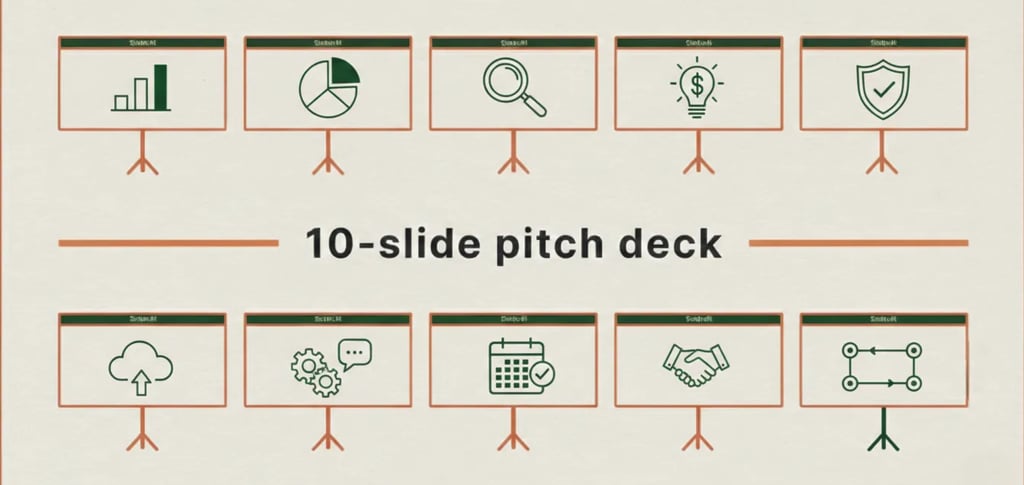
The Standard 10-Slide Pitch Deck Structure Explained for Startups
You will leave the partner meeting without a term sheet. The reason is already sitting in your deck — and it has nothing to do with your business.
The standard 10-slide pitch deck structure is the most discussed format in early-stage fundraising and the most incorrectly built. Founders treat it as a content checklist: ten boxes, ten topics, ten slides that prove the business exists. That is not what the format is. The 10-slide structure is a compression protocol — a mechanism for forcing a complete investment thesis into the minimum number of decision surfaces a VC needs to move from introduction to conviction. When it is built as a checklist, it produces a deck that is technically complete and functionally unconvincing. That distinction is the difference between a second meeting and a polite pass. The architectural logic behind why certain formats convert and others don't is part of the forensic framework inside Core Pitch Deck Structures: How VCs Recognise Signal vs Noise. This post is the exact build specification for a 10-slide deck that functions as an investment thesis, not an information summary.
Why the Standard 10-Slide Format Fails Founders Who Think They Are Following It
The format's failure rate is not a mystery. It is a structural problem with a specific cause: the 10-slide deck was designed to eliminate everything that does not directly advance a VC's capital allocation decision. Most founders build it by starting with what they want to say and cutting until they reach ten slides. The correct method is the opposite — start with the ten questions a VC must resolve to write a check and build one slide to answer each question.
Those two methods produce entirely different documents. The first produces a compressed company overview. The second produces a decision engine. A VC reading the first is processing information. A VC reading the second is resolving risks. One of those experiences ends in a request for more information. The other ends in a meeting request.
The most common structural failure is what analysts at Series A funds privately call the "thin middle" — slides 4 through 7, where the business model, market dynamics, competitive reality, and product evidence should be doing the heaviest analytical lifting. In a checklist-built deck, these slides contain assertions. In a decision-engine deck, they contain proof. The distinction is not a matter of length or visual density. It is a matter of whether the slide answers the VC's question or merely raises it.
The last four founders who brought a checklist-structured 10-slide deck to a partner meeting at a fund I track were all asked to resubmit with "additional supporting data" — which is not an invitation to revise. It is a rejection with courtesy packaging.
The psychological driver is almost always time pressure misapplied. Founders compress their deck to ten slides because they believe brevity signals confidence. It does — but only when the compression is the result of clarity, not omission. A slide that contains one idea expressed with maximum precision is compression. A slide that contains one idea expressed without supporting logic is a gap.
The Analytical Cost of a Checklist Deck: What Each Weak Slide Actually Destroys
The 10-slide format has a specific cognitive economy. Each slide consumes a finite amount of a VC's attention and must return more conviction than it costs. Here is what the math looks like when slides fail their job:
The Conviction-Per-Slide Accounting:
Pitch Deck Slide Breakdown
1. Title / Company Purpose
Question: "What is this company in one sentence?"
Cost of Failure: A wrong mental model forms. All subsequent slides are evaluated against the wrong framework, making it unrecoverable in a cold read.
2. Problem
Question: "Is this pain real, large, and currently unsolved?"
Cost of Failure: The solution is orphaned. The VC will invent their own problem definition, which is rarely in your favor.
3. Solution
Question: "Does this directly eliminate the cost named on slide 2?"
Cost of Failure: The product reads as a feature seeking a market.
4. Market Size
Question: "Can this return the fund?"
Cost of Failure: A weak TAM (Total Addressable Market) slide kills the financial conversation instantly. A $500M TAM cannot return a $150M fund.
5. Business Model
Question: "How does this company make money and what does it look like at scale?"
Cost of Failure: Future revenue projections become unanchored; the VC cannot evaluate the model without understanding the unit economics.
6. Traction
Question: "Is there market evidence that this works?"
Cost of Failure: The entire thesis becomes theoretical. Without traction, every other slide is just a projection.
7. Competition
Question: "Why does this company win?"
Cost of Failure: Without a credible answer, the VC's default assumption is that a better-funded incumbent will simply replicate you.
8. Team
Question: "Can these people execute this specific plan?"
Cost of Failure: Technical competence without domain relevance is viewed as high execution risk at Series A.
9. Financials
Question: "What does the path to return look like?"
Cost of Failure: Projections read as "optimism formatted as a spreadsheet" rather than a grounded financial slide.
10. Ask
Question: "What am I being asked to fund and what does it produce?"
Cost of Failure: A vague ask signals the founder doesn’t know how to deploy capital—the final risk a VC prices before deciding.
As of early 2026, the median Series A check size in the US sits at $8M–$12M for SaaS, with top-tier funds requiring a clear line of sight to $8M–$10M ARR within 24 months of the investment. Each slide in the 10-slide format must be load-bearing at that capital scale. A slide that works for a $750K pre-seed ask does not automatically survive the scrutiny applied to a $10M Series A decision — the proof threshold changes even if the format does not.
The VC-Ready 10-Slide Build Protocol: Specification-Level Instructions for Each Slide
This is not a list of topics. It is the exact specification each slide must meet to function as a decision surface rather than an information container.
Slide 1 — Company Purpose
One sentence. Subject, verb, object, outcome. The test is relay accuracy: can a VC's analyst describe your business correctly to a partner who was not in the room, using only this slide? If the answer requires interpretation, the sentence is not done yet.
Weak Version: "We help businesses grow faster with better data."
VC-Ready Version: "We automate churn prediction for B2B SaaS companies between $2M and $20M ARR, reducing involuntary churn by an average of 34% within 90 days of deployment."
The VC-ready version contains the ICP, the mechanism, the outcome, and the timeframe. It is not longer. It is denser.
Slide 2 — Problem
One problem. One population. One quantified cost. Three elements that must all be present simultaneously:
The pain is real and affects a definable, reachable population
The cost of the pain is expressed in dollars, time, or strategic risk — not adjectives
Current solutions have specifically failed to eliminate it, and the failure mode is named
The failure mode of existing solutions is the element most founders omit. Without it, the VC's immediate question is "why doesn't Salesforce just build this?" — and they answer it themselves, almost always in Salesforce's favour.
Slide 3 — Solution
The causal link from Problem to Solution must be explicit and direct. The solution slide describes the mechanism by which the cost named on slide 2 is eliminated, reduced, or converted. It does not describe features. It does not describe the product roadmap. It describes the outcome the customer is purchasing.
Weak Version: "Our AI-powered platform predicts churn using behavioural signals and usage data."
VC-Ready Version: "We identify churn signals 47 days before cancellation by analysing product usage decay patterns — giving CS teams a 6-week intervention window they currently do not have. Customers who receive an intervention within that window retain at 78%."
The VC-ready version names the mechanism, quantifies the lead time, and closes with a retention outcome that directly answers the cost defined in the Problem slide.
Slide 4 — Market Size
Bottom-up, not top-down. Build the SAM from the ICP defined in your Problem slide using a visible calculation: number of addressable companies × realistic ACV = SAM. The TAM is the ceiling; the SAM is what you are actually underwriting. A VC who cannot see your bottom-up logic will construct their own — and their SAM will be smaller than yours.
The additional requirement at Series A: a serviceable obtainable market (SOM) figure with a 3-year capture assumption. This is not modesty — it is the number the VC uses to back-check your financial projections. If your Year 3 revenue implies a 60% SOM capture rate, your model is not aggressive — it is unbelievable.
Slide 5 — Business Model
Pricing structure, gross margin, and one unit economics statement. The gross margin figure is non-negotiable at Series A — it is the first number a VC uses to assess scalability. A SaaS business with 60% gross margin and a SaaS business with 82% gross margin are different investment theses. Do not make the VC infer which one you are.
The unit economics statement: one metric that proves the model works at the unit level before scale. LTV:CAC ratio above 3:1, CAC payback under 18 months, or NRR above 110% — choose the one that is strongest and state it explicitly.
Slide 6 — Traction
The traction slide must answer one question: has the market confirmed that this solution eliminates the cost named in your Problem slide at the price your Business Model slide requires?
The minimum viable traction architecture for Series A:
MRR with 3-month trailing growth rate
NRR (leads with this if above 100%)
CAC payback period
One cohort retention data point — even a 6-month curve
Activity metrics — downloads, signups, pilots, LOIs — are acceptable at pre-seed. At Series A, they signal that revenue conversion has not been proven. Do not submit them in place of revenue metrics unless you are explicitly pre-revenue and the round is structured accordingly.
Slide 7 — Competition
The competitive slide answers one question: why does your company occupy a position that well-funded incumbents structurally cannot reach? If your differentiation can be replicated by a Salesforce product team in a 6-month sprint, it is a feature, not a moat.
Acceptable competitive framing: a positioning map that shows a structural gap, not a quality gap. "We are better" is not differentiation. "The architectural constraint of legacy ERPs prevents them from solving the exception-handling layer — and that constraint is the market we occupy" is differentiation.
Slide 8 — Team
The team slide answers: why are these specific people the highest-probability executors of this specific plan? Domain tenure, prior exits, and direct customer relationships count. The test: if you removed the names and replaced them with generic descriptors, would a VC's conviction in the business decrease? If not, the team slide is not working.
One credibility signal per founder. Not a career timeline — a single proof point that answers the "why them" question for this specific problem.
Slide 9 — Financials
Three-year projections with a visible assumption set. The three numbers that must appear explicitly: current burn rate, current runway, and the runway post-close assuming full deployment of the raise.
The 2025–2026 diligence standard: top-tier US and UK funds are stress-testing for a minimum 18-month post-close runway as a baseline requirement. A financial slide that implies a 14-month runway after the raise closes will generate a specific objection in the partner meeting that is difficult to recover from — not because the math is wrong, but because it signals capital inefficiency at the point of deployment.
Slide 10 — The Ask
Amount, instrument, and three use-of-funds line items maximum. The milestone this capital produces — stated as a specific, measurable outcome that reduces risk for the next round. Not "scale go-to-market." The exact proof point: "$8M to reach $5.4M ARR and 110%+ NRR across two enterprise cohorts by Q4 2027 — the Series B qualification threshold."
The ask slide is the last risk the VC prices. A vague ask is not modest — it signals a founder who has not modelled capital deployment with precision. At Series A, that is an execution risk the fund is being asked to absorb.
Before vs. After — The Ask Slide at Series A
Weak Version: "Raising $8M to accelerate growth, expand the team, and scale our go-to-market."
VC-Ready Version: "$8M Series A. $3.2M to product and engineering (expand exception-handling coverage from 6 ERP systems to 22). $2.8M to sales (4 enterprise AEs targeting mid-market manufacturing). $2M to CS and onboarding infrastructure. Milestone: $5.4M ARR by Q4 2027. Series B trigger."
The VC-ready version tells the VC exactly what their money buys, what it produces, and when the next capital event occurs. That is not additional information. It is the information the VC needs to present your deal to an investment committee.
Three Death Traps Inside the 10-Slide Build
1. The Traction-Before-Business Model Error. Some founders move Traction to slide 4 to front-load credibility. This forces the VC to evaluate revenue data before they understand the unit economics model — which means they are drawing their own margin assumptions, which are invariably conservative. Traction lands with more force after the VC understands the model it is confirming.
2. The Adjective Problem. Weak versions of every slide in this format share one characteristic: they use adjectives where numbers should be. "Significant market opportunity." "Strong unit economics." "Rapid growth." These phrases do not transfer conviction. They transfer the cost of conviction back to the VC — who will fill the gap with scepticism, not optimism.
3. Building the Financial Slide Last and Treating It as a Formality. The financial slide is not a summary of the preceding nine slides. It is a capital efficiency argument. Founders who build it after the rest of the deck produce projections that are internally consistent with their narrative but externally inconsistent with the market their VC is deploying into. Build the financial model first. Let it constrain the rest of the deck.
What a Decision-Engine 10-Slide Deck Delivers at the Pre-Money Negotiation
A correctly built 10-slide deck does not just produce a term sheet. It produces a term sheet with fewer open questions — which directly affects your pre-money negotiating position. Every unresolved question a VC brings to the investment committee is priced into the valuation as a risk discount. A deck that pre-answered those questions through its structure does not just accelerate the process. It changes the price at which the round closes.
The complete system for building decks that convert at analyst pre-screens, survive partner meetings, and hold their structure through investment committee is inside Pitch Deck Slides Structure & Frameworks. If you are preparing for a Series A process in the next 90 days, use it as the specification before you open a design tool.
The 16 VC-Quality AI Prompts inside the $5K Consultant Replacement Kit are built to handle exactly this problem — each prompt is mapped to a specific slide in the 10-slide format, engineered to produce the proof-dense, causally linked content a Series A analyst is trained to screen for, rather than the assertion-heavy language most founders default to under time pressure. Founders who deploy this walk into partner meetings with slides that already answer the questions the fund's pre-screen is checking against. The full Kit is $497. Access it at the 16 VC-Quality AI Prompts for 10-Slide Deck Construction.
Ten slides is not a constraint. It is a discipline. Build each one as if the deal depends on it — because at Series A, each one does.
Funding Blueprint
© 2026 Funding Blueprint. All Rights Reserved.