
The “Confusion Signal” That Instantly Kills Investor Interest
Is a "Confusion Signal" costing you $1.2M? Discover the positioning formulas Tier-1 VCs demand and learn to pass the 10-second stress test today.
1.9 HOW BAD PITCH DECKS KILL DEALS INSTANTLY
2/10/20265 min read
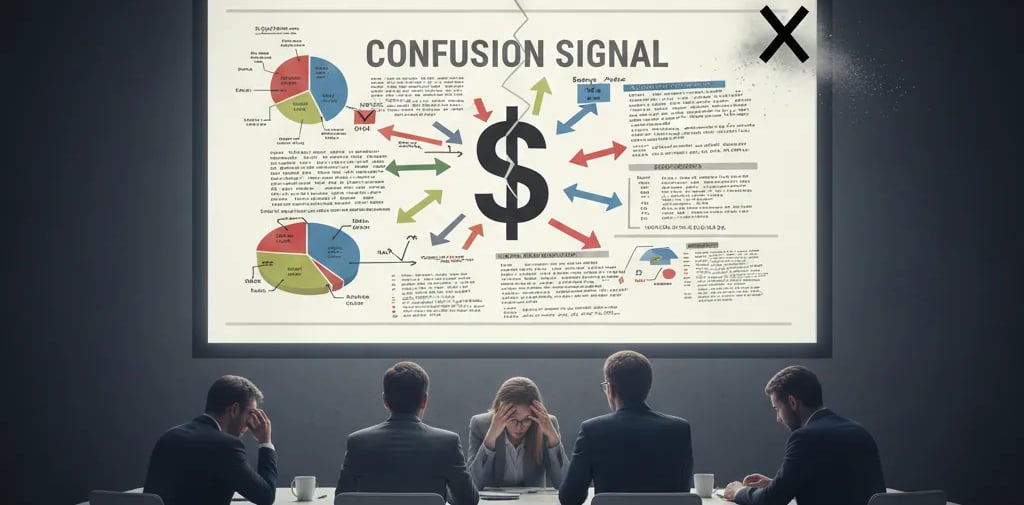

The "Confusion Signal" That Instantly Kills Investor Interest
You have 11 seconds. That's the average time a Series A investor spends on your deck before deciding whether to keep reading or archive your email. If they're confused by slide three, you're done. Not "probably done"—mathematically eliminated. This isn't about having a "bad pitch." It's about triggering the one neurological response that overrides every other decision factor: cognitive friction. When a VC's brain has to work to understand what you do, their pattern-matching system flags you as high-risk, and no amount of traction data will override that initial classification. This mechanism is one of the foundational failure patterns explored in how bad pitch decks kill deals before you ever get a meeting.
Why Clarity Failure Is a Pre-Emptive Rejection Mechanism
The confusion signal isn't subjective. It's a measurable friction point that VCs use as a filtering heuristic. When Sequoia's associate opens your deck at 6:47 PM on a Wednesday, they're in triage mode—processing 40+ decks that week. Their brain is running a binary classification system: "Do I understand this in under 15 seconds?" If the answer is no, you're categorized with the 89% of decks that get rejected without a follow-up call.
The Red Flag Scenario: Your slide two says "We're building AI-powered infrastructure for the future of work." The VC reads it twice. They still don't know if you sell software to HR departments, make collaboration tools, or operate a recruiting marketplace. That 4-second re-read just cost you the deal. Their internal monologue: "If the founder can't explain this clearly, they can't explain it to customers, which means CAC is going to be a disaster."
Psychological Audit: Founders create confusion through three failure modes. First, positioning cowardice—they use vague language because they're afraid of being "put in a box" and want to preserve optionality for pivots. Second, feature obsession—they lead with technology instead of the commercial problem. Third, borrowed credibility—they use buzzwords ("AI," "Web3," "Vertical SaaS") as substitutes for actual explanation because they've seen other funded companies do it.
How Confusion Compounds Into Rejection
Here's the mathematical proof. Venture capital operates on a power law model where 90% of returns come from 10% of investments. This creates an asymmetric risk profile: false negatives (missing a winner) are acceptable, but false positives (funding a loser) are career-ending. Confusion acts as a heuristic for complexity, which correlates with execution risk.
The Friction Cascade:
Second 0-7: VC opens deck, sees company name and tagline. If tagline is unclear, confusion flag is raised.
Second 8-15: VC reads slide two (Problem/Solution). If they can't restate your value proposition in one sentence, cognitive load exceeds threshold.
Second 16-30: VC's brain now assigns you to the "requires extra work" category. This triggers loss aversion bias—they'd rather pass on a potentially good deal than invest mental energy clarifying a confusing one.
Second 31+: Even if your traction slide shows 300% YoY growth, it's processed through a skepticism filter. "If it's this good, why can't they explain it clearly?"
The cost is binary. You don't get "partial credit" for having strong unit economics if your positioning is unclear. The confusion signal overrides positive data because it suggests founder capability issues—specifically, the inability to distill complex operations into simple narratives, which is the core skill required to recruit executives, close enterprise customers, and manage board communication.
Rebuilding Your Positioning From Zero
Step 1: Deploy the One-Sentence Stress Test
Your grandmother should be able to repeat what you do after hearing it once. If she can't, you've failed. The formula: "We sell [SPECIFIC PRODUCT] to [SPECIFIC CUSTOMER] so they can [SPECIFIC OUTCOME]."
Weak Version: "We're a B2B SaaS platform leveraging machine learning to optimize enterprise workflows."
VC-Ready Version: "We sell automated invoice processing software to mid-market accounting firms so they can eliminate 60 hours/month of manual data entry."
The difference: specificity eliminates interpretation variance. The VC can immediately pattern-match you to "vertical SaaS for accounting, comparable to Bill.com or Stampli."
Step 2: Front-Load the Commercial Mechanism
Your slide two must answer: "How do you make money?" Not your vision. Not your technology. Your actual revenue model.
Before: Slide two shows a product screenshot with feature callouts.
After: Slide two states: "$12K ACV, sold to accounting firms with 10-50 employees, 18-month sales cycle, $8K CAC, net revenue retention of 118%."
This is "information density." Every number is a pattern-matching anchor. The VC now knows you're a traditional enterprise SaaS motion, not a consumption-based or marketplace model, which changes their entire evaluation framework.
Step 3: Use "The Competitive Anchor" Shortcut
If you're truly novel, you're too risky for Series A. Use analog positioning: "We're [FUNDED COMPANY A] meets [FUNDED COMPANY B] for [UNDERSERVED MARKET]."
Example: "We're Notion for construction project management" instantly communicates your product category (collaborative workspace), business model (freemium SaaS), and ICP (construction teams), in six words. The VC's mental model shifts from "undefined risk" to "validated category, new vertical."
Step 4: Eliminate Jargon Completely
Run your deck through the "14-year-old test." If a high school freshman can't understand slide two, you're using jargon as a crutch. Replace:
"AI-powered" → "Automated"
"Leverage our proprietary algorithms" → "Our software predicts"
"Revolutionize" → "Replace"
The Over-Correction Death Traps
Trap 1: Oversimplification to the Point of Commoditization
Founders panic and strip out all differentiation. "We sell CRM software" makes you sound like the 400th Salesforce clone. The balance: specific enough to be clear, differentiated enough to justify venture returns. Formula: Clear category + unique mechanism. "We sell CRM software that auto-generates proposals using sales call transcripts."
Trap 2: The "Explainer Slide" Bloat
Founders add a slide three titled "How It Works" with a 9-step process diagram. This is desperation clarity—you're trying to compensate for slide two's failure. Delete it. If you need an explainer slide, your core positioning is broken.
Trap 3: Audience Mismatch
You simplify for the wrong persona. Your deck gets read by associates (25-year-old ex-consultants) first, then partners (40-year-old ex-operators) second. Optimize for the associate. They're filtering for partners, so they need to be able to re-pitch you in 30 seconds during Monday morning partnership meetings. If your positioning requires domain expertise to understand, you won't survive the associate screen.
The $1.2M Valuation Tax of Confusion
Here's the financial impact. Clear positioning allows VCs to quickly comp you against funded peers, which anchors your valuation discussion around market multiples. Confusing positioning forces them to use "risk-adjusted" valuation models, which apply a 30-40% discount for "execution uncertainty", you can check full pillar HOW VC PITCH DECK WORKS for deep insights.
Real example: Two companies, both at $2M ARR, 120% net dollar retention. Company A has clear positioning ("Stripe for healthcare payments"). Company B has vague positioning ("AI-powered financial infrastructure"). Company A raises at 12x ARR ($24M pre-money). Company B raises at 8x ARR ($16M pre-money). The $8M gap is the confusion tax.
You can rebuild your positioning manually over 40 hours of customer interviews, competitive analysis, and A/B testing taglines—or you can eliminate this risk entirely using the Series A Execution Blueprint, which includes the Slide-By-Slide VC Instruction Guide that maps exactly how to structure every positioning element using the frameworks outlined above. It's $497, which filters for founders who treat their fundraise as a $20M+ financial transaction, not a creative exercise.
Clarity isn't a "nice-to-have." It's the entry fee. Fix it, or watch your deck get archived at second 11.
Funding Blueprint
© 2026 Funding Blueprint. All Rights Reserved.