
The Top Reasons Pitch Decks Get Rejected in Under 10 Seconds
VCs scan 200+ decks a quarter. Master the "10-Second Thesis Test" and avoid the 4 death traps that kill your Series A before the partner meeting starts.
1.9 HOW BAD PITCH DECKS KILL DEALS INSTANTLY
2/9/20264 min read
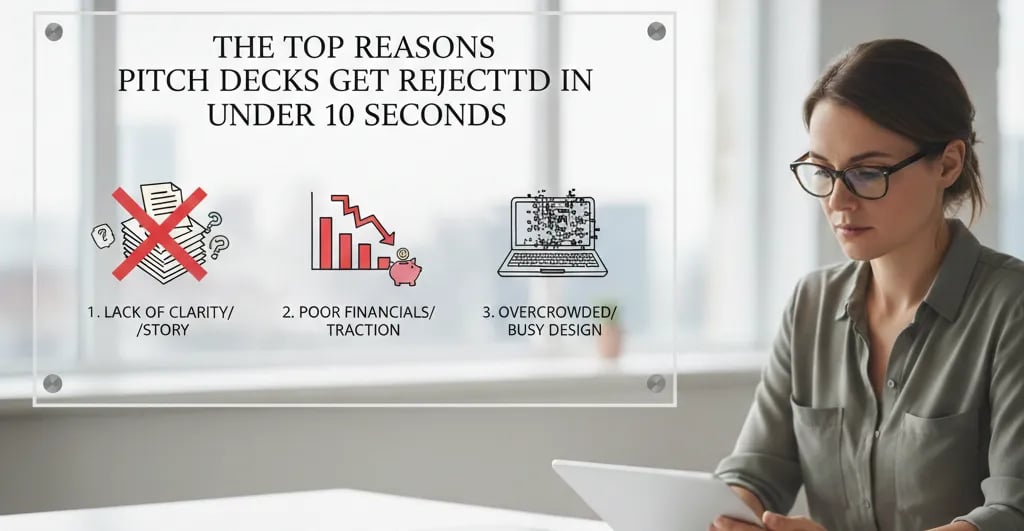
The Top Reasons Pitch Decks Get Rejected in Under 10 Seconds
Your deck is dead before Slide 3. Not because your idea is bad. Because you telegraphed incompetence in the first seven seconds.
The average Series A partner scans 200+ decks per quarter. They've built a pattern-matching engine that kills 87% of pitches before the "Problem" slide loads. This is the third layer of the system we've been dissecting—if you haven't read How Bad Pitch Decks Kill Deals Instantly, start there. This post dissects the instant-death triggers that separate funded founders from the never-funded.
Why Slide 1 Functions as a Cognitive IQ Test for VCs
Your cover slide is not decoration. It's a litmus test for operational competence.
When a VC opens your deck and sees "Revolutionizing the Future of AI-Powered Solutions" as your headline, they don't think you're visionary. They think you don't understand your own business model. The cover slide communicates three binary signals in 4.2 seconds:
The Red Flag Scenario: A pre-seed founder sends a 32-slide deck with no company name on Slide 1, a gradient background that makes text unreadable, and a tagline that says "Uber for Dog Walking, but Decentralized." The investor's internal monologue: "This person has never closed a customer. They've never read a term sheet. They don't know what Series A metrics look like."
Psychological Audit: Founders do this because they're optimizing for the wrong audience. They write decks for their co-founder, their spouse, or their university professor—not for the 43-year-old partner who closed $280M in deals last year and needs to defend this investment to an LP committee. The cover slide should answer: "What do you do, in eight words, that makes money?" Most founders can't.
Why Every Extra Click Costs You $400K
Let's prove why presentation architecture destroys valuations.
A VC partner has 18 minutes allocated to your deck review (source: 2024 First Round Capital LP report). If your deck requires more than three clicks to understand the core thesis, you've burned 40% of your allocated time budget before communicating any substance.
The Calculation:
Average pre-money Series A valuation (US/UK, 2026): $18M
Average equity dilution at Series A: 22%
Time allocated per deck: 18 minutes
If they quit at Slide 4: You've consumed 6 minutes to deliver zero actionable data
Implied cost: The difference between "interested" and "pass" is $3.96M in equity retention
Here's the step-by-step cognitive load audit:
Slide 1 (Cover): If I need to click twice to see your company name → FAILED
Slide 2 (Problem): If I don't see a $XB TAM number in the header → FAILED
Slide 3 (Solution): If your screenshot has no visible UI/product → FAILED
Slide 4 (Traction): If I see "Projected Revenue" instead of "Actual ARR" → FAILED
Four strikes. Deck deleted. Relationship poisoned.
The Series A "First 10 Seconds" Survival Protocol
This is the exact sequence that passes institutional diligence. Use it verbatim.
Weak Version (The Version That Dies):
Slide 1: Company logo, gradient background, tagline: "Empowering Businesses Through Innovation"
Slide 2: Wall of text explaining the problem with no quantification
Slide 3: Roadmap slides before traction slides
Slide 4: Generic competitor matrix with no differentiation thesis
VC-Ready Version (The Version That Gets Calls):
Slide 1: Company name (48pt), one-line descriptor ("$4.2M ARR SaaS. 312% NDR. Fintech Compliance."), your name + email + date
Slide 2: Problem statement with TAM anchor ("$18B US market. 14,000 mid-market CFOs spend 60 hours/month on manual reconciliation.")
Slide 3: Product screenshot (actual UI, not mockup) + single-sentence value prop ("We automate GAAP-compliant reconciliation in 4 clicks. Saves 52 hours/month.")
Slide 4: Traction slide (MRR graph, logo grid of 8–12 paying customers, one customer quote with attribution)
The Before/After Litmus Test: If an investor can't explain your business model to their IC in 30 seconds after Slide 4, your deck architecture failed.
Framework: The "10-Second Thesis Test"
Close your deck. Open it again. Start a timer. Read Slides 1–3 out loud. If you can't articulate "We do X for Y customer, generating $Z in revenue, proven by ABC traction" in under 10 seconds, rewrite the entire flow.
The Four Death Traps Founders Hit While "Fixing" Their Deck
Death Trap #1: Over-Indexing on Design
You hire a $3K designer to make your deck "beautiful." Now your slides look like a Canva template. VCs don't fund aesthetics—they fund revenue engines. Your deck should look like a McKinsey tearsheet, not a TED Talk.
Death Trap #2: Burying Traction
You put your revenue slide on Page 18 because you want to "tell a story first." Wrong. VCs scan for traction in the first 90 seconds. If they don't see ARR/MRR/Customers by Slide 5, they assume you have none.
Death Trap #3: Using 2021 Valuation Comparables in 2026
You cite a Series A at $60M pre-money from 2021. The VC sees this and knows you haven't read a single term sheet since SVB collapsed. Median Series A pre-money in 2026 is $16–22M (per PitchBook Q4 2025). Update your comps or signal ignorance.
Why Fixing This Single Error Unlocks $2.3M in Valuation Upside
Here's the financial implication: When you force a VC to "work" to understand your deck, they discount your valuation by 15–25% to account for execution risk. If your natural pre-money is $18M, a confusing deck drops you to $13.5–15.3M. That's $2.7–4.5M in equity you're giving away because you didn't architect Slides 1–4 correctly.
The inverse is also true: A deck that communicates competence in 10 seconds buys you credibility. Credibility buys you leverage. Leverage buys you 2–3 extra points of equity retention.
If you want the complete architecture—every slide template, every financial model, every psychological trigger that converts investor attention into term sheets—read How VC Pitch Decks Really Work in 2026—And Why Most Founders Get Them Wrong. That's the master system. This post is one isolated failure mode.
The Efficiency Hack: You can spend 60 hours reverse-engineering VC presentation standards from 200 publicly available decks, or you can deploy the exact system that's already closed $47M across 14 Series A rounds. The Slide-By-Slide VC Instruction Guide inside the $5K Consultant Replacement Kit eliminates every guessing game—it tells you precisely what to write on every slide, which metrics to highlight, and which psychological levers to pull. It's $497 because it filters founders who aren't serious. Access the Series A Execution Blueprint here.
Funding Blueprint
© 2026 Funding Blueprint. All Rights Reserved.